Ancient Sites: The Rough Hill
Ancient Sites: Search For the Holy Well
Victorian Photo Album: More New Street (c. 1890)
![]() |
| Christ Church from New Street. Held at Birmingham Archive. |
This photograph is taken at the top end of New Street, looking up to the Town Hall - taken in about 1890. On the left, the canopy belongs to the Theatre Royal, and on the right is the Royal Society of Arts with its classical portico. The spire belongs to Christ Church.
The Making of Gilt & Enamel Equipage (c. 1760s)
![]() |
| Equipage with egg-shaped containers and etui, c. 1760s. Wolverhampton Museum Collection. |
The Absent City: Grosvenor House by Cotton, Ballard & Blow (New Street & Bennetts Hill, 1951-3)
Victorian Photo Album: Chaucer's Head Bookshop (New Street, c. 1870s)
![]() |
| Chaucer's Head bookshop at 74 New Street, c. 1870s. Held at Birmingham Archive @ Library of Birmingham. |
See more of the Victorian Photo Album.
Victorian Photo Album: Looking Through Windows - Ornaments & Things Inside (Part Four)
Tour of Lost Birmingham Nᵒ.61: A Regency Stay at the Hen and Chickens Hotel (New Street)
![]() |
| The Hen and Chicken's on New Street, with King Edward's school to the right, c. 1808. Coaches would enter the rear stables through the arch. Held by Birmingham Museums. |
Were you at the “Hen and Chickens,” from which I write, however, you would be very well content with your quarters [...] I am surrounded by vases of beautiful flowers, many of them the choice productions of the green house in our rude climate, which ornament and perfume the halls and landings of the staircases, and impart an air bordering on elegance, to the general neatness and comfort of the establishment. The inn at which we are, is said to be the best in this great work-shop of iron and steel [...].*
Victorian Photo Album: Looking Through Windows - Greenery in the "Slums" (Part Three)
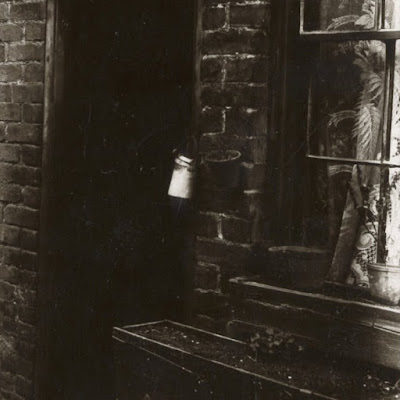
Part three (of three parts) of Looking Through Windows (Greenery). See part one, here and part two, here. Please contact to use these cropped images in this way - mappingbirmingham@gmail.com
During the late Victorian period many of central Birmingham's poorer housing was earmarked for demolition in a drive to revamp the city centre and move those living in these houses out to newer homes in the outer parts of the town. Hundreds of photographs of 'slum housing' (Victorian terminology, not mine) were taken of the many courts of back to back housing in the town. These images were taken was to assert the reasoning for their demolition, that they were run down, so they "frame" the buildings to tell this story. This is only one story, though, as these buildings were filled with families living their lives and beautifying their homes, and if you zoom into the images you can find traces of this.
Paper Remnants: Billinge & Edwards Tool Makers on Snow Hill (c. 1810)
![]() |
| Trade card for Billinge & Edwards on Snow Hill, c. 1810. Engraved by Cottrell. Held at Yale Center for British Art. B1978.43.956. |
Catherine Hutton's Poem on Love & a Cosy Cottage
![]() |
| Held at Birmingham Archive in the Hutton Collection. |
Birmingham Women: Catherine Hutton, Writer and Home Crafter (1756-1846)
Catherine Hutton (11 February 1756 to 13 March 1846) was part of the Birmingham Hutton family, the daughter of stationer, book seller and historian William Hutton and his wife Sarah Cock.*1* Catherine was a weaver of tales as well as a needlecrafter, a weaver of threads, and was putting pen to paper right up to her death at the age of 91. She was particularly a fan of Jane Austen, as she explained 'I have been going through a course of novels by lady authors, beginning with Mrs Brooke and ending with Miss Austen, who is my especial favourite. I had always wished, not daring to hope, that I might be something like Miss Austen; and, having finished her works, I took to my own, to see if I could find any resemblance'.*2* In 1813 she published her first novel, The Miser Married (1813), and published two subsequent novels, The Welsh Mountaineer (1817) and Oakwell Hall (1819). Catherine published other fiction and articles in magazines, and her published letters outline the life of a middle-class woman at this time.
Tour of Lost Birmingham Nᵒ.60: Turner's Brass Houses (Coleshill Street, c. 1740)
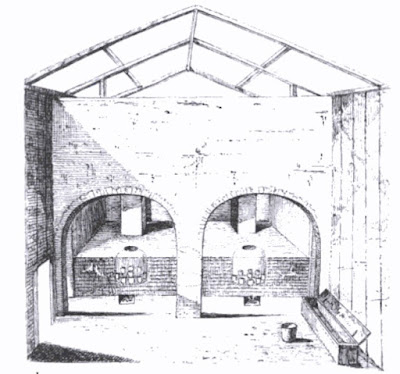
| Interior Mr. Turner's Brass Works from R. R. Angerstein's Illustrated Travel Diary, 1753-1755. |
Reinhold Rücker Angerstein was a Swedish metallurgist from a family of iron masters, who extensively travelled Britain's industrial works in the early 1750s, including many in Birmingham and nearby. In 1754 he visited Turner's brass works in Birmingham:
The brass-works [...] belongs to Mr Turner and consists of nine furnaces with three built together in each of three separate buildings. The furnaces are heated with mineral coal, of which 15 tons is used for each furnace, and melting lasting ten hours. Each furnace holds nine pots, 14 inches high and nine inches diameter at the top. Each pot is charged with 41 pounds of copper and 50 pounds of calamine. Mixed with [char]coal. During charging I observed that a handful of coal and calamine was first placed on the bottom of the pot, then came the mixture, which was packed in tightly, followed by about a pound of copper in small pieces, and finally again coal and calamine without copper, covering the top. This procedure was said to lengthen the life of the pot both at the top and the bottom. [...] There are six workers for the nine furnaces and casting takes place twice every 24 hours.*1*
Victorian Photo Album: Looking Through Windows - Greenery in the "Slums" (Part Two)
Part two (of three parts) of Looking Through Windows (Greenery). See part one, here. Please contact to use these cropped images in this way - mappingbirmingham@gmail.com
During the late Victorian period many of central Birmingham's poorer housing was earmarked for demolition in a drive to revamp the city centre and move those living in these houses out to newer homes in the outer parts of the town. Hundreds of photographs of 'slum housing' (Victorian terminology, not mine) were taken of the many courts of back to back housing in the town. These images were taken was to assert the reasoning for their demolition, that they were run down, so they "frame" the buildings to tell this story. This is only one story, though, as these buildings were filled with families living their lives and beautifying their homes, and if you zoom into the images you can find traces of this.Tour of Lost Birmingham Nᵒ.59: St. Martin's Parsonage (Smallbrook Street)
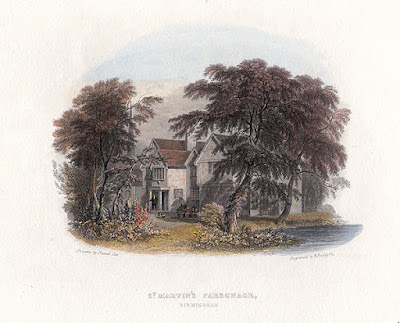
| St. Martin's Parsonage, from a drawing by David Cox and engraved by William Radcliffe, published 25 March 1827. Hand coloured later. |
St. Martin's Parsonage was demolished in 1826. The image above was drawn in about 1825 or 1826 by David Cox, and the original drawing is held by Birmingham Museums (see here). The Parsonage housed a long line of the rectors of St. Martin's, and stood a little distance from the church, up Edgbaston Street and at the base of Smallbrook Street.
Victorian Photo Album: Looking Through Windows - Greenery in the "Slums" (Part One)
![]() |
| Original full photograph of 'slum housing', back of 52 & 54 Midland Street, late 1800s. |
Paper Remnants: G. Hougton & Son "Foremost High Class Gent's Hosier's" (New Street, 1899)
![]() |
| G. Houghton & Son on Birmingham's New Street, 1899. Printed by W. B. Hill & Co. |
Victorian Photo Album: The Old Farrier's Arms (Lichfield Street)
| Old Farrier's Arms, c. 1880s or 1890s. Held by Birmingham Archive - WK/B11/1264. |
The Old Farrier's Arms was a public house on Lichfield Street, a street which was removed as part of the Corporation Street development, completed in 1903. The buildings were constructed in the eighteenth century, and the pub probably opened in the 1840s.
Victorian Photo Album: "A Kind of Subtle Beyond" on (actually Edwardian) New Street
| New Street, 1902. Held at Birmingham Archive. |
Victorian Photo Album: The Site of the Council House (Victoria Square As It Was)
![]() |
| The corner of Congreve Street and Ann Street (looking up Ann Street), May 1867. Held at Birmingham Archive. |