Showing posts with label Tour of Lost Birmingham. Show all posts

Tour of Lost Birmingham Nᵒ.61: A Regency Stay at the Hen and Chickens Hotel (New Street)

The Hen and Chicken's on New Street, with King Edward's school to the right, c. 1808.
Coaches would enter the rear stables through the arch.
Held by Birmingham Museums.

Were you at the “Hen and Chickens,” from which I write, however, you would be very well content with your quarters [...] I am surrounded by vases of beautiful flowers, many of them the choice productions of the green house in our rude climate, which ornament and perfume the halls and landings of the staircases, and impart an air bordering on elegance, to the general neatness and comfort of the establishment. The inn at which we are, is said to be the best in this great work-shop of iron and steel [...].*

Tour of Lost Birmingham Nᵒ.60: Turner's Brass Houses (Coleshill Street, c. 1740)

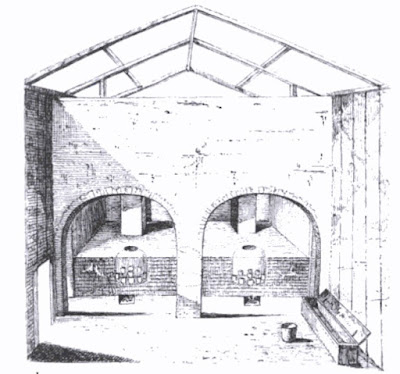
Interior Mr. Turner's Brass Works from R. R. Angerstein's Illustrated Travel Diary, 1753-1755.

Reinhold Rücker Angerstein was a Swedish metallurgist from a family of iron masters, who extensively travelled Britain's industrial works in the early 1750s, including many in Birmingham and nearby. In 1754 he visited Turner's brass works in Birmingham: 
The brass-works [...] belongs to Mr Turner and consists of nine furnaces with three built together in each of three separate buildings. The furnaces are heated with mineral coal, of which 15 tons is used for each furnace, and melting lasting ten hours. Each furnace holds nine pots, 14 inches high and nine inches diameter at the top. Each pot is charged with 41 pounds of copper and 50 pounds of calamine. Mixed with [char]coal. During charging I observed that a handful of coal and calamine was first placed on the bottom of the pot, then came the mixture, which was packed in tightly, followed by about a pound of copper in small pieces, and finally again coal and calamine without copper, covering the top. This procedure was said to lengthen the life of the pot both at the top and the bottom. [...] There are six workers for the nine furnaces and casting takes place twice every 24 hours.*1*

Tour of Lost Birmingham Nᵒ.59: St. Martin's Parsonage (Smallbrook Street)

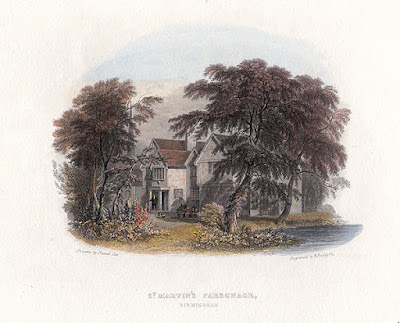
St. Martin's Parsonage, from a drawing by David Cox and engraved by William Radcliffe, published 25 March 1827. Hand coloured later.

St. Martin's Parsonage was demolished in 1826. The image above was drawn in about 1825 or 1826 by David Cox, and the original drawing is held by Birmingham Museums (see here). The Parsonage housed a long line of the rectors of St. Martin's, and stood a little distance from the church, up Edgbaston Street and at the base of Smallbrook Street.

Victorian Photo Album: The Old Farrier's Arms (Lichfield Street)

Old Farrier's Arms, c. 1880s or 1890s.
Held by Birmingham Archive - WK/B11/1264.

The Old Farrier's Arms was a public house on Lichfield Street, a street which was removed as part of the Corporation Street development, completed in 1903. The buildings were constructed in the eighteenth century, and the pub probably opened in the 1840s. 

Victorian Photo Album: The Site of the Council House (Victoria Square As It Was)

The corner of Congreve Street and Ann Street (looking up Ann Street), May 1867.
Held at Birmingham Archive.


This is probably the earliest photograph of Ann Street, taken in May 1867, and is an image of the site where the Council House was built between 1874 and 1879. Ann Street is now called Colmore Row. 

Bisset's Magnificent Directory: Jones, Smart & Co., Glass Manufacturers (Plate W)

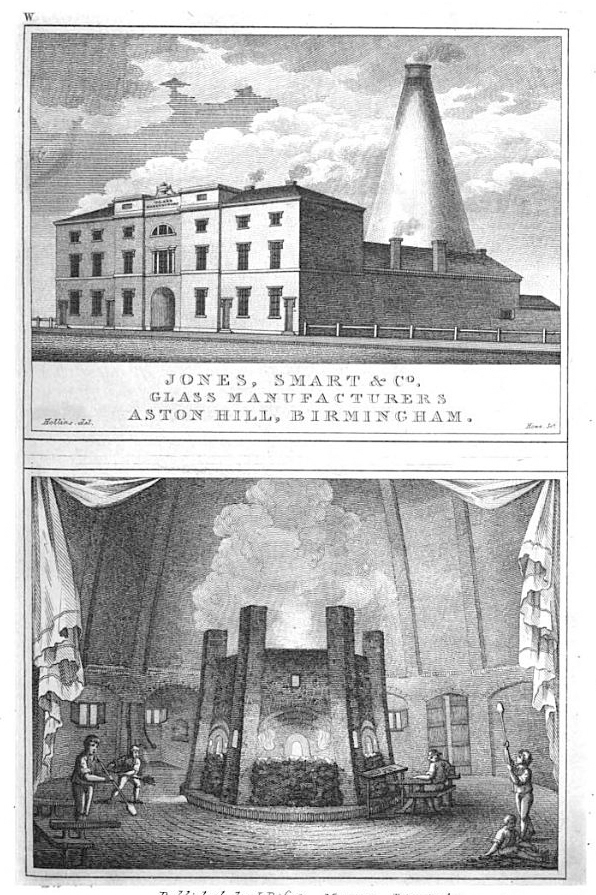
Plate W in James Bisset's Magnificent Directory (1800).


A page from Bisset's Magnificent Directory printed in 1800 depicting glass blowing at Jones, Smart and Co. who were glassmakers at Aston Hill in Birmingham.

Tour of Lost Birmingham Nᵒ.58: The Old Lamb House (Bull Street)

Photograph of the Old Bull House shortly before demolition. WK-B11-1261.


The Old Lamb House was a timber-framed building which survived the red-brick redevelopments of the eighteenth century and most of the nineteenth century, but was demolished probably in the early 1880s. Despite its name suggesting that it had possibly been a public house there is no evidence that it was ever used as such. It was situated on Bull Street, one of Birmingham's oldest streets, and had probably been the home and retail premises of a wealthy merchant.

Georgian Terraces: 103 New Street

About 104-102 New Street (numbers later changed), c. 1860-1870. Held at Birmingham Archive.

See other Georgian terraces.

Even in Victorian Birmingham the central streets of the town, like New Street, still contained grand residential properties, like 103 New Street where the Wilkes family lived. The house in which they lived was a fine Georgian townhouse, one of many built in the 1700s, but few remained as residential properties in Birmingham's main shopping streets. The photograph might show the property shortly after it was vacated, and then, of course, demolished. Today, this is about where Hotel Chocolat and Blue Banana are. When the photograph was taken, there were still net curtains at the window.

Tour of Lost Birmingham Nᵒ.57: John Wilkes' House (Bull Street, 1709)

The Quaker Meeting House (centre building) on Bull Street.
Conjectural image of what it would have looked like after opening, c. 1702.
Held by Birmingham Archive.

John Wilkes was a lockmaker living in Birmingham from about 1674 (aged about 23) till his death in 1709. Many of his locks survive and can be seen in a gallery here. In his will was an inventory of the contents of the family home and John's workshop, which gives some insight into life in the early 1700s for an artisan. The Wilkes' owned maps, pictures and books, as well as a 'Clock & Case' and a looking glass. There was also a good range of furniture, so this was a comfortable home.

Georgian Terraces: The Square


'The Square' was an early eighteenth-century urban development completed in about 1713. This was elite living, including fine townhouses which were bought and lived in by some of the town's wealthiest inhabitants.

Georgian Terraces: Summer Lane and Another Grand Townhouse

381 Summer Lane (to the right) at the junction with Hospital Street.
Taken 14 August 1932. Held at Birmingham Archive.

A photograph of a fine Georgian townhouse at 381 Summer Lane, at the junction of Hospital Street, which goes into the distance on the left. 

Birmingham Printers: Thomas Aris & the Gazette Offices

Plate D from Bisset's Directory,
showing High Street, including the
Aris's Birmingham Gazette offices.

Thomas Aris was a London stationer and printer who came to Birmingham in about 1740 in order to set up a printing business, including publishing a newspaper in the town. It was not the town's first newspaper. Thomas Warren had printed The Birmingham Journal from 1732 which continued till 1743, but the paper that Aris set up, The Gazette, or Aris's Birmingham Gazette, was the dominant paper of Birmingham over the eighteenth-century. Also, Aris's Gazette survives, whereas there is only one known surviving copy of Warren's Journal.

Georgian Terraces: Thomas Aris's House, Holloway Head

Photograph of Thomas Aris's house on Holloway Head.
Held at Birmingham Archive.

Thomas Aris was a bookseller and printer on Birmingham High Street between 1741 and 1761, and published the Birmingham Gazette, the town's first surviving newspaper. His success as a printer is perceivable in the size of his Georgian townhouse. You can find out more about him here.

The image below zooms into the door which clearly reads 'Thomas', so probably the rest says Aris's House.

Other Georgian Terraces

Tour of Lost Birmingham Nᵒ.56: Bromford Forge, and the Interior of the 18th Century Iron Forge (Aston)

An Iron Forge, by Joseph Wright of Derby (1772)

The first mention of the Bromford mill as a forge was in 1605, but the site had previously worked as a water-powered mill, possibly dating back to Domesday, but definitely the thirteenth century. Like many mills it had been converted from corn grinding to fulling, the pounding of wool to remove oil and dirt.* From working as a fulling mill it was an easy conversion to become a forge to hammer iron instead of wool, as seen in Joseph Wright’s 1772 painting of an iron forge (above). Wright was inspired by the industries of the Midlands, and although there is no reason to believe that he visited Bromford, there would be similarities.

Tour of Lost Birmingham Nᵒ.55: Aston Furnace in the 1750s (Aston)


Aston Furnace in 1753, drawn by R. R. Angerstein.**

Aston Furnace, now demolished, was on the Hockley Brook, near where Porchester Street is today. The current site is grade A listed, although it has been built on. The original furnace was for iron and was first noted in 1615. In the late 1600s it was run by the renowned Jennens ironmasters, who also worked Bromford Forge. British History Online states that there is no evidence that the furnace itself was water-powered, but that the brook was used to power the bellows.*

Tour of Lost Birmingham Nᵒ.53: Freeth's Coffee House & the Society Feasts (Bell Street)


Freeth's Coffee House was a tavern (more formally known as the Leicester Arms) on Bell Street, a lost street which would have stood under the complex of the new Bull Ring Shopping Centre. It was run by John Freeth (sometimes John Free), a local poet and political commentator, often known as Poet Freeth and printing publications such as The Political Songster. As with many coffee houses in the eighteenth-century, it was a meeting place, not just of people, but of ideas. Most well-known are the meetings of the Jacobin Club, a group of political radicals including James Bisset (toy-maker and museum keeper) and James Sketchley (printer and auctioneer). In his obituary in 1808 it was noted that Freeth would sing his poems and 'delight a large company with original songs, composed from subjects of a public nature, replete with wit and humour'.

The pub was the site of a number of dinners where the radical politics and current affairs of the day could be discussed. The call to these feasts was frequently through a few lines of poetry, printed in letterpress onto small cards. Here are some examples:

Click on the cards to enlarge.


Poet Freeth (John Freeth).
1730-1808.

Tour of Lost Birmingham Nᵒ.52: The Swan Hotel in Pictures (High Street)

Swan Hotel in 1829.

The Swan Hotel was a large and dominant coaching inn on the High Street throughout the eighteenth-century and before. According to Joseph Hill it was an ancient tavern, the land of which stretching across the corner of High and New Streets, and belonged to a family called Rastell during the reign of Henry VIII. Between 1666 and 1688 the landlord of the Swan was Edward Crank, who demolished the old tavern, and built another set back from the street, with a large yard in front for carriages, and erected a row of five smart town houses along the street (seen on the left of the trade card, above).* The Swan was a haunt of Samuel Johnson, who wrote in 1755 'I was extremely pleased to find that you have not forgotten your old friend, who yet recollects the evenings which we have passed together at Warren's and the Swan'. Johnson resided in Birmingham in the early 1730s with Edmund Hector (to whom he writes above) at Thomas Warren's bookshop, which situated opposite the Swan at that time, as Warren's shop moved about.

Contemporary colouring of the 1829 card.

In the 1730s, as the notice below announces, you could catch a stage-coach to London at the Swan at six on a Monday morning, and return 'if God permit' on the Saturday. Take a journey on the Birmingham to London stage-coach here.


A map of the Swan Hotel was produced for a sale of the property in 1836. Although the hotel survived after this date, many of the extended parts of the property, such as the stables on Worcester Street, were being sold in different lots. The railway came to Birmingham in 1838 with the opening of Curzon Street Station, and whether prospective buyers would have been aware of the impact of the looming rail network, this was the end of an era for coaching inns like the Swan.

Held at Birmingham Archive.

The 'Coach Office', which can be seen in green on the map (Lot 1) on New Street, is depicted in the image belowThe street on the right of 'W. JONES', the trunk manufacturer, was Worcester Street, and when the Rotunda was built, this became Worcester Passage, which has now gone itself, but was covered and cut underneath the Rotunda building.

New Street (left) at the corner of Worcester Street (right), c. 1840.
By Thomas Underwood, held at Birmingham Archive.

A later map of the Swan, from the 1850s, shows that the grand open entrance, where the coaches would turn (as seen in the 1820s trade card), had been built up with new shops, and the hotel itself had been limited to the site behind the New Street Coach Office.

1850s map showing the Swan Hotel.

The Twentieth Century Swan
The hotel survived until the late 1950s, but was demolished before 1961 to make way for the new Rotunda. The photos below were taken in 1932 by William A. Clark (all held at Birmingham Archive).

The swan over the door. 
The entrance door with the swan over, looking up
Swan Alley. Note Fred Burn on the right.
Poor image of the alley from the other direction. Not taken by Clark.
Landing of the Swan Hotel.

~ FINIS ~

Swan atop the left-hand building of the Hotel in 1800.
From Bisset's directory.

Tour of Lost Birmingham Nᵒ.51: John Baskerville's House and Something Unexpected in the Garden (Easy Hill)

Baskerville's house at Easy Hill.

John Baskerville was a japanner, letter cutter, type founder and printer in Birmingham in the mid eighteenth-century. Japanning was his initial, and also very prosperous, trade, which enabled him to build himself a grand house on the outskirts of Birmingham in 1747, at Easy Hill. By the 1770s the Birmingham Canal and its wharf had encircled the house, and the town was encroaching nearer and nearer (see map below).

1778 map highlighting the house at Easy Hill, with a long tree lined drive
garden, and possible orchard. Birmingham is expanding onward.


Baskerville died in 1775, and the house was lived in by his widow and daughter, and his daughter owned it until 1788 when it was bought by John Ryland, who had the images below produced. They give some interesting detail of the ornamentation, and if anyone knows what the statues are, please let me know in the comments.

Easterly front of Baskerville's house.

Southerly front of Baskerville's house.

Close-up of the statues.
The house is thought to have been demolished in about 1795, and the land utilised for manufacture, and by a canal wharf, the construction of which, in the 1820s, unearthed Baskerville's corpse, which he had asked to be buried in a catacomb built especially for the purpose in the garden. Below is a drawing of said corpse, produced by Thomas Underwood in 1829, after the body had been on display. It says something about Baskerville's fame and renown that this seemed acceptable.

Held at Birmingham Archive.