Showing posts with label Victorian Photo Album. Show all posts

Victorian Photo Album: More New Street (c. 1890)

Christ Church from New Street. Held at Birmingham Archive.

This photograph is taken at the top end of New Street, looking up to the Town Hall - taken in about 1890. On the left, the canopy belongs to the Theatre Royal, and on the right is the Royal Society of Arts with its classical portico. The spire belongs to Christ Church.

Victorian Photo Album: Looking Through Windows - Ornaments & Things Inside (Part Four)


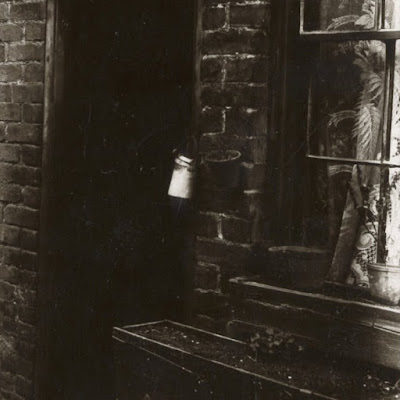
The last Looking Through Windows (here, here & here) posts explored 'Greenery in the "Slums"'; and showed that despite these houses being termed 'slums' by officials, the people living them adorned and beautified their homes in multiple ways. 

With a desire to knock down these houses, the photographers took pictures of buildings with cracks in the walls and broken windows, but didn't always notice the little things, the things which can be found by zooming into the old Victorian photographs. 

The previous posts looked at plants and flowers, this one looks at ornaments on window ledges and outside, and other things which can be peeped at by zooming in.  

This Looking Through Windows explores the things that people owned which can be seen in the shadows inside the homes (some door peeking as well as window peeking was necessary). See the images below.....

Victorian Photo Album: Looking Through Windows - Greenery in the "Slums" (Part Three)

Part three (of three parts) of Looking Through Windows (Greenery). See part one, here and part two, here. Please contact to use these cropped images in this way - mappingbirmingham@gmail.com

During the late Victorian period many of central Birmingham's poorer housing was earmarked for demolition in a drive to revamp the city centre and move those living in these houses out to newer homes in the outer parts of the town. Hundreds of photographs of 'slum housing' (Victorian terminology, not mine) were taken of the many courts of back to back housing in the town. These images were taken was to assert the reasoning for their demolition, that they were run down, so they "frame" the buildings to tell this story. This is only one story, though, as these buildings were filled with families living their lives and beautifying their homes, and if you zoom into the images you can find traces of this

Click on the images, below, to view in a lightbox.

Victorian Photo Album: Looking Through Windows - Greenery in the "Slums" (Part Two)


Part two (of three parts) of Looking Through Windows (Greenery). See part one, here. Please contact to use these cropped images in this way - mappingbirmingham@gmail.com

During the late Victorian period many of central Birmingham's poorer housing was earmarked for demolition in a drive to revamp the city centre and move those living in these houses out to newer homes in the outer parts of the town. Hundreds of photographs of 'slum housing' (Victorian terminology, not mine) were taken of the many courts of back to back housing in the town. These images were taken was to assert the reasoning for their demolition, that they were run down, so they "frame" the buildings to tell this story. This is only one story, though, as these buildings were filled with families living their lives and beautifying their homes, and if you zoom into the images you can find traces of this

Click on the images, below, to view in a lightbox.

Victorian Photo Album: Looking Through Windows - Greenery in the "Slums" (Part One)

Original full photograph of 'slum housing',
back of 52 & 54 Midland Street, late 1800s.

During the late Victorian period many of central Birmingham's poorer housing was earmarked for demolition in a drive to revamp the city centre and move those living in these houses out to newer homes in the outer parts of the town. Hundreds of photographs of 'slum housing' were taken of the many courts of back to back housing in the town. These images were taken was to assert the reasoning for their demolition, that they were run down, so they "frame" the buildings to tell this story. This is only one story, though, as these buildings were filled with families living their lives and beautifying their homes, and if you zoom into the images you can find traces of this

Below is part one (of three parts) of Looking Through Windows (Greenery). Please contact to use these cropped images in this way - mappingbirmingham@gmail.com

Click on the images, below, to view in a lightbox.

Victorian Photo Album: The Old Farrier's Arms (Lichfield Street)

Old Farrier's Arms, c. 1880s or 1890s.
Held by Birmingham Archive - WK/B11/1264.

The Old Farrier's Arms was a public house on Lichfield Street, a street which was removed as part of the Corporation Street development, completed in 1903. The buildings were constructed in the eighteenth century, and the pub probably opened in the 1840s. 

Victorian Photo Album: "A Kind of Subtle Beyond" on (actually Edwardian) New Street

New Street, 1902.
Held at Birmingham Archive.

Photographs often include things that the photographer did not intend to capture. This is an unassuming shot of some of New Street; the hill rising towards Victoria Square. Roland Barthes called what was outside of the photographer's intention the 'punctum'. For him, the punctum exposed the life that was external to the photograph, "a kind of subtle beyond"*. In the windows of one of the nearer buildings, number 62 in fact, are a couple of strange items. They are barely noticeable without zooming in, but they look like two gaunt, white faces staring out onto the street.

Victorian Photo Album: The Site of the Council House (Victoria Square As It Was)

The corner of Congreve Street and Ann Street (looking up Ann Street), May 1867.
Held at Birmingham Archive.


This is probably the earliest photograph of Ann Street, taken in May 1867, and is an image of the site where the Council House was built between 1874 and 1879. Ann Street is now called Colmore Row. 

Tour of Lost Birmingham Nᵒ.58: The Old Lamb House (Bull Street)

Photograph of the Old Bull House shortly before demolition. WK-B11-1261.


The Old Lamb House was a timber-framed building which survived the red-brick redevelopments of the eighteenth century and most of the nineteenth century, but was demolished probably in the early 1880s. Despite its name suggesting that it had possibly been a public house there is no evidence that it was ever used as such. It was situated on Bull Street, one of Birmingham's oldest streets, and had probably been the home and retail premises of a wealthy merchant.

Georgian Terraces: 103 New Street

About 104-102 New Street (numbers later changed), c. 1860-1870. Held at Birmingham Archive.

See other Georgian terraces.

Even in Victorian Birmingham the central streets of the town, like New Street, still contained grand residential properties, like 103 New Street where the Wilkes family lived. The house in which they lived was a fine Georgian townhouse, one of many built in the 1700s, but few remained as residential properties in Birmingham's main shopping streets. The photograph might show the property shortly after it was vacated, and then, of course, demolished. Today, this is about where Hotel Chocolat and Blue Banana are. When the photograph was taken, there were still net curtains at the window.

Georgian Terraces: Thomas Aris's House, Holloway Head

Photograph of Thomas Aris's house on Holloway Head.
Held at Birmingham Archive.

Thomas Aris was a bookseller and printer on Birmingham High Street between 1741 and 1761, and published the Birmingham Gazette, the town's first surviving newspaper. His success as a printer is perceivable in the size of his Georgian townhouse. You can find out more about him here.

The image below zooms into the door which clearly reads 'Thomas', so probably the rest says Aris's House.

Other Georgian Terraces

Victorian Photo Album: Castle Bromwich Mill

Castle Bromwich Mill, 1895. Held at Birmingham Archive.

Castle Bromwich mill was the manorial corn mill, probably dating from the thirteenth-century. Not much can be discovered about the history of the mill, but it was a constant presence in the area for centuries, and still being worked in the 1890s (images above and below).


The miller in 1895.


Victorian Photo Album: Queen Victoria's Visit (Paradise Street)

Held at Birmingham Archive.

This wonderful image, one of the oldest photographs depicting Birmingham, was taken from Paradise Street on 15th June 1858: the day that Queen Victoria first visited Birmingham. It depicts some of the Georgian remnants of the street, a little row of brick residential houses on the left. Next to them is the brand new (begun in 1855 and completed in 1860) Birmingham and Midland Institute rising a little higher and topped with a Union Jack. It had been designed by Edward Middleton Barry. Local newspapers reported that the Institute was 'prettily ornamented with wreaths and festoons of artificial flowers-displayed with much taste, and arranged so as not to interfere with the beautiful architecture of the building itself'.**

Tour of Lost Birmingham Nᵒ.48: Remnants of Greek Revival on New Street


New Street in 1901 by George White.
Held at Birmingham Archive.


This little snippet of New Street, taken shortly after the death of Queen Victoria, contains the elegant silhouette of a Victorian gas lamp, the Georgian frontage of the Theatre Royal in the far ground, and an unassuming row of four or five shabby-looking shops. 

Tour of Lost Birmingham Nᵒ.43: Life Back to Back (an Ann Street court)

Court 6, Ann Street (later Colmore Row), 1860s.

This is one of many of courts of back-to-back housing which existed in Birmingham, and were photographed during the Victorian period. This is court 6, Ann Street, which was just opposite the Town Hall, the roof of that building just visible near the chimney stacks to the right. The church in the background on the left is the now demolished Christ ChurchAt the time the image was taken, in the 1860s, the area was being prepared for demolition for the new Council House (which still stands on Victoria Square); the rubble in the foreground had previously been other housing.

Victorian Photo Album: 79 New Street - Moore's Oyster Shop (Victoria Square As It Was, c. 1880s)

Moore's Oyster Rooms at 79 New Street, undated (c. 1880s-1890s).
Held at Birmingham Archive.

Moore's Oyster Rooms, were set into the wall of Christ Church on, what is now, Victoria Square. This little row of four shops was built with the church in 1805. For some reason, some of those posing for the photograph are in barrows! Oysters were relatively inexpensive at this time and oyster rooms or oyster bars were popular urban venues.*1*

Victorian Photo Album: 63 Great Hampton Street (c. 1900)

63 Great Hampton Street, c. 1900. Held at Birmingham Archive.


W.J. Clarke. Authorised plumber, gas fitter, zinc worker, &c

E. Swan. Brooch tongues, watch bows, joints & catches, jewellers materials. 

In directories of this time, W.J. Clarke was at number 63 and E. Swan (and others) at 63 1/2.


Georgian Terraces: Paradise Street

Held at Birmingham Archive.

The Georgian terrace was, as Harry Mount states, 'the most popular building in Britain'.** They were an excellent choice for expanding towns, box shaped and placed side by side they took up little room, but there was still often space for expansion to the front and to the rear. Birmingham utilised this to a high degree, building shops and even manufactories on the front of grand terraces, and ever expanding onto the rear gardens with manufactories, warehouses and with even more dwelling houses.