Showing posts with label High Street. Show all posts

Birmingham Printers: Thomas Aris & the Gazette Offices

Plate D from Bisset's Directory,
showing High Street, including the
Aris's Birmingham Gazette offices.

Thomas Aris was a London stationer and printer who came to Birmingham in about 1740 in order to set up a printing business, including publishing a newspaper in the town. It was not the town's first newspaper. Thomas Warren had printed The Birmingham Journal from 1732 which continued till 1743, but the paper that Aris set up, The Gazette, or Aris's Birmingham Gazette, was the dominant paper of Birmingham over the eighteenth-century. Also, Aris's Gazette survives, whereas there is only one known surviving copy of Warren's Journal.

Birmingham Printers: Thomas Warren, Lady Holte & Links to Samuel Johnson

Printed in Joseph Hill's Bookmakers of Old Birmingham (1907),
the original in Birmingham Archive.

Thomas Warren (1700-1767) was first noted as a 'bookseller' in 1727.* He sold a range of works, some of them known about through the shopping bills of Lady Holte, of Aston Hall, who visited frequently between 1729 and 1730. She bought two volumes of Gulliver's Travels; Hutchinson's 'On ye Passions'; spelling books, presumably for her children; 'Headley's method of Teaching'; the 'Beggars Opera', first performed in 1728; two volumes of 'Cyclopedia'; as well as many more publications. She had books bound and bought ink, and also paid for 'Reading' certain books, so presumably Warren offered a lending service. Warren also sold Holte other items, including a 'Pair of fine Pockett Globes' which he bought in from London. Books allowed the reader to explore the expanding eighteenth-century world, so the globes were an apt addition to the bookshop, and Warren sold books about globes and exploration too.**

Tour of Lost Birmingham Nᵒ.52: The Swan Hotel in Pictures (High Street)

Swan Hotel in 1829.

The Swan Hotel was a large and dominant coaching inn on the High Street throughout the eighteenth-century and before. According to Joseph Hill it was an ancient tavern, the land of which stretching across the corner of High and New Streets, and belonged to a family called Rastell during the reign of Henry VIII. Between 1666 and 1688 the landlord of the Swan was Edward Crank, who demolished the old tavern, and built another set back from the street, with a large yard in front for carriages, and erected a row of five smart town houses along the street (seen on the left of the trade card, above).* The Swan was a haunt of Samuel Johnson, who wrote in 1755 'I was extremely pleased to find that you have not forgotten your old friend, who yet recollects the evenings which we have passed together at Warren's and the Swan'. Johnson resided in Birmingham in the early 1730s with Edmund Hector (to whom he writes above) at Thomas Warren's bookshop, which situated opposite the Swan at that time, as Warren's shop moved about.

Contemporary colouring of the 1829 card.

In the 1730s, as the notice below announces, you could catch a stage-coach to London at the Swan at six on a Monday morning, and return 'if God permit' on the Saturday. Take a journey on the Birmingham to London stage-coach here.


A map of the Swan Hotel was produced for a sale of the property in 1836. Although the hotel survived after this date, many of the extended parts of the property, such as the stables on Worcester Street, were being sold in different lots. The railway came to Birmingham in 1838 with the opening of Curzon Street Station, and whether prospective buyers would have been aware of the impact of the looming rail network, this was the end of an era for coaching inns like the Swan.

Held at Birmingham Archive.

The 'Coach Office', which can be seen in green on the map (Lot 1) on New Street, is depicted in the image below. The street on the right of 'W. JONES', the trunk manufacturer, was Worcester Street, and when the Rotunda was built, this became Worcester Passage, which has now gone itself, but was covered and cut underneath the Rotunda building.

New Street (left) at the corner of Worcester Street (right), c. 1840.
By Thomas Underwood, held at Birmingham Archive.

A later map of the Swan, from the 1850s, shows that the grand open entrance, where the coaches would turn (as seen in the 1820s trade card), had been built up with new shops, and the hotel itself had been limited to the site behind the New Street Coach Office.

1850s map showing the Swan Hotel.

The Twentieth Century Swan
The hotel survived until the late 1950s, but was demolished before 1961 to make way for the new Rotunda. The photos below were taken in 1932 by William A. Clark (all held at Birmingham Archive).

The swan over the door. 
The entrance door with the swan over, looking up
Swan Alley. Note Fred Burn on the right.
Poor image of the alley from the other direction. Not taken by Clark.
Landing of the Swan Hotel.

~ FINIS ~

Swan atop the left-hand building of the Hotel in 1800.
From Bisset's directory.

Tour of Lost Birmingham Nᵒ.44: Birmingham in Miniature or Richards's Magazine (High Street)

Plate from Bisset's Directory, 1808. An advert for Richards's toy-shop.


Welcome to Richards's toy-shop, run by Theophilus Richards; a toy at the turn of the century being a luxury, adornment item. In 1767 toy-makers were described:
"these Artists are divided into several branches, as the Gold and Silver Toy Makers, who make Trinkets, Seals, Tweezer and Toothpick cases, Smelling Bottles, Snuff Boxes, and Filigree Work, such as Toilets, Tea Chests, Ink Stands &c &c. The Tortoiseshell Toy Maker, makes a beautiful variety of the above and other Articles; as does the Steel; who makes Cork Screws, Buckles, Draw and other Boxes: Snuffers, Watches, Stay Hooks, Sugar knippers &c. and almost all these are likewise made in various metals."
The advert above is tantalising; it is a mixture of graphic depiction, with urns and motifs, and reality, with the shop front and open door captured. Inside, as was prevalent in adverts of this time, can be seen refined middle class customers perusing Richards's wares. Richards sold the jewellery, cutlery and silverware that he most likely made himself, but considering that he termed his shop 'Birmingham in Miniature', it seems likely that he also sold items from many other manufacturers so that the premises became almost like a museum of Birmingham wares. This is asserted by the fact his shop was promoted as part of a tour of Birmingham's manufacturing 'curiosities', and that it was included in Admiral Nelson's tour of Birmingham in 1802, and was also visited in 1805 by HRH Prince William of Gloucester. Richards would have sold luxury consumer goods and novelties made by the innovative Birmingham manufacturers to adorn the home and person of the rising middle classes. A small example can be seen in one of the shop's bills:

From Birmingham Archive: A Bill for Richards's

As well as making items, it can be seen, from the bill below, that shops also made repairs; something we struggle to find today in our throw-away society.
The advert at the top left is for a commemorative coin/medal of George III, these coins were highly popular and widely collected at the time; Richards, as had many others, had obviously tapped into this lucrative market. The patent bronzed corkscrew is likely to be a Thomason corkscrew, made locally by another manufacturer- Edward Thomason.

The Rev. W. Fenwick
                                              To Theo. Richards & Son
1821
April 17th   Repairing Candlestick                                               2. 0.
Oct 13       1 Patent Bronzed Corkscrew                                     7. 0.
Dec 29       taking to pieces old urn & repairing it
                  with new cock mouth & new chimney                         6. 0.
1822
Jan 17        Rep Corkscrew                                                          1. 0.
[....??...] 
                                         For Theo. Richards & Son
                                        Thos. Day [Thomas Day]
Northfield

The Richards family were silversmiths, cutlers and gun makers, and the gun making branch of their business still trades today on Birmingham's Pritchett Street (see their website here). It is also due to Theophilus Richards that we have a copy of the 1731 map of Birmingham, as reprints were made of an original copy that was in his possession in 1789. Theophilus Richards (born 1748) was nephew to William Westley, the man who drew up the map. Theophilus's father, Thomas, had been making guns in Birmingham since at least the 1740s, but Theophilus himself branched into the toy trade.

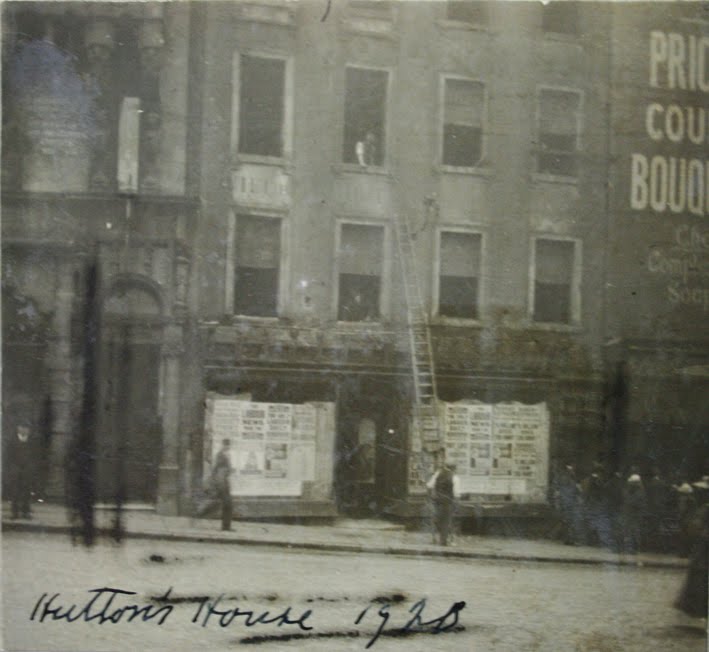
Tour of Lost Birmingham Nᵒ.26: "I have for ever quitted Birmingham as a home" (High Street)

William Hutton's house and shop in High Street, Birmingham, as it was
being taken down in 1928. It was the events that occurred at this house in 1791,
as well as elsewhere in Birmingham, that caused Hutton's daughter Catherine
to declare that she would never live there again.
Held at Birmingham Archive.

Catherine Hutton stated in 1791 'I have for ever quited Birmingham as a home', no-one knew if she meant it, but she never did return to live in Birmingham again, and she had good reason to want to stay away. The 14th of July 1791 was the day of the King and Country Riots, it all boiled up after a few men met at the Hotel to celebrate the anniversary of the storming of the Bastille and the ideals of the French Revolution. Here, a few windows got smashed, but the riot soon spread across Birmingham and most houses did not get off so lightly, many were burnt to the ground, though William Hutton's house on High Street was saved that fate as the neighbours protested in fear that it may spread to their own homes. The rioting was targeted towards religious dissenters*; research and conjecture as to why this was the case could fill an essay in themselves, so here I will only note that William Hutton was a dissenter, and one, like many others in Birmingham, who had done well for himself in business. He ran his shop as a stationers on High Street, where he lived above, but also had a large house a little out of Birmingham on Washwood Heath where his wife, who suffered from illness, and daughter Catherine usually resided. That house did get burnt down, but here I will explore what happened on High Street.

Catherine was with her mother at Washwood Heath when the rioters called on her father and brother in High Street on the 15th, the day after the riots began. Dissenter Meeting Houses had already been burnt to the ground, as well as Joseph Priestley's, John Ryland's and John Taylor's houses. William Hutton had not been at the dinner at the Hotel, but he was a Unitarian (dissenter), and as well as that, he was also a Commissioner at the Court of Requests, dealing with those who owed debts. Hutton stated himself, that 'armed with [this] power, I have put a period to thousands of quarrels, have softened the rugged tempers of devouring antagonists, and, without expense to themselves, sent them away friends. But the fatal rock upon which I split was, I never could find a way to let both parties win. If ninety-nine were content, and one was not, that one would be more solicitous to injure me than the ninety-nine to serve me'. Hutton was known, when dealing with litigations, for his statement 'thee pay sixpence, and come again next Friday' (Friday was when the court was held); as the mob threw his possessions out of the windows of his house it was recorded that they shouted 'who bids for this?' to which the reply came 'thee pay sixpence, and come again next Friday'.

When the mob gathered before William Hutton's shop** on High Street on the afternoon of the 15th he tried to buy them off with money, even borrowing from neighbours to continue paying; they demanded alcohol and gave them all he could, but when he could give them no more they took him to a local tavern (against his will) and drank 329 gallons on his credit. The destruction of the house began by first only smashing windows and knocking loudly on the doors. Catherine Hutton's brother, Thomas, had gone out to try and deal with them but was nearly attacked with a bludgeon before a friend came to his aid. Thomas then went to try and help save Mr. Taylor's house, but on finding that futile turned back and discovered furniture from his house in Digbeth, thus realising that the crowds had managed to break through the doors of his father's shop. Those inside had thrown paper 'out of the drawing room windows, and women [had carried] out aprons full of [the family's] property'. The neighbours were unwilling to help; those nearby had pleaded for the house not to be burnt to save their own properties, and Thomas Carless,*** who lived opposite, refused to take in paper that had been thrown out of the shop, or to allow the young Mr. Hutton to escape from the crowds through his house. The mob continued through the night, as Catherine Hutton's aunt visited the scene at about 4am and saw 'drawers, wardrobes, and clothes [...] being thrown out of the windows and prints being trampled on the street'. The mob had threatened the life of William Hutton, so at this point the family, who were staying with that aunt, decided to flee to Sutton.

Once the soldiers were employed to restore some order to Birmingham on the 17th the family returned from their exile. On High Street, the rioters had 'demolished all the doors, windows, chimney-pieces, wainscotts, skirting boards, and banisters, together with the roof of the house'. They had also attempted to remove the staircase, but had only reached the sixth step (before, presumably, they realised that they should have begun from the top and worked down). The Beadle of the Court had managed to save some of the Hutton's property and keep it in the Court of Requests, which was very near Hutton's shop; Catherine was also reunited with her guitar which a friend had bought from a rioter for sixpence. By the 19th of July, William Hutton had completed some repairs and was able to 'appear at business'; soon Thomas and the servants could sleep in the house, but William preferred to retire with his family in the country. Slowly the repairs were completed until it was business as usual and William remained trading in High Street till 1793 when he handed over the business to Thomas.

NOTES
William Hutton bought a house on High Street in 1772, but the house in the photograph was the one that he had built on that site in 1775.
Photograph courtesy of the Library of Birmingham.
~ References on request.
* Dissenters were Christians who had separated from the Church of England, often due to dislike of state intervention into religious matters, or believing in varying doctrines.
** Hutton was a stationer, he was the first person to Birmingham to make paper and ran his paper mill just out of Birmingham. He also sold books and ran a lending library, at a small charge.
*** Thomas Carless was a druggist, and uncle to Richard Pratchett who I wrote about in the post Pratchett's Bull Ring.

Tour of Lost Birmingham Nᵒ.25: Depriving Many a Poor Creature of Liberty (High Street)

Door of the Debtor's Prison, from the exhibition
Birmingham: it's people, it's history at BMAG.  

Visit the now demolished Debtor's Prison and the building that housed it, here. Find out about the Birmingham History Galleries which display this piece, here.

The plaque at the top of the door states "THIS DEBTORS PRISON DOOR STOOD IN HIGH STREET, BIRMINGHAM, DEPRIVING MANY A POOR CREATURE OF LIBERTY. NOTE THE BARS THRO WHICH CHARITABLE PASSERS-BY DROPPED COINS TO THE INMATES". Unlike the main prison, there was alot more sympathy towards the inmates in the debtor's prison, as many in business could be at risk of ending up there if their business dealings did not go well. The Debtor's Prison was tucked down an alley on Birmingham's High Street, inside the Court of Requests building.

Tour of Lost Birmingham Nᵒ.24: Pratchett's Bull Ring (High Street)

Often described as the work of William Hollins
but Thomas Hollins originally made the drawing in mid 1811 and published
prints from it in 1812; as recorded in newspapers of the time. 

Drawing of the Bull Ring area and St. Martin's church by Thomas Hollins, 1811.

One of the most changeable sites in Birmingham is the Bull Ring, it has undergone several alterations, each with some contention. The iconic Selfridges building sits, today, just to the left of the church; if it were to be placed in the scene above it would fill the sky above the little Georgian shops, and probably leave the people dumbstruck at what their town will become. The scene today could not be more different, the church is the oldest building but was rebuilt in the 1870s. Admiral Nelson (the statue, centre) still stands watching over her as he did from the day he was first unveiled in 1809.


Mr. Parkes visits Birmingham after a period of time
and enthusiastically notes the changes to the
main market area around St. Martin's church. 1810.
I call the area in Hollins's drawing 'Pratchett's Bull Ring' as Richard Pratchett, a High Bailiff, was one of the most influencial Street Commissioners of the time and his 'fundraising had substantially assisted the Street Commissioners in their grand scheme' (Upton). This 'grand scheme' was the alterations initiated by an act of parlaiment in 1801 to the areas around Birmingham's markets including the Bull Ring which involved removing the shambles (old tightly packed butcher's shops), the Welsh Cross and a number of other buildings which opened up the area around St. Martin's in the way it is characterised by today (see left). Pratchett himself lived and ran his business near the Bull Ring (image here), which was a druggist's and grocer's, a business that he inherited from his uncle, Thomas Carless, near the Swan coaching inn. Pratchett had left his particular mark on the improvement scheme around St. Martin's when he commissioned Thomas Hollins's brother William to design a sculpture that would surround the water-pump that had become exposed after the shambles was removed.

In 1806 William Hollins put forward a proposal for the monument of Lord Nelson which the Street Commissioners had proposed, but lost out to Sir Richard Westmacott whose work can be seen above. William’s design was much more complex and expensive in comparison with the simple statue that was chosen and included a post office and dispensary. A year later Pratchett asked him to design the water conduit to surround the pump but the design proved very unpopular. William called the sculpture the 'Egyptian Conduit'; many local people named it 'Pratchett’s Folly'. It was designed as a tribute to Nelson’s victories on the Nile, and may have been an elaborate show of what William could have done with the previous Nelson monument. It was in the shape of a pyramid, combining Egyptian, Grecian and English styles, and was ornamented with papyrus, Grecian honeysuckle and a lion’s head, all with associated mythological symbolism, and crowned with an urn which was a representation of the ashes of Nelson.* It can just be seen in the image above in front of St. Martin’s, just behind the first pair of horses. It seems that the sculpture was thought of as pretentious, with too much symbolism, unlike the statue of Nelson which was a simple tribute.*

Richard Pratchett was, of course, not solely responsible for the changes to the Bull Ring of the early nineteenth century; there were other Street Commissioners, 120 in fact. Yet, in another sense, it was Pratchett's Bull Ring. He had been a major part of the changes, he lived there and saw it everyday through his window, and it probably felt like 'his place', like every other individual might feel like they belong to a place and who make a bond to their location, it is a very human thing.

In 1812 J. C. Stadler produced a coloured version of Thomas Hollins's etching. Above (right) you can see the Georgian St. Martin's church in more detail with 'Pratchett's Pump' by William Hollins tucked into the church wall. Green fields can be seen in the distance. The left imaged depicts shop windows, still looking homely and decorated with curtains; a couple of the shops seem to have small images pasted to the insides of their windows. The full image is below.   


NOTES
William Hollins was also commissioned to build the Public Office on Moor Street which was part of the Street Commissioners improvements of this time too. As High Bailiff, Richard Pratchett was the chosen representative of the Commissioners and laid the first stone on 18 Sep 1805.
* References on request

Tour of Lost Birmingham Nᵒ.19: Architectural Focus - Court of Requests (High Street)


The Court of Requests is initially thought to have been built as the grand dwelling house for the wealthy John Jennens; it was built in about the 1650s and exhibits some early classical influences. The door surround (top image) is known as an aedicule and consists of two pilasters topped with and arched open pediment which allows for a decorative vase filled with foliage. There may well have been more decoration originally within the pediment. There is no frieze in the entablature.
In the second image you can see the architraves of the sash windows punctured by the dropped keystones which project from the cornice, and the decorative quoins at the corner of the building. You can also see some detail of the brickwork.

You can find out about the history of this building's usage here. The photographs were all taken from about the late 1860s when the building would have been about 200 years old. By that time the building had ceased to be used as the Court of Requests; hence the blind in the enlarged window (top image) stating 'Old Courthouse'. To the left is the alley leading off High Street to Court House Yard where the old house stood. Below is the whole building sitting in Court House Yard with all the later buildings tacked onto it and built nearby.


Photographs used courtesey of the archive services at the Library of Birmingham.

Punishing Debtors: The Court of Requests


Part of High Street in about the 1820s to 1830s.

Tucked behind the main shops of High Street, down an alley, (as seen in the 1820s illustration above) stood a shabby old building,[1] but one holding onto the remnants of grandeur. It had been built in about 1650, reputedly for the wealthy ironmonger John Jennens, as a smart house and home, and exhibited some good examples of the new classical influences that were permeating into architectural designs at that time; the segmental pediment over the door is particular of the period (see image below). By the 1770s, the building was being used by Benjamin Mansell as a tea-warehouse,[2] though, by the time of the drawing above, the building was used as the Court of Requests, and its basement would have most likely been filled with imprisoned debtors unable to pay what they owed. This close proximity of the incarcerated to daily life is alien to us today. At about the same time as the above image Nathaniel Drinkwater ran a fruiterer's in the Court of Requests yard, and the image itself suggests that there may also have been a brewery, the passage leading to the court was often 'packed along with baskets of goods and boxes',[3] so business and life went on around the building with the prisoners being audible and perhaps visible through the heavily barred windows.

The house had been acquired by the newly homeless Court of Requests in 1784 as the court had originally been held in the room above the Old Cross, a building demolished that year; and had been, since an act of Parliament in 1752, the court dealing with small debts of no more than 40 shillings for the Birmingham and Aston area. Larger debts were still dealt with at the county court. Both at the Old Cross, and at the court’s new home, 72 ‘commissioners’[3a] were chosen from the local area to pass judgement, only three sitting for each hearing, and always on Friday’s. The Court of Requests also shared the building with the town’s magistrates, but in 1807 they moved to the new public offices in Moor Street, and the building became synonymous with the ‘poor debtors’ that it incarcerated. The same year the magistrates moved out the building was also extended and another act was passed so that the court could deal with those with debts up to £5.

There is a definite sympathy in the writing of contemporaries;[4] Walter Showell notes in 1882 that there were 'many [who] are still living who can recollect the miserable cry of "Remember the poor debtors," which resounded morning, noon and night from the heavily-barred windows of these underground dungeons'.[5] How true this was is uncertain, but for any person in business, except the very wealthy, bankruptcy and the prospect of debtor’s prison could be a very real threat, especially as fashions waxed and waned and economies (as today) were uncertain. On the 1841 census, just three years before the prison shut down, there were 24 men and one woman incarcerated in the court of requests. Some were serial bankrupts, such as James Stainton, an ivory and bone turner, and Henry Flavell, a publican. William Luckcock, a jeweller, was most likely related to the wealthier Luckcock brothers whose jeweller’s establishment was on St. Paul’s Square, so there were business owners from all parts of the social spectrum.

The poor conditions of the prison were well known, it had been nicknamed the ‘Louse Hole’, and considering that the poorest inside slept on the cellar floor with only straw, lice were likely not to be the only problem. Some could purchase better conditions, but those were often businessmen who had chosen a spell in prison over paying their debts. In 1827 a report recorded that the paying inmates (paying two shillings a week) still slept three to a bed and that 19 of these men slept in a space only four paces square.[6] Those sentenced to time in the prison and these conditions (at the time when the maximum debt was £5) received 'one day in durance for each shilling due',[7] but no more than 100 days in total. There could be 30 to 40 trials an hour, with about one in ten being sentenced to imprisonment, and there could be no appeal to the verdict.


[*] References available on request.
[3a]  Although originally anyone who wanted to could apply to be a commissioner, towards the latter part of the courts use all commissioners were required to have an income from real estate of at least £50 per year of be personally worth £1000.[8] William Hutton (the historian) was a commissioner for about 19 years till the riots of 1791 when he retired his post.
[6] Chris Upton, 'Heavy Punishments 200 Years Ago', Birmingham Post, 14 May 2010, found online here.

Tour of Lost Birmingham Nᵒ.11: Market Cross and Welsh Cross (High Street)

Old/Market Cross 1702-1784.  Welsh Cross c.1705-1803.


Illustrations from Hutton's 'History of Birmingham', 1836

Throughout Medieval England it was common to have a religious cross elevated on a pole in the market place, it is unknown when the cross was originally erected in Birmingham's market, but the market itself had been registered since 1166. The cross building was built in 1702; it provided shelter for the market people and the room above provided a space for public meetings and the court leet.* Hutton believed that the Welsh Cross building had originally been the site of a direction post as it stood at the junction between Dale End, Bull Street and High Street. The building itself was built in the early 1700s for a Saturday market, but it was 'never heartily adopted',* though from 1768 a cheese market was held there.* The upper room was used as a military guard room securing prisoners, and punishments were dealt out below where there were a pillory, stocks and a whipping post. The pillory was similar to the stocks, with holes to support the hands and head, but was sometimes part of a more severe punishment as physical violence such as whipping or branding could be included. The stocks and the pillory were used mainly for public humiliation, and were placed in the market place so that the largest amount of people could see them. At the beginning of the nineteenth century these kinds of punishments became less acceptable and the pillory was abolished in 1837. Although the Welsh Cross was removed for street widening in 1803 the last use of the pillory was in 1813.*

Pillory in Charing Cross, London, c. 1808.

NOTES
Please note that the image of the pillory being used is in London, so not specific to Birmingham.
* References on request.