Showing posts with label St. Martin's Area. Show all posts

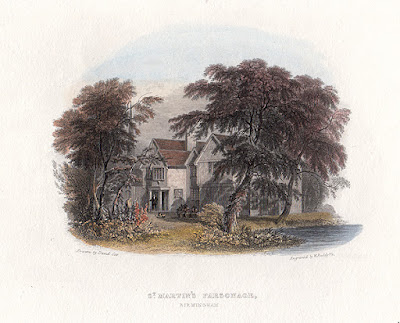
Tour of Lost Birmingham Nᵒ.59: St. Martin's Parsonage (Smallbrook Street)

St. Martin's Parsonage, from a drawing by David Cox and engraved by William Radcliffe, published 25 March 1827. Hand coloured later.

St. Martin's Parsonage was demolished in 1826. The image above was drawn in about 1825 or 1826 by David Cox, and the original drawing is held by Birmingham Museums (see here). The Parsonage housed a long line of the rectors of St. Martin's, and stood a little distance from the church, up Edgbaston Street and at the base of Smallbrook Street.

Churches: St. Martin's Church Through Time

14th century wall paintings found and recorded in the19th century by Allen Edward Everitt.
Held at Birmingham Museums.

St. Martin is situated in the Bull Ring in Birmingham, the ancient market area.

The church was first mentioned in 1263. In a rebuild of the church in the 1800s wall paintings were uncovered from the 1300s. These were painted by Allen Edward Everitt in the early 1870s (images above and below).

14th century wall paintings found and recorded in the 19th century by Allen Edward Everitt.
Held at Birmingham Museums.

1600s: The first image below is the only known image of the pre-Georgian church, and shows it in about 1656. In around 1690 the church was encased in red sandstone in a neo-classical style, although the spire and much of the interior was left. 

1700s: A brick clerestory (Wikipedia) was added in 1733, and a vestry to the south-east in 1760.* The latter was designed by William Hiorn who also repaired the spire in 1753.** Hiorn was a Warwick-based architect who was involved in other Birmingham buildings. 

Some of the spire was rebuilt in 1781 by John Chesshire.*3* In 1786 the interior was altered. 

1800s: By the 1800s the church was in great need of repair. In 1820 Thomas Rickman prepared drawings for the restoration, but this never took place. The drawings survive though. P. C. Hardwick restored the tower and spire between 1853 and 1855.* Between 1872 and 1875 the church was rebuilt by J. A. Chatwin and everything but the spire and tower were replaced, including the interior.


St. Martin Gallery
c. 1656
Section including St. Martin's, taken from a south-east prospect of the town produced by Wenceslaus Hollar, c. 1656.


1750
Etching of South View of St. Martin from 1750 Map of Birmingham, by Samuel Bradford.


1783
St. Martin's Church.

The illustration above is taken from the 1783 edition of William Hutton's A History of Birmingham. Read his full account of the church, written in 1783, here. Below is an excerpt:
The antiquity of St. Martin's will appear by surveying the adjacent ground. From the eminence upon which the High-street stands, proceeds a steep, and regular descent into Moor-street, Digbeth, down Spiceal-street, Lee's-lane, and Worcester-street. This descent is broken only by the church-yard; which, through a long course of internment, for ages, is augmented into a considerable hill, chiefly composed of the refuse of life. We may, therefore, safely remark, in this place, the dead are raised up. Nor shall we be surprised at the rapid growth of the hill, when we consider this little point of land was alone that hungry grave which devoured the whole inhabitants, during the long ages of existence, till the year 1715, when St. Philip's was opened. The curious observer will easily discover, the fabric has lost that symmetry which should ever attend architecture, by the growth of the soil about it, causing a low appearance in the building, so that instead of the church burying the dead, the dead would, in time, have buried the church.

It is reasonable to allow, the original approach into this place was by a flight of steps, not by descent, as is the present case; and that the church-yard was surrounded by a low wall. As the ground swelled by the accumulation of the dead, wall after wall was added to support the growing soil; thus the fence and the hill sprang up together; but this was demonstrated, August 27, 1781, when, in removing two or three old houses, to widen St. Martin's Lane, they took down the church-yard wall, which was fifteen feet high without, and three within. This proved to be only an outward case, that covered another wall twelve feet high; in the front of which was a stone, elevated eight feet, and inscribed, "Robert Dallaway, Francis Burton." Church-wardens, anno dom. (supposed) "1310." As there is certain evidence, that the church is, much older than the above date, we should suspect there had been another fence many ages prior to this. But it was put beyond a doubt, when the workmen came to a third wall, four feet high, covered with antique coping, probably erected with the fabric itself, which would lead us far back into the Saxon times.

Around the late 1700s.
St. Martin from the Aylesford Collection, late 1700s or early 1800s.
Held at Birmingham Archive. Included in an Iron Room post written by Rachel MacGregor. 

The above image was produced after the top part of the spire was rebuilt in 1781.

1811
Painting of St. Martin and the Bull Ring on a japanned tea tray.
Taken from a drawing and print by Thomas Hollins, 1811.
See post about this drawing and consequent prints, here.


1827
Section of a print of The High Street Market [Bull Ring market], drawn by David Cox and engraved by William Radclyffe, 1827.


1841
Section showing St. Martin's of the 1841 vista of Birmingham.
Held at Birmingham Archive.


1847-1851
The Bull Ring (with St. Martin) from The Land We Live In (London: 1847-51).
Held at the British Museum. 


Above: a view of the Bull Ring with St. Martin's church in the centre middle distance and the fenced statue of Nelson by Sir Richard Westmacott in front of the church. Seen from High Street where a herd of cows are passing in the left foreground and a boy is pushing a cart on the right.


c. 1850-1872
St. Martin's Church, by Night, by Elijah Walton, c. 1850-1872.
Held by Birmingham Museums.


Post 1873 Rebuild
This church was demolished in 1873 and rebuilt by the architect J. A. Chatwin, preserving some of the earlier tower and spire.

c. 1880


<<<***>>>


ST. MARTIN FAMILY RESEARCH
Records found at Birmingham Archives
Baptisms: Microfilm 1555-1929
Marriages: Microfilm 1554-1981
Burials: Microfilm 1554-1915
Available to buy from BMSGH
Baptisms: 1554-1929 Marriages: 1554-1903 Burials: 1554-1915. On DVD or CD format: visit site.

NOTES
To find out more about architectural changes to the church, a useful article has been written by Bill Dargue, here.
* Andy Foster, Pevsner Architectural Guides: Birmingham (New Haven and London: Yale University Press, 2005), p. 53.
** Howard Colvin, A Biographical Dictionary of British Architects 1600-1840, 3rd edn., (New Haven and London: Yale University Press, 1995), p. 495-496.
*3* A concise history of Birmingham, (Birmingham: R. Jabet and P. Lucas, 1808), 4th edn.,  p. 18.

Tour of Lost Birmingham Nᵒ.32: The Bull Ring & the Spectacle of Bull Baiting (High Street)

Drawing by Samuel Lines Senior. Held by Birmingham Museum and Art Gallery.

The Georgian Bull Ring (part of Birmingham's market area, now a shopping centre) would have been a very crowded and muddled hodge-podge of buildings, many of which encroached over the roads and left scarce room for pedestrians, let alone carts. The Shambles was a group of butcher's shops, which can be seen on the right of the image, above, and filled the area leading to St. Martin's church (left). As the town grew this traditional market place became too small and crowded, and so, from 1801, the Bull Ring was cleared of many of the obstructions, including the Shambles. This was done by the Street Commissioners who were in charge of maintaining the town, and especially in keeping the markets running smoothly.

At the time when this whole area was cleared, a small metal ring was removed from the middle of the ground between the Shambles and St. Martin's church. These rings, that were found in other towns too (Ludlow still has a street called Bull Ring), were 'an iron ring that sticketh in the corne market, to which the bulles that are yearelie bated be usallie tied',* and it was one of these rings that had given the Bull Ring its name. Bull-baiting was a popular recreation in markets, dating back to origins perhaps in the 12th century. The bull would be attached to the ring and dogs would be set on it, this was thought to improve the quality of the meat and make it 'softer in digestion',* as well as provide 'sport' for the spectators in the market. In fact, there is evidence that bull baiting was developed not as an entertainment, but solely as the way to slaughter the meat of older bulls, which would often be tough, and was common practice for butchers.** It is no surprise that the Birmingham 'bull ring' was placed by the butcher's shambles, as it would be a short journey from the killed bull to having the meat then placed on sale.

There is very little evidence of the tradition of bull baiting in Birmingham's market, but if bull baiting began less as a sport and more as the common process of slaughter, this is not so surprising. The area known as the Bull Ring was first shown on the 1778 map, before that (1750 map) it was just the Shambles and the corn market recorded, so it could be that the ring was a late addition to the market area and the practice relatively short lived within the market place. Equally so, the actual ring could have been in place for many, many years, but the area only became known as the 'Bull Ring' at this time.

There are some mentions of bull baiting in the records. In the 1760s a man called John Cooper was given permission to bait a bull in the Bull Ring 'whenever he pleased' by the Lord of the Manor,* probably for the supply of baited meat, but Showell tells us that bull baiting was completely prohibited in Birmingham in 1773.* There were still attempts, though, to bait in and around the town in 1777:
'There have been great Disturbances in the Hamlets of Deritend, Erdington, Saltley, and other Places, in or near this town [Birmingham], occasioned by Bull-baiting, and other Methods made use of to collect disorderly People together, to the great Annoyance of the Publick Peace'.**
The reason for banning bull baiting at this time was less about any mistreatment of the animal and more about unruly groups of people and the 'unsanctioned use of the streets'.**

It was not till the early 1800s that the practice came under any real criticism with regards to cruelty to the animals involved. Although Birmingham was free from bull baiting by this time, many surrounding areas, especially in the Black Country, still maintained a number of blood 'sports', and complaints were issued in the Birmingham Gazette about the custom:
18 March 1828


The 'sport' was also thought to cause drunkeness, and alongside a blood-lust, consequently could lead to violence through fighting and domestic abuse, which are hinted at in the article. Bull baiting was finally banned by law in 1835, though the last known instance in England was in 1838 near Birmingham Heath on the outskirts of the town.*

Bear baiting in a provincial town, 1749. The bear is being
taunted and hit with wheel-barrows.


NOTES
Top image drawn by Samuel Lines Senior
* References on request
** Emma Griffin, England's Revelry: A History of Popular Sports and Pastimes, 1660-1830.

Tour of Lost Birmingham Nᵒ.30: Medieval Birmingham


This is quite a bit before the period I cover with this blog, I know, but I felt that this reconstruction of Birmingham in about 1300 was an interesting prelude to the Birmingham that I explore. It is currently situated in the Birmingham History Galleries in Birmingham museum, and was produced using as much educated guess work as archaeological evidence, but is still an interesting impression of the town's beginnings. St. Martin's church can be seen in red, as that was the colour of the local stone, as well as the only other stone building, the manor house. The designers created eight different kinds of wooden houses for the model ranging from the smallest, of which there were many, to only one of the largest house owned by the wealthiest merchant. There was also the manor house for the lord of the manor. The shape of the Bull Ring can be seen, and High Street and New Street are lined with buildings.

Tour of Lost Birmingham Nᵒ.24: Pratchett's Bull Ring (High Street)

Often described as the work of William Hollins
but Thomas Hollins originally made the drawing in mid 1811 and published
prints from it in 1812; as recorded in newspapers of the time. 

Drawing of the Bull Ring area and St. Martin's church by Thomas Hollins, 1811.

One of the most changeable sites in Birmingham is the Bull Ring, it has undergone several alterations, each with some contention. The iconic Selfridges building sits, today, just to the left of the church; if it were to be placed in the scene above it would fill the sky above the little Georgian shops, and probably leave the people dumbstruck at what their town will become. The scene today could not be more different, the church is the oldest building but was rebuilt in the 1870s. Admiral Nelson (the statue, centre) still stands watching over her as he did from the day he was first unveiled in 1809.


Mr. Parkes visits Birmingham after a period of time
and enthusiastically notes the changes to the
main market area around St. Martin's church. 1810.
I call the area in Hollins's drawing 'Pratchett's Bull Ring' as Richard Pratchett, a High Bailiff, was one of the most influencial Street Commissioners of the time and his 'fundraising had substantially assisted the Street Commissioners in their grand scheme' (Upton). This 'grand scheme' was the alterations initiated by an act of parlaiment in 1801 to the areas around Birmingham's markets including the Bull Ring which involved removing the shambles (old tightly packed butcher's shops), the Welsh Cross and a number of other buildings which opened up the area around St. Martin's in the way it is characterised by today (see left). Pratchett himself lived and ran his business near the Bull Ring (image here), which was a druggist's and grocer's, a business that he inherited from his uncle, Thomas Carless, near the Swan coaching inn. Pratchett had left his particular mark on the improvement scheme around St. Martin's when he commissioned Thomas Hollins's brother William to design a sculpture that would surround the water-pump that had become exposed after the shambles was removed.

In 1806 William Hollins put forward a proposal for the monument of Lord Nelson which the Street Commissioners had proposed, but lost out to Sir Richard Westmacott whose work can be seen above. William’s design was much more complex and expensive in comparison with the simple statue that was chosen and included a post office and dispensary. A year later Pratchett asked him to design the water conduit to surround the pump but the design proved very unpopular. William called the sculpture the 'Egyptian Conduit'; many local people named it 'Pratchett’s Folly'. It was designed as a tribute to Nelson’s victories on the Nile, and may have been an elaborate show of what William could have done with the previous Nelson monument. It was in the shape of a pyramid, combining Egyptian, Grecian and English styles, and was ornamented with papyrus, Grecian honeysuckle and a lion’s head, all with associated mythological symbolism, and crowned with an urn which was a representation of the ashes of Nelson.* It can just be seen in the image above in front of St. Martin’s, just behind the first pair of horses. It seems that the sculpture was thought of as pretentious, with too much symbolism, unlike the statue of Nelson which was a simple tribute.*

Richard Pratchett was, of course, not solely responsible for the changes to the Bull Ring of the early nineteenth century; there were other Street Commissioners, 120 in fact. Yet, in another sense, it was Pratchett's Bull Ring. He had been a major part of the changes, he lived there and saw it everyday through his window, and it probably felt like 'his place', like every other individual might feel like they belong to a place and who make a bond to their location, it is a very human thing.

In 1812 J. C. Stadler produced a coloured version of Thomas Hollins's etching. Above (right) you can see the Georgian St. Martin's church in more detail with 'Pratchett's Pump' by William Hollins tucked into the church wall. Green fields can be seen in the distance. The left imaged depicts shop windows, still looking homely and decorated with curtains; a couple of the shops seem to have small images pasted to the insides of their windows. The full image is below.   


NOTES
William Hollins was also commissioned to build the Public Office on Moor Street which was part of the Street Commissioners improvements of this time too. As High Bailiff, Richard Pratchett was the chosen representative of the Commissioners and laid the first stone on 18 Sep 1805.
* References on request