Showing posts with label 1791 Riots. Show all posts

Historic Graffiti: Georgian Graffiti & Political Discontent

"TIME YOU'VE ENJOYED WASTING
ISN'T WASTED TIME"
Advice from a graffiti artist beneath the M6 between Aston and Bromford. The concrete pillars of this 'underneath place' form canvases for graffiti, hidden from anyone but the most intrepid explorer (I was there following the River Tame through Birmingham). 

Graffiti is nothing new though (see this post about graffiti on Aston Church), and in Birmingham Archive there's a document where manufacturer and museum keeper, James Bisset, recorded the changing inscriptions on Birmingham's walls in the late 1700s. In the 1780s the inscriptions "BUCKLES" and "NO SHOE STRINGS" reveal how the waning fashion for shoe buckles was affecting local artisans who were going out of business and struggling financially. Many Birmingham buckle makers petitioned the King, who promised to wear buckles and not shoe laces, but fashion is a cruel mistress, and 'shoe strings' won the day.

Hotting up - The 1791 Riots


By 13th July 1791 things were definitely hotting up in Birmingham. A number of handbills had been circulating, and those who had arranged the French Revolution Dinner published a statement in Aris's Gazette, above, stating their loyalty to the King and the English system. Graffiti could be found scrawled across walls;
Joseph Priestley was advised not to attend the dinner, in an attempt to calm the animosity, to which he agreed.

I PREDICT A RIOT!

'The Test ____' published 20th February 1790. Depicting the percieved
threat of Dissenters to 'Church and King'. This cartoon helps to depict
some of the tensions leading up to the Priestley or 'Church and King'
riots in Birmingham on 14th July 1791.
Joseph Priestley is depicted in the bottom right corner.
'The Flame of Liberty' is about to burn down the building represented
by the symbols of Church (to the left) and King (to the right).


The cartoon above (published February 1790) is fictional, but depicts the perceived threat of the religious Dissenters by the mainstream Anglican church. Joseph Priestley (second image), a Dissenter, is shown as part of a mob bent on the destruction of Church and King (third image). The following post will explore this backdrop to the Priestley riots (also called the Church and King riots, as the mob were for "Church and King") that began on 14th July 1791, and were directed at the Dissenters.

After the Revolution in France there was a rising feeling in England that political change could occur here as well, both from those who desired it and those who feared it. But unlike France, the desire for political change here was greatly tied up with religion, as many fighting for political reform were religious Dissenters who questioned the Anglican church. Dissenters were not allowed to become Members of Parliament, nor study at university, due to the Test Acts that had been written during the Restoration to prevent Catholics gaining power. They wished to change this so that they could have more say, but Parliamnet seemed rooted in opposition to this. As well as this though, Dissenters, and others, fought for universal suffrage, the removal of Rotton Boroughs (boroughs with only a handful of residents where MP's could buy their way in) and to allow growing towns like Birmingham to send members to Parliament (as at this time Birmingham's thousands of residents had no representation in Parliament).

Dissenters attack the Church

Due to the restraint on education many ambitious Dissenters entered trade and manufacturing, which is why there was a strong base of Dissenting groups in Birmingham. By far the largest group were the Unitarians, of which Joseph Priestley was a part, as well as being preacher at the New Meeting House on Moor Street. Priestley was highly outspoken in matters of religion and politics, which worried many; Samuel Johnson stated that Priestley's 'work unsettles everything'.* After the French Revolution Priestley's fervour stepped up a notch, at one point comparing free enquiry to 'laying gunpowder, grain by grain'.* Although he later declared that the allusion to the Gunpowder Plot was unintentional, he became set in the eyes of his critics as a dangerous man, and was nicknamed Gunpowder Joe. Perhaps if Priestley's and the other Dissenters ideas on political reform had not been tied up with religion the story of this country may have been a different one.

Since the commencement of the French Revolution the friction between groups and ideas was heightened, there was fear of the air of revolution and at the beginning of 1790 Samuel Parr wrote that a 'storm is gathering, depend upon it [...] and if the church does not exert itself it will fall'.** The church certainly did exert itself as in 1790 George Croft preached at St. Martin's against the Dissenters and warned that 'while their meeting-houses are open they are weakening and almost demolishing the whole fabric of Christianity'.** The reply from Unitarian minister John Hobson was that Croft was 'viciously prejudiced [...] persecuting and abusive'. And Joseph Priestley himself was a prolific writer and published many pamphlets and leaflets addressing his opponents head-on. Within Birmingham a specific committee was formed to oppose the Dissenter groups, and by the end of 1790 troops were ordered as rioting or similar disorder seemed highly possible. This died down but in July 1791, after the the French Revolution Dinner was announced, trouble began to stir again.**

NOTES
* References on request
** This paragraph written using research from: R. B. Rose, The Priestley Riots of 1791

Paper Remnants: Your Invitation to the French Revolution Dinner (1791)


Dear Reader,

We would like to invite you to a Grand Dinner being held at Dadley's Hotel on Temple Row on July 14th to celebrate the second anniversary of Revolution in France. We aim to promote 'equal government' and a 'free intercourse' in promoting the 'Rights of Mankind'. If you are 'disposed to join the intended temperate festivity, [it] is desired [that you] leave [your] name at the bar of the Hotel, where tickets may be had at five shillings each, including a bottle of wine'. The dinner will commence at three o'clock and we expect near 100 gentlemen to attend, including, we have been advised, Dr. Priestley.

Yesterday Aris's Birmingham Gazette, printed, as advised, the announcement of our plans to dine (see below). There has been a little concern that attached to this advertisement the paper have stated that they will publish the names of the diners, seemingly to stir up animosity towards our gathering. If you are 'any friend of freedom' be not moved by this act, but although this will not subvert our celebration we propose to make our first toasts to 'The King and Constitution' and 'The Prince of Wales'. We are certain that the dinner will pass with no trouble.


Your sincerely,
J. D.

This is part of a series of posts about the Priestley Riots which took place in Birmingham from 14th to 17th July 1791; and this dinner was a significant spark. Dr. Priestley, after advice from friends, did not attend the dinner in the end, but this did not quash the angry mobs. Click here to see all posts about the riots and Joseph Priestley.

Joseph Priestley in Birmingham: Religious Dissent and Political Change


Produced 1790 by William Dent, this charicatured representation of Joseph Priestley depicts him in a barrel with the word FANATICISM written on the side. The group in front ask if there is such a thing as a Devil, to which Priestley replies NO, but behind him is the Devil in flames about to skewer him. Priestley was progressive; he promoted free inquiry in religion, made prominent discoveries in science (he discovered oxygen) and dealt in radical politics including promoting the ideals of the French Revolution which had erupted a year previously. The cartoon is actually quite threatening, with the Devil stating that if Priestley 'had eyes behind [he'd] know better'. Just over a year later Priestley was taught his lesson for talking so candidly, as the rioters of 1791 burnt his home and the meeting house that he preached in to the ground. This was more than just questioning doctrine; Priestley shook the very core of established order. This spirit of questioning remained in Birmingham though, after Priestley abondoned the town following the riots, and it was one of the leading lights in political, and consequently social reform over the next few decades.

Tour of Lost Birmingham Nᵒ.26: "I have for ever quitted Birmingham as a home" (High Street)

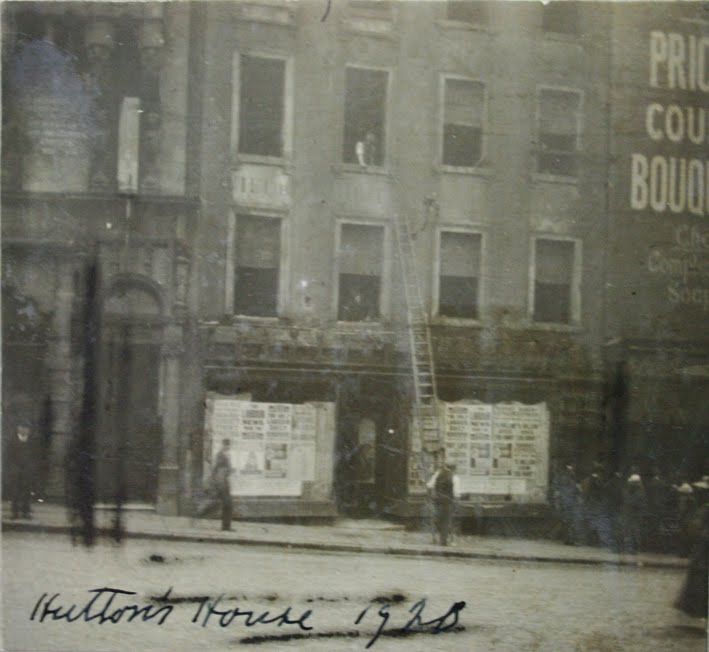
William Hutton's house and shop in High Street, Birmingham, as it was
being taken down in 1928. It was the events that occurred at this house in 1791,
as well as elsewhere in Birmingham, that caused Hutton's daughter Catherine
to declare that she would never live there again.
Held at Birmingham Archive.

Catherine Hutton stated in 1791 'I have for ever quited Birmingham as a home', no-one knew if she meant it, but she never did return to live in Birmingham again, and she had good reason to want to stay away. The 14th of July 1791 was the day of the King and Country Riots, it all boiled up after a few men met at the Hotel to celebrate the anniversary of the storming of the Bastille and the ideals of the French Revolution. Here, a few windows got smashed, but the riot soon spread across Birmingham and most houses did not get off so lightly, many were burnt to the ground, though William Hutton's house on High Street was saved that fate as the neighbours protested in fear that it may spread to their own homes. The rioting was targeted towards religious dissenters*; research and conjecture as to why this was the case could fill an essay in themselves, so here I will only note that William Hutton was a dissenter, and one, like many others in Birmingham, who had done well for himself in business. He ran his shop as a stationers on High Street, where he lived above, but also had a large house a little out of Birmingham on Washwood Heath where his wife, who suffered from illness, and daughter Catherine usually resided. That house did get burnt down, but here I will explore what happened on High Street.

Catherine was with her mother at Washwood Heath when the rioters called on her father and brother in High Street on the 15th, the day after the riots began. Dissenter Meeting Houses had already been burnt to the ground, as well as Joseph Priestley's, John Ryland's and John Taylor's houses. William Hutton had not been at the dinner at the Hotel, but he was a Unitarian (dissenter), and as well as that, he was also a Commissioner at the Court of Requests, dealing with those who owed debts. Hutton stated himself, that 'armed with [this] power, I have put a period to thousands of quarrels, have softened the rugged tempers of devouring antagonists, and, without expense to themselves, sent them away friends. But the fatal rock upon which I split was, I never could find a way to let both parties win. If ninety-nine were content, and one was not, that one would be more solicitous to injure me than the ninety-nine to serve me'. Hutton was known, when dealing with litigations, for his statement 'thee pay sixpence, and come again next Friday' (Friday was when the court was held); as the mob threw his possessions out of the windows of his house it was recorded that they shouted 'who bids for this?' to which the reply came 'thee pay sixpence, and come again next Friday'.

When the mob gathered before William Hutton's shop** on High Street on the afternoon of the 15th he tried to buy them off with money, even borrowing from neighbours to continue paying; they demanded alcohol and gave them all he could, but when he could give them no more they took him to a local tavern (against his will) and drank 329 gallons on his credit. The destruction of the house began by first only smashing windows and knocking loudly on the doors. Catherine Hutton's brother, Thomas, had gone out to try and deal with them but was nearly attacked with a bludgeon before a friend came to his aid. Thomas then went to try and help save Mr. Taylor's house, but on finding that futile turned back and discovered furniture from his house in Digbeth, thus realising that the crowds had managed to break through the doors of his father's shop. Those inside had thrown paper 'out of the drawing room windows, and women [had carried] out aprons full of [the family's] property'. The neighbours were unwilling to help; those nearby had pleaded for the house not to be burnt to save their own properties, and Thomas Carless,*** who lived opposite, refused to take in paper that had been thrown out of the shop, or to allow the young Mr. Hutton to escape from the crowds through his house. The mob continued through the night, as Catherine Hutton's aunt visited the scene at about 4am and saw 'drawers, wardrobes, and clothes [...] being thrown out of the windows and prints being trampled on the street'. The mob had threatened the life of William Hutton, so at this point the family, who were staying with that aunt, decided to flee to Sutton.

Once the soldiers were employed to restore some order to Birmingham on the 17th the family returned from their exile. On High Street, the rioters had 'demolished all the doors, windows, chimney-pieces, wainscotts, skirting boards, and banisters, together with the roof of the house'. They had also attempted to remove the staircase, but had only reached the sixth step (before, presumably, they realised that they should have begun from the top and worked down). The Beadle of the Court had managed to save some of the Hutton's property and keep it in the Court of Requests, which was very near Hutton's shop; Catherine was also reunited with her guitar which a friend had bought from a rioter for sixpence. By the 19th of July, William Hutton had completed some repairs and was able to 'appear at business'; soon Thomas and the servants could sleep in the house, but William preferred to retire with his family in the country. Slowly the repairs were completed until it was business as usual and William remained trading in High Street till 1793 when he handed over the business to Thomas.

NOTES
William Hutton bought a house on High Street in 1772, but the house in the photograph was the one that he had built on that site in 1775.
Photograph courtesy of the Library of Birmingham.
~ References on request.
* Dissenters were Christians who had separated from the Church of England, often due to dislike of state intervention into religious matters, or believing in varying doctrines.
** Hutton was a stationer, he was the first person to Birmingham to make paper and ran his paper mill just out of Birmingham. He also sold books and ran a lending library, at a small charge.
*** Thomas Carless was a druggist, and uncle to Richard Pratchett who I wrote about in the post Pratchett's Bull Ring.

The Dinner That Caused a Riot?

A BIRMINGHAM TOAST, published 23 July 1791 following the dinner
at the Hotel which fired the Birmingham riots beginning 14 July 1791.
Published in London.

Visit the Hotel here

The image is meant to depict the Constitutional Society of Birmingham that held a 'French Revolution Dinner' at Birmingham's Hotel to commemorate the second anniversary of the storming of the Bastille on 14th July 1791. The event has been transformed into a satirical cartoon by James Gillray, representing the London viewpoint of the riots and containing a number of false embelishments, one being that Joseph Priestley (standing, second from left) did not attend the dinner at the Hotel, nor did many of the others shown (see below) who lived a good distance from Birmingham. The dinner had caused a stir amongst some of Birmingham's inhabitants who believed that those attending were unpatriotic, and who had been antagonised by a seditious hand-bill that had been distributed a few days before the dinner, though all at the dinner denied any connection with it. But this was before France's King had been executed (which occured in January 1793), and before the full bloody violence of the revolution had truly begun. James Gillray took a conservative stance to the Revolution from the beginning and often ridiculed both it and those who believed in it's ideals.

On the evening of the dinner, the 80 or 90 diners were hissed at as they arrived, then the rioting began later that evening when a mob arrived at the Hotel and started smashing windows. The mob were pursuaded to move on by the Hotel's proprietor Thomas Dadley, but then the rioting continued for another three days. It was easy for those critical of the Revolution in France to blame the dinner, but as we have found more recently in the riots of August 2011, one thing may trigger an anger that has been deep rooted for a considerable amount of time. Joseph Priestley, who was pinpointed by Gillray, was a religious dissenter (specifically, a Unitarian), and he with a large number of other dissenters were targeted by the rioters and their homes destroyed. Priesltley, although not present, describes the dinner as it led up to the riot, and specifically mentions how the chair of the dinner was a church of England man:

"When the company met, a croud [sic] was assembled at the door, and some of them hissed, and shewed [sic] other marks of disapprobation, but no material violence was offered to any body. Mr. Keir, a member of the church of England, took the chair; and when they had dined, drank their toasts, and sung the songs which had been prepared for the occasion, they dispersed. This was about five o'clock, and the town remained quiet till about eight. It was evident, therefore, that the dinner was not the proper cause of the riot which followed: but that the mischief had been pre-concerted, and that this particular opportunity was laid hold of for the purpose."
For Priestley, the dinner was a contrived reason for rioting, as it was easier than voicing fears and predjudices towards the dissenting groups in Birmingham. But what causes riots is something that we may never be able to truly describe, there is often a friction that builds up between different groups of people who want different things, and from the fear of the desires of others.

INFORMATION ABOUT THE PRINT
The print reads: 
A BIRMINGHAM TOAST, as given on the 14th of July, by the ----------* Revolution Society
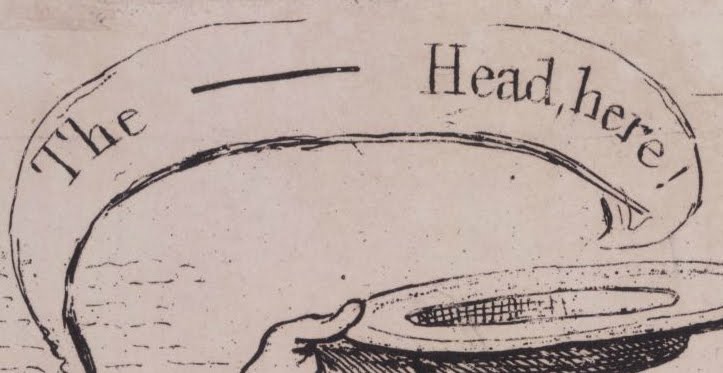
Joseph Priestley (standing) holds up a chalice and communion plate and states: "The King's* Head, here!"
Sir Cecil Wray (on our left) with a reddened face, pours himself some sherry and exclaims "Damn my eyes! but I'll pledge you that Toast tho Hell gapes for me". In the orange coat Richard B. Sheridan declares"O Heavins [sic]! why I empty a Chelsea Pensioner's small-beer barrel, in such a cause!". Charles James Fox's (centre) portly face is also reddened and as he raises his glass he says"My Soul & Body, both, upon the Toast!!!". Next to Fox is Horne Tooke who states"I have not drunk so glorious a Toast since I was Parson of Brentford, & kept it up with Balf & McQuirk!". To the right a rather drunk looking Theophilus Lindsey is saying"Amen, Amen". Behind this group are charicatured religious dissenters, from left to right saying:
"Hear our Prayers: & preserve us from Kings, & Whores of Babylon!!"
"Put enimity between us & the ungodly and bring us down the Heads of all Tyrants & usurpers quickly good Lord--Hear us"
"O, grant the wishes of these inheritance"
The frame on the back wall shows St. Paul's Cathedral, with three pigs eating from a trough, underneath it reads: 'A PIG's STYE, a View from Haskney'


* There are a couple of alterations within the above image, firstly the word 'King's' has been written into Priestley's quote, though later productions show only a dash (both above). Also, at the base of the image a word has been covered up (see below), and other prints show this incorporated. It may be that this was one of the original prints by Gillray and the alterations were made for legal reasons. All those at the dinner were adamant that no toast was made for the head of the King.