Showing posts with label Angerstein's Visit. Show all posts

Tour of Lost Birmingham Nᵒ.60: Turner's Brass Houses (Coleshill Street, c. 1740)

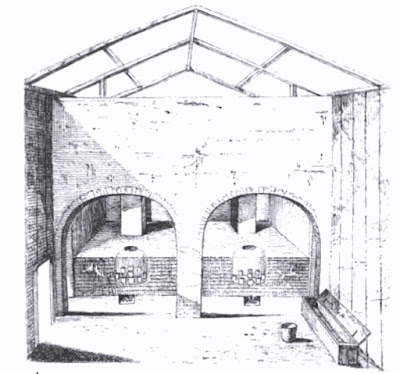
Interior Mr. Turner's Brass Works from R. R. Angerstein's Illustrated Travel Diary, 1753-1755.

Reinhold Rücker Angerstein was a Swedish metallurgist from a family of iron masters, who extensively travelled Britain's industrial works in the early 1750s, including many in Birmingham and nearby. In 1754 he visited Turner's brass works in Birmingham: 
The brass-works [...] belongs to Mr Turner and consists of nine furnaces with three built together in each of three separate buildings. The furnaces are heated with mineral coal, of which 15 tons is used for each furnace, and melting lasting ten hours. Each furnace holds nine pots, 14 inches high and nine inches diameter at the top. Each pot is charged with 41 pounds of copper and 50 pounds of calamine. Mixed with [char]coal. During charging I observed that a handful of coal and calamine was first placed on the bottom of the pot, then came the mixture, which was packed in tightly, followed by about a pound of copper in small pieces, and finally again coal and calamine without copper, covering the top. This procedure was said to lengthen the life of the pot both at the top and the bottom. [...] There are six workers for the nine furnaces and casting takes place twice every 24 hours.*1*

Lost Trades Nᵒ.11: John Taylor (c. 1711 to 1775) & Birmingham's First Factory (probably)

John Taylor I, c. 1750. In the possession
of Lloyd's Bank, London.

John Taylor (c. 1711 to 1775)

John Taylor was one of Birmingham’s most dominant manufacturers of small wares, often called 'toys', including japanned goods (decorative lacquer), metal buttons and enamelled boxes. In 1766 Lady Shelburne, who was visiting the Birmingham manufactories with her husband and some friends, called Taylor the 'principal manufacturer' of the town.* Taylor's business had grown from the 1730s, and his manufactory was probably Birmingham's first factory, in the sense we understand it today. He also was a partner in Taylor and Lloyd's bank, which opened in Birmingham in 1765 and is now simply Lloyd's Bank, and he died in 1775 a very wealth man.

Tour of Lost Birmingham Nᵒ.56: Bromford Forge, and the Interior of the 18th Century Iron Forge (Aston)

An Iron Forge, by Joseph Wright of Derby (1772)

The first mention of the Bromford mill as a forge was in 1605, but the site had previously worked as a water-powered mill, possibly dating back to Domesday, but definitely the thirteenth century. Like many mills it had been converted from corn grinding to fulling, the pounding of wool to remove oil and dirt.* From working as a fulling mill it was an easy conversion to become a forge to hammer iron instead of wool, as seen in Joseph Wright’s 1772 painting of an iron forge (above). Wright was inspired by the industries of the Midlands, and although there is no reason to believe that he visited Bromford, there would be similarities.

Tour of Lost Birmingham Nᵒ.55: Aston Furnace in the 1750s (Aston)


Aston Furnace in 1753, drawn by R. R. Angerstein.**

Aston Furnace, now demolished, was on the Hockley Brook, near where Porchester Street is today. The current site is grade A listed, although it has been built on. The original furnace was for iron and was first noted in 1615. In the late 1600s it was run by the renowned Jennens ironmasters, who also worked Bromford Forge. British History Online states that there is no evidence that the furnace itself was water-powered, but that the brook was used to power the bellows.*