Showing posts with label Birmingham Archive. Show all posts

Tour of Lost Birmingham Nᵒ.61: A Regency Stay at the Hen and Chickens Hotel (New Street)

The Hen and Chicken's on New Street, with King Edward's school to the right, c. 1808.
Coaches would enter the rear stables through the arch.
Held by Birmingham Museums.

Were you at the “Hen and Chickens,” from which I write, however, you would be very well content with your quarters [...] I am surrounded by vases of beautiful flowers, many of them the choice productions of the green house in our rude climate, which ornament and perfume the halls and landings of the staircases, and impart an air bordering on elegance, to the general neatness and comfort of the establishment. The inn at which we are, is said to be the best in this great work-shop of iron and steel [...].*

Catherine Hutton's Poem on Love & a Cosy Cottage

Held at Birmingham Archive in the Hutton Collection.

A watercolour of a small cottage accompanied by a five verse poem painted and written by Catherine Hutton (1756-1846) of Birmingham.

The poem reads:

Victorian Photo Album: "A Kind of Subtle Beyond" on (actually Edwardian) New Street

New Street, 1902.
Held at Birmingham Archive.

Photographs often include things that the photographer did not intend to capture. This is an unassuming shot of some of New Street; the hill rising towards Victoria Square. Roland Barthes called what was outside of the photographer's intention the 'punctum'. For him, the punctum exposed the life that was external to the photograph, "a kind of subtle beyond"*. In the windows of one of the nearer buildings, number 62 in fact, are a couple of strange items. They are barely noticeable without zooming in, but they look like two gaunt, white faces staring out onto the street.

Victorian Photo Album: The Site of the Council House (Victoria Square As It Was)

The corner of Congreve Street and Ann Street (looking up Ann Street), May 1867.
Held at Birmingham Archive.


This is probably the earliest photograph of Ann Street, taken in May 1867, and is an image of the site where the Council House was built between 1874 and 1879. Ann Street is now called Colmore Row. 

Georgian Terraces: 103 New Street

About 104-102 New Street (numbers later changed), c. 1860-1870. Held at Birmingham Archive.

See other Georgian terraces.

Even in Victorian Birmingham the central streets of the town, like New Street, still contained grand residential properties, like 103 New Street where the Wilkes family lived. The house in which they lived was a fine Georgian townhouse, one of many built in the 1700s, but few remained as residential properties in Birmingham's main shopping streets. The photograph might show the property shortly after it was vacated, and then, of course, demolished. Today, this is about where Hotel Chocolat and Blue Banana are. When the photograph was taken, there were still net curtains at the window.

Lost Trades Nᵒ.12: The Trade Catalogue of Ford Whitmore & Brunton (c. 1775)

Held at Birmingham Archive, MS 3506.

This catalogue for Ford, Whitmore and Brunton (c. 1775) provides amazing insight into the tools of the eighteenth-century Birmingham jeweller and watchmaker, including the range of precision instruments which were being used.

Paper Remnants: Thomas Rooker's Trade Card (c. 1760)

Held at Birmingham Archive.
Box 10, No. 637.

A hand bill for Thos Rooker (Thomas Rooker) selling cocks on Lichfield Street. Rooker doesn't appear in any directories, which survive from 1767, and the rococo design of the bill suggests the late 1750s or very early 1760s, so the pencil-written date of c. 1760 seems right.

Georgian Terraces: Summer Lane and Another Grand Townhouse

381 Summer Lane (to the right) at the junction with Hospital Street.
Taken 14 August 1932. Held at Birmingham Archive.

A photograph of a fine Georgian townhouse at 381 Summer Lane, at the junction of Hospital Street, which goes into the distance on the left. 

Georgian Terraces: Thomas Aris's House, Holloway Head

Photograph of Thomas Aris's house on Holloway Head.
Held at Birmingham Archive.

Thomas Aris was a bookseller and printer on Birmingham High Street between 1741 and 1761, and published the Birmingham Gazette, the town's first surviving newspaper. His success as a printer is perceivable in the size of his Georgian townhouse. You can find out more about him here.

The image below zooms into the door which clearly reads 'Thomas', so probably the rest says Aris's House.

Other Georgian Terraces

Suburbs (Perry Barr): "One of the Most Perfect Little Paradises" - Perry Pont House

Perry Pont House in 1909. In 1833 Mr. & Mrs. Osborn held a lawn party in a
tent here 'to partake of a handsome cold collation [cold food]' in 
celebration of the consecration of the nearby church to St. John. A 
musical band played and fifty-four rounds of cannon fire were set off.   

In Perry Barr, at the place where the River Tame curves sharply just before it comes upon Perry Bridge, which takes traffic over the Aldridge Road, a little island of land is formed hemmed in by the river on two sides and the road on one. It was here that wine merchant and coal dealer, William Henry Osborn, created 'one of the most perfect little paradises which any man could desire', or so it was said by those surveying the new Grand Junction Railway in 1838. On the site stood Perry Pont House, a Georgian six bedroom villa., a walled garden, several different kinds of trees, gardens, as well as meadows leading down to the, then, meandering river; it was a beautiful spot. Osborn was a keen gardener and achieved green-fingered fame for growing a perfect green rose at Perry Pont, as well as the first to officially record the Elford Pippin apple, apparently a delicious dessert fruit, and appeared in Regency botanical publications such as The Floral Cabinet.

Considering his love of the garden it seems likely that it was Osborn that turned the grounds of Perry Pont onto a wondrous park of outdoor curiosities, as in 1938 it was described that throughout the grounds were grottoes, statues and other follies, including a miniature church. The church could contain six people, and was complete with font and altar. One folly had an arched entrance and stained glass windows, with oyster shells set into the roof, another had a miniature of Cleopatra's Needle at the entrance and inside a mosaic floor made of horses teeth and animal bones; its stained glass was filled with imagery of unicorns and lions. Some follies had collapsed, but one that had survived was described in detail: 
only a glimmer of light oozes through air holes in the rock roof. The pillar is coated with pearly coloured oyster shells, interlaced with ribs of polished black stone and coral; on the walls are more oyster shells and pieces of shiny stone. At one side there is a miniature fire-place, its mantel-shelf decorated with pearly shells. And at intervals around the walls are small niches. 
Below is the 'entrance to a secret passage'. 

Entrance to a secret passage at Perry Pont, 1909.
Entrance to the miniature church, 1938.
Stool found at Perry Pont in 1909, which had the inscription
that it was made from part of the root of the tree which
Charles II sheltered within in 1651 after the Battle of
Worcester. The householders seem to have had a taste
for curiosities. 

By 1938 the river was dirty and muddy, its situation as a beauty spot diminished, and the house was planned to be demolished and replaced by industrial buildings. This may have taken several decades, as the house can be seen on maps through and after the war period, but by the 1960s the site was a builders' yard.

Map of Perry Pont in the 1880s.

Perry Pont in April 2019.

Photographs held by Birmingham Archive.

NOTES
William Henry Osborn died on 21 December 1862, and his wife, Mary Ann, on 8 May 1869.

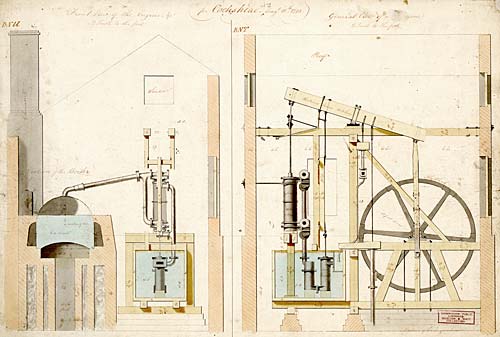
Curious Machines: Beautiful Machinery - Double Cylinder Steam Engine (1797)

Double cylinder engine produced for a mill in Nottinghamshire, 1797.

Many Birmingham industrialists fought for their decorative manufactured goods to be seen within the bracket of 'arts' and they were often called the 'useful arts'. The machinery produced in the town, though, had a beauty of its own, especially in the way it was drawn and depicted in the eighteenth century style of depiction. 

These engine plans were produced by Boulton & Watt at the Soho manufactory near Birmingham. They have been digitised by Digital Handsworth and placed online here, with additional information.

Engine for Henry Whately, gun manufacturer, Smethwick. 1796.

Six horse power crank engine for the Cockshead Colliery in Staffs. 1793.

Alteration to an engine by Boulton & Watt. 1776-7.

Pumping engine from the Paris Water Works, 1779.

Tour of Lost Birmingham Nᵒ.53: Freeth's Coffee House & the Society Feasts (Bell Street)


Freeth's Coffee House was a tavern (more formally known as the Leicester Arms) on Bell Street, a lost street which would have stood under the complex of the new Bull Ring Shopping Centre. It was run by John Freeth (sometimes John Free), a local poet and political commentator, often known as Poet Freeth and printing publications such as The Political Songster. As with many coffee houses in the eighteenth-century, it was a meeting place, not just of people, but of ideas. Most well-known are the meetings of the Jacobin Club, a group of political radicals including James Bisset (toy-maker and museum keeper) and James Sketchley (printer and auctioneer). In his obituary in 1808 it was noted that Freeth would sing his poems and 'delight a large company with original songs, composed from subjects of a public nature, replete with wit and humour'.

The pub was the site of a number of dinners where the radical politics and current affairs of the day could be discussed. The call to these feasts was frequently through a few lines of poetry, printed in letterpress onto small cards. Here are some examples:

Click on the cards to enlarge.


Poet Freeth (John Freeth).
1730-1808.

Tour of Lost Birmingham Nᵒ.52: The Swan Hotel in Pictures (High Street)

Swan Hotel in 1829.

The Swan Hotel was a large and dominant coaching inn on the High Street throughout the eighteenth-century and before. According to Joseph Hill it was an ancient tavern, the land of which stretching across the corner of High and New Streets, and belonged to a family called Rastell during the reign of Henry VIII. Between 1666 and 1688 the landlord of the Swan was Edward Crank, who demolished the old tavern, and built another set back from the street, with a large yard in front for carriages, and erected a row of five smart town houses along the street (seen on the left of the trade card, above).* The Swan was a haunt of Samuel Johnson, who wrote in 1755 'I was extremely pleased to find that you have not forgotten your old friend, who yet recollects the evenings which we have passed together at Warren's and the Swan'. Johnson resided in Birmingham in the early 1730s with Edmund Hector (to whom he writes above) at Thomas Warren's bookshop, which situated opposite the Swan at that time, as Warren's shop moved about.

Contemporary colouring of the 1829 card.

In the 1730s, as the notice below announces, you could catch a stage-coach to London at the Swan at six on a Monday morning, and return 'if God permit' on the Saturday. Take a journey on the Birmingham to London stage-coach here.


A map of the Swan Hotel was produced for a sale of the property in 1836. Although the hotel survived after this date, many of the extended parts of the property, such as the stables on Worcester Street, were being sold in different lots. The railway came to Birmingham in 1838 with the opening of Curzon Street Station, and whether prospective buyers would have been aware of the impact of the looming rail network, this was the end of an era for coaching inns like the Swan.

Held at Birmingham Archive.

The 'Coach Office', which can be seen in green on the map (Lot 1) on New Street, is depicted in the image belowThe street on the right of 'W. JONES', the trunk manufacturer, was Worcester Street, and when the Rotunda was built, this became Worcester Passage, which has now gone itself, but was covered and cut underneath the Rotunda building.

New Street (left) at the corner of Worcester Street (right), c. 1840.
By Thomas Underwood, held at Birmingham Archive.

A later map of the Swan, from the 1850s, shows that the grand open entrance, where the coaches would turn (as seen in the 1820s trade card), had been built up with new shops, and the hotel itself had been limited to the site behind the New Street Coach Office.

1850s map showing the Swan Hotel.

The Twentieth Century Swan
The hotel survived until the late 1950s, but was demolished before 1961 to make way for the new Rotunda. The photos below were taken in 1932 by William A. Clark (all held at Birmingham Archive).

The swan over the door. 
The entrance door with the swan over, looking up
Swan Alley. Note Fred Burn on the right.
Poor image of the alley from the other direction. Not taken by Clark.
Landing of the Swan Hotel.

~ FINIS ~

Swan atop the left-hand building of the Hotel in 1800.
From Bisset's directory.

Tour of Lost Birmingham Nᵒ.51: John Baskerville's House and Something Unexpected in the Garden (Easy Hill)

Baskerville's house at Easy Hill.

John Baskerville was a japanner, letter cutter, type founder and printer in Birmingham in the mid eighteenth-century. Japanning was his initial, and also very prosperous, trade, which enabled him to build himself a grand house on the outskirts of Birmingham in 1747, at Easy Hill. By the 1770s the Birmingham Canal and its wharf had encircled the house, and the town was encroaching nearer and nearer (see map below).

1778 map highlighting the house at Easy Hill, with a long tree lined drive
garden, and possible orchard. Birmingham is expanding onward.


Baskerville died in 1775, and the house was lived in by his widow and daughter, and his daughter owned it until 1788 when it was bought by John Ryland, who had the images below produced. They give some interesting detail of the ornamentation, and if anyone knows what the statues are, please let me know in the comments.

Easterly front of Baskerville's house.

Southerly front of Baskerville's house.

Close-up of the statues.
The house is thought to have been demolished in about 1795, and the land utilised for manufacture, and by a canal wharf, the construction of which, in the 1820s, unearthed Baskerville's corpse, which he had asked to be buried in a catacomb built especially for the purpose in the garden. Below is a drawing of said corpse, produced by Thomas Underwood in 1829, after the body had been on display. It says something about Baskerville's fame and renown that this seemed acceptable.

Held at Birmingham Archive.


Victorian Photo Album: Queen Victoria's Visit (Paradise Street)

Held at Birmingham Archive.

This wonderful image, one of the oldest photographs depicting Birmingham, was taken from Paradise Street on 15th June 1858: the day that Queen Victoria first visited Birmingham. It depicts some of the Georgian remnants of the street, a little row of brick residential houses on the left. Next to them is the brand new (begun in 1855 and completed in 1860) Birmingham and Midland Institute rising a little higher and topped with a Union Jack. It had been designed by Edward Middleton Barry. Local newspapers reported that the Institute was 'prettily ornamented with wreaths and festoons of artificial flowers-displayed with much taste, and arranged so as not to interfere with the beautiful architecture of the building itself'.**