Showing posts with label James Bisset. Show all posts

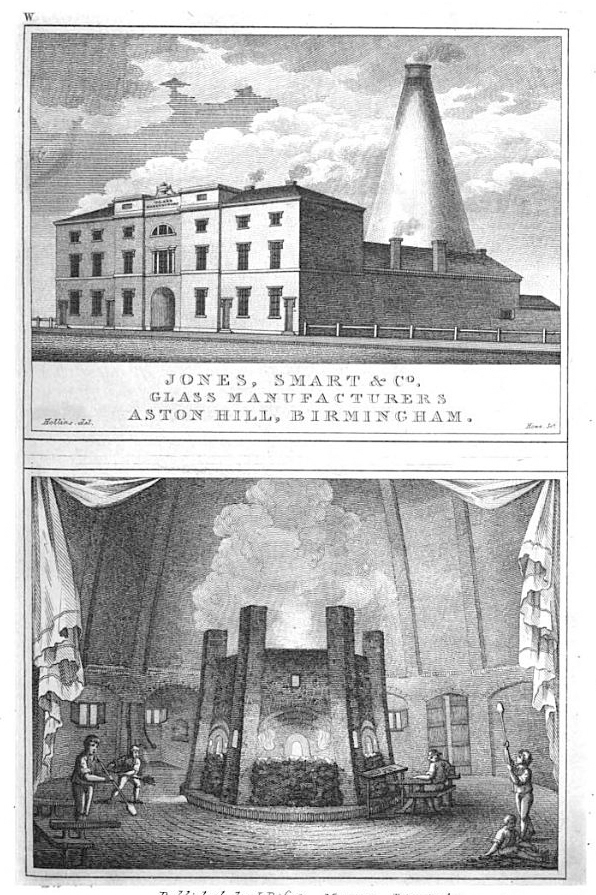
Bisset's Magnificent Directory: Jones, Smart & Co., Glass Manufacturers (Plate W)

Plate W in James Bisset's Magnificent Directory (1800).


A page from Bisset's Magnificent Directory printed in 1800 depicting glass blowing at Jones, Smart and Co. who were glassmakers at Aston Hill in Birmingham.

Lost Trades Nᵒ.16: Japanned Boxes and a Bilston Japanner's Design Book

Fig. 1.

Pages of a Bilston japanners design book from about 1761, held at the Winterthur Museum in Delaware, USA. It is thought to be from a Bilston maker as another book bought with it, from a later date, has 'Bilston' written on it. This pattern book is probably from the 1760s, though, as some of the designs (figs. 11-14) have designs celebrating the coronation of George III, which was on 22 September 1761. This is an excellent survival, as japanned boxes are liable to damage as the varnish and paint gets chipped away, so provides insight into what boxes might have looked like at this time, and many similar examples were made in Birmingham.

Historic Graffiti: Georgian Graffiti & Political Discontent

"TIME YOU'VE ENJOYED WASTING
ISN'T WASTED TIME"
Advice from a graffiti artist beneath the M6 between Aston and Bromford. The concrete pillars of this 'underneath place' form canvases for graffiti, hidden from anyone but the most intrepid explorer (I was there following the River Tame through Birmingham). 

Graffiti is nothing new though (see this post about graffiti on Aston Church), and in Birmingham Archive there's a document where manufacturer and museum keeper, James Bisset, recorded the changing inscriptions on Birmingham's walls in the late 1700s. In the 1780s the inscriptions "BUCKLES" and "NO SHOE STRINGS" reveal how the waning fashion for shoe buckles was affecting local artisans who were going out of business and struggling financially. Many Birmingham buckle makers petitioned the King, who promised to wear buckles and not shoe laces, but fashion is a cruel mistress, and 'shoe strings' won the day.

Tour of Lost Birmingham Nᵒ.45: A Trip to Thomason's Show Rooms (Church Street)

Edward Thomason's trade card, circa 1815.

When Sir Edward Thomason retired in 1835 he had built up a business that was one of the jewels of Birmingham's manufacturing crown. It had been visited by Princes, Dukes and Emperors from all the corners of Europe; and considering this global renown of Thomason in his time, I thought that you might like to take a tour as well.

The manufactory that you see before you (see image above) was composed from a number of dwelling houses that had lined the top end of Church Street, built in the 1700s. But from 1793, after an apprenticeship with Matthew Boulton, Edward Thomason began trading, utilising his father's buckle manufactory that had been left for him on the same site. Thomason's apprenticeship with Boulton had showed him what ambition could achieve and whetted his appetite for science and mechanics. His 'mind became restless to produce some novelty or invention worthy to be patented'.* He began making gilt and plated buttons, but soon branched into jewellery, coins, tokens and medals, continually expanding the business, so that by 1796 sixty to seventy rooms were utilised for his manufactures, as well as having twelve show rooms. The use of show rooms was an excellent tactic as it included Thomason's manufactory as part of the Birmingham tour where the town's articles could be examined and the the ingenuity of their maker wondered at.

Throughout this time Thomason was also working to achieve his ambitions of invention, and after several years of being generally unsuccessful he finally patented a new design for a corkscrew in 1802 that helped to make his name, as well as a good fortune. His ingenuity was aided by unflinching self promotion; he would send examples of new articles to whomever he thought best to promote himself and his wares, whether that be scientific medals to the most eminent scientists if the day, or commemorative medals to the Prince Regent himself. He also made the town and himself known to all Europe by sending religious medals to all of Europe's monarchs, and over the nineteenth century he received many honours and gifts from these; honours that he actively sought, and sometimes asked for.* He included illustrations of many of these gifts in his memoirs, as well as a portrait of himself wearing his honours (see below), and the many letters of praise received from esteemed persons. He was obviously very proud of his achievements, but one commentator (who called Thomason 'pleasant, chatty, spirited, yet egotistical') gave vanity as one of the main drivers in Thomason's memoirs.**

Thomason with his honours, from his Memoirs.

But, less about the man, let us take a look inside, where you can explore within one space a great range of the metallic arts; the 'show-rooms [...] profusely supplied with all that can be conceived of elegance and magnificence',*** and 'considered to be the most complete of the kind in Birmingham, and not to be equalled by many in England. He has a splendid exhibition of costly ornamental productions, in gold, silver, brass, and bronze, with a great variety of medals of the finest workmanship', as well as mechanical items.**** In 1832 Charles Stewart visited Birmingham. During his short stay (he found Birmingham too modern) he visited the ‘ingenious manufactories’ of both Thomason and Jones and found them both ‘rich in specimens of the most beautiful workmanship' and containing several items of special interest, including the Warwick Vase, of which Thomason's establishment was particularly noted for.

Over the next few weeks there will be some more posts about the Warwick Vase and other items that you might have been able to see in Thomason's show rooms. 

By this time (1832) the manufactory Thomason had inherited and built up was a very large affair and Thomason himself had made a name for himself through his ambition, innovation and clever promotion. It was three weeks after Stewart visited that Thomason was knighted, the first Brummie to be so. Shortly afterwards his friend, James Bisset, sent him the following verse:

‘”TO MY VERY OLD AND HIGHLY-ESTEEMED FRIEND, SIR EDWARD THOMASON, KNT.”
“DEAR SIR,
            I congratulate you on the honor
So lately conferr'd by our Monarch (the donor).
Who, judging most wisely where merit is due,
The badge of true Knighthood bestowed upon you;
And feeling as all other amateurs felt,
Rewards you with title, gilt spurs, sword, and belt!
    I remember the time (fifty years since, when boys)
Your name at SOHO 'gan to make a great noise;
And when to the 'toy shop of Europe' you came,
Each season exalted a THOMASON'S fame.
As an Artist whose works o'er the globe have been whirl'd,
Your renown has extended all over the world!
No wonder HIS MAJESTY then thought it right
(High-talented Edward) to make you a KNIGHT!
                       I am Sir, Yours very faithfully,
                                        JAMES BISSET,
                                                 A Septuagenarian."'

Edward Thomason attributed to Sir William Beechey.
Date unknown but probably late 1700s.


* Thomason's Memoirs
** The Worthies of Warwick
*** A Picture of Birmingham
**** A History of Birmingham

Scientific and Philosophical Medals
A Young Man in Town, Master Bisset

A fashionable man from c. 1780. James
Bisset describes a similar mode of dress
on the day he arrived in Birmingham.

James Bisset first arrived in Birmingham in 1776 as a young 16 year old ready to join his elder brother who had been working in the town already.* James had been expecting to find a ''black and dismal town, smoky and unhealthy', but was delighted to discover that it had many fine streets, good brick buildings and one of the most handsome churches he had ever seen.'* He describes his attire on the day that he arrived in the town:

"I was dressed [...] in white kerseymere vest & small clothes, a light blue coat, white silk stockings a pair of light pumps with silver buckles, a light stock with a stock buckle set with Bristol stone, a ruffled shirt & frill of lace worked by my sisters of which I had six others in my dressing trunk (exclusive of half a dozen other shirts with plain muslin ruffles which were then generally worn by every person the least genteel). My hat was a small cock & pinch."*

'kerseymere vest' was one made of a fine woolen cloth with a fancy twill weave, twill being a pattern of diagonal parallel ribs (tweed is one form of twill pattern).
Although not mentioned, James would have been wearing knee breaches (like the ones above) with his 'white silk stockings' which both men and women wore. The buckles on his shoes could have possibly been made in Birmingham as there were a large number of buckle makers in the town.
A 'stock' was a band of linen folded or swathed around the neck, and the buckle held the fabric in place. The 'Bristol stones' set into James's 'stock buckle' were a kind of soft diamond-like crystal found in limestone only found in the Clifton area of Bristol.
The 'cock & pitch' or cock-and-pitch hat was as can be seen in the image, a three cornered hat, pinched at each corner.

We can see from his description that James was styled as a fashionable young gentleman, but his future was not certain; he had no fortune and had to make his way in the changeable world of business and industry that Birmingham offered. He was apprenticed to a japanner (Bellamy's) and painted landscapes, flowers and fruit, and other decoration onto snuff boxes and waiters, working 12 hours a day. Not all of his fellow apprentices achieved as great a success in life as Bisset, and James really worked hard for all he accomplished.*
* References on request
Books and articles used:
Leonore Davidoff & Catherine Hall, Family Fortunes
Maxine Berg, Inventors of the World of Goods

A Tour of Lost Birmingham Nᵒ.13: James Bisset's 'Objects of Curiosity'


A promotional coin struck for James Bisset advertising his own museum and other 'objects of curiosity' in Birmingham. Circa 1800.

Side A.
OBJECTS OF CURIOSITY AND CONSEQUENCE, TO BE SEEN IN BIRMINGHAM.
---------
BISSET'S MUSEUM, AND GRAND PICTURE GALLERY.
---------
CLAY'S PATENT PAPER MANUFACTORY.
---------
---------
---------
WHITMORE'S ENGINE WORKS.
---------
NELSON'S STATUE.
---------
---------


Side B.
BIRMINGHAM MANUFACTORIES.
ARMY
ACCOUTREMENT.
BUTTON, BUCKLE,
GLASS & CHINA.
JAPAN, AND PAPER MACHEE.
NEEDLE, AND FISH HOOK.
STEEL, GOLD, SILVER, AND GILT TOY.
SWORD, GUN, & PISTOL.
TEA URN, WHIP, PIN, & WIRE.
TYPE, CAST IRON, & BRASS FOUNDRY.
---------
PRINCIPAL INNS.
CASTLE, DOG, GEORGE,
SARACENS HEAD, & UNION
INNS.
SHAKESPEAR TAVERN.

Birmingham Books: The Patriotic Clarion (1803), by James Bisset

Frontispiece of The Patriotic Clarion, by James Bisset, 1803.
Bisset invt., Hollins delin & Hancock fect.
Held at the British Museum.


Frontispiece of The Patriotic Clarion (1803) by James Bisset. The design was produced by Bisset, drawn by Thomas Hollins and engraved by Thomas Hancock. The book was printed by Myles Swinney.