Showing posts with label Enamel Menagerie. Show all posts

Enamel Menagerie Nᵒ.9: Squirrel Boxes

Enamel squirrel bonbonnière, c. 1765-70.
Sold at Bonham's in 2011 for £2,250. Originally from
the Mort & Moira Lesser collection. (6 cm high)

An enamelled red squirrel sitting upright and nibbling at a nut, with additional nuts depicted in the grass (see below). It was probably made in Birmingham, Bilston or Wednesbury and was part of range of creatures produced between in about the 1760s and 1770s, see the rest of the enamel menagerie.

Enamel Menagerie Nᵒ.8: Swan Boxes


Enamel swan bonbonnière, c. 1760-1770.
Privately sold (English Enamel Company).


This swan bonbonnière (sweet box) adds another form to the range of animals produced in enamelled copper boxes in the later eighteenth century, made in the Birmingham, Bilston or Wednesbury areas. The swan is simply painted with festoons of grey dots forming the plumage on the body and more intricately painted wing feathers in three kinds. Other animals were made sitting on grassy mounds, such as frogs and tigers. The base of this swan box is below.


Base of swan bonbonnière, above.

Enamel Menagerie Nᵒ.7: Lions Boxes

Enamel lion bonbonnière, c. 1760-70.
Sold at Bonham's in 2011 for £2,750. Originally from
the Mort & Moira Lesser collection, and before that,
the Ionides Collection.


This beautifully painted lion's head was used as a bonbonnière (sweet box) in the late 1700s. It was made in Birmingham or Bilston, or possibly Wednesbury, and is a particularly fine example. Similar boxes for other big cats, such as tigers and leopards, were made but the copper base of the box is raised around the mane, suggesting that this box was designed from start to finish as a lion. The mane and fur are painted in delicate lines in multiple shades of yellow and brown and his whiskers and teeth are particularly endearing. 

The lid (see below) was painted with an image of Sampson grappling with a lion. The lid is hinged and mounted simply. 
Lid of lion bonbonnière (above).
6.2cm diameter.

Enamel Menagerie Nᵒ.6: Tiger Boxes

Enamel tiger bonbonnière, c. 1760 (5.8cm diameter).
Sold at Bonham's in 2011 for £4,500. Originally
from the Mort & Moira Lesser collection.


This cheeky, grinning tiger is beautifully painted with glowing teeth and slicked-back whiskers in vibrant magenta and white. He is one of several creatures included in the menagerie of eighteenth-century enamels made in Birmingham and Bilston in about the 1760s and 1770s. These were bonbonnières (sweet boxes), which were larger containers to the pill and patch boxes produced at a similar time.

The lid (below) is hinged and simply mounted onto the box, and decorated with a hunting scene, with a pyramid or obelisk behind the tiger, all framed in colourful scrolling. Many boxes depicting large cats included hunting scenes on the lid, perhaps influenced by well-known prints produced 150 years previously by Antonio Tempesta, an Italian painter and engraver (see lion boxes).
Lid of the tiger bonbonnière (above).

Enamel Menagerie Nᵒ.5: Pigeon Boxes

Enamel pigeons, c. 1760-70 (6.3cm high).
Sold at Bonham's in 2011. Originally from
the Mort & Moira Lesser collection.

These amorous pigeons provide another example of the variety of animal bonbonnières (sweet boxes) produced in enamel in eighteenth-century Birmingham and Bilston. The two pigeons have interlocking beaks, one painted purple, and the other brown, and may have been given as a token of love or affection. Doves are more usually the bird of love as doves pulled Venus's chariot so became associated with her, the goddess of love. The difference between pigeons and doves, though, is linguistic and aesthetic rather than scientific, and some doves look similar to certain pigeons.*

Venus, by Carlo Lasinio (after Raphael) c. 1780s.
Wellcome Collection.


The lid of the box (below) shows a bird perched on a bunch of grapes, with pears and other fruit nearby. The lid has a simple mount with a hinge opening.
Lid of the pair of pigeons, above.

Enamel Menagerie Nᵒ.4: Boar Boxes

Enamel wild boar, c. 1760-70.
Sold at Bonham's for £1.375 in 2011. Originally
from the Mort & Moira Lesser collection.

Important note: Some of these boxes include mild eighteenth-century erotica.

The boar head box (above and below) was probably made in Birmingham or Bilston in the 1760s. They were usually bonbonnières, which were boxes for keeping sweets, often used to sweeten the breath in eighteenth-century social encounters. Lots of boar boxes survive suggesting that they were popular, or perhaps they were preferred by later collectors. Many of the boxes include images of boar hunting on the lid and, compared to other animals produced as part of the eighteenth-century enamel menagerie, many contain mild erotica either hidden on a secret inner lid or in plain view. ~

The boar's face (above) is intricately painted with each hair visible, complete with tusks and pink snout. The lid (below) is painted with a boar in a woodland scene.
Lid of the above box, 7.5 cm wide.

Enamel Menagerie Nᵒ.3: Birds of Prey Boxes

Enamel hawk or falcon bonbonnière, c. 1765. 
Sold at Bonham's. Originally from the
Mort & Moira Lesser collection(6.1cm long)

An either Birmingham or South Staffordshire made bonbonnière (sweet box) in the shape of a bird of prey from about 1760 to 1770, with intricately painted plumage, especially around the beak. The lid (below) is painted with a mother-hen protecting her chicks from a falcon or hawk flying overhead. The mount is of gilt metal.
Lid of above box.

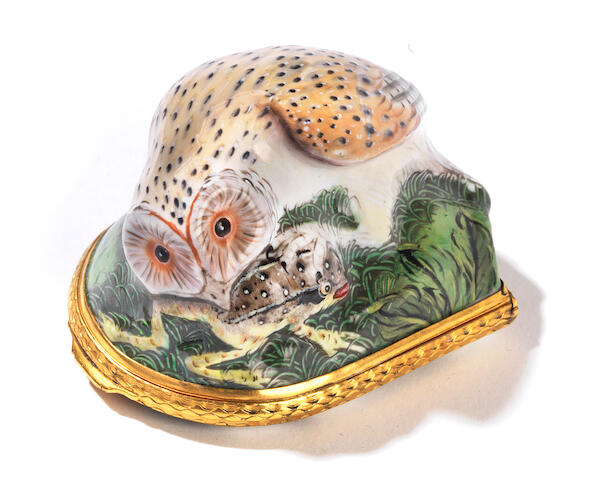
Enamel Menagerie Nᵒ.2: Owl (and Unfortunate Frog) Boxes

A fine Birmingham or South Staffordshire enamel bonbonnière, circa 1760
Box 1: Snuff-box or bonbonnière, c. 1760. Sold at Bonhams. 
Originally from the Mort & Moira Lesser collection.

Previously I wrote about enamelled frog boxes, but here, I'm afraid, it is bad news for the unfortunate frog. He's owl supper!

Many of these animal-shaped boxes were made between about 1760 and 1780 in Birmingham or South Staffordshire, and depict all kinds of creatures, both exotic and more familiar. They were made using a shaped copper base which was then enamelled and mounted with a decorative rim. The copper shape of this owl must have been particularly difficult to form with his raised wing.

Base of owl bonbonnière, above. Transfer printed and overpainted.

Enamel Menagerie Nᵒ.1: Frog Boxes

Box 1: Enamel bonbonnière (sweet box), c. 1765-80.
Sold at Bonham's for £1,500 in 2011. Originally from the
Mort & Moira Lesser collection.

This little frog bonbonnière (sweet box) was made in the 1760s or 1770s in either Birmingham or the Black Country, as were lots of other 'critters' just like him (see the whole menagerie here). The eighteenth-century was a period when the natural world was being increasingly studied and categorised, with many animals being depicted in new ways, with increasing accuracy. These boxes provided their owners with an amusing novelty - a frog in their pocket.

Pattern & Design Books: A Book of Birds & Squirrels &c. (c. 1758)

The new range of goods which flooded shops and lives during the eighteenth century required inspiration, and one person serving this was Robert Sayer. Sayer produced sets of prints, usually in sets of six, over the 1750s and 1760s which served crafts such as enamelling, wallpaper making and fabric printing, and many surviving eighteenth-century goods contain imagery directly taken from these prints. 

Some of these prints are considered to have been produced by Charles Fenn in Birmingham, but many appeared on Birmingham-made products in the eighteenth century, especially enamel boxes and other adornments. These include a squirrel bonbonnière, and similar images on several enamelled objects with swan designs.

The set of six prints included here was called A Book of Birds & Squirrels &c. The animal engravings were taken from original prints by Francis Barlow (c. 1626-1704) who was popular in the eighteenth century due to the natural poses of his animal prints.


Below is the frontispiece for another set of prints.

Enamel Menagerie Extra: Hunting Scenes & Antonio Tempesta

A Lion Hunt, with a Lion Killing a Man (c. 1620),
by Antonio Tempesta.
Held at Harvard Art Museums.

Several enamelled boxes depict hunting scenes on the lid, especially those formed into animals frequently hunted, such as boars, tigers, and lions. Many of these were probably inspired by prints by Antonio Tempesta (lived 1555-1630), an Italian painter and engraver, who produced dozens of hunting prints depicting men hunting both traditional and exotic animals with spears. Above and below are two examples, a lion and an ostrich.

Men and Dogs Hunting Ostriches (1624),
by Antonio Tempesta.
Held at Harvard Art Museums.

Below are examples of lids depicting scenes similar to Tempesta's, with links to the boxes from which they come.

Lid of a lion bonbonnière

The same design can be found on a different box, below, but framed in scrolling.
Lid of a tiger bonbonnière, c. 1760.

The same scrolling can be found on other boxes (below), suggesting that they were made in the same manufactory, or even painted by one individual.
Lid of a lion bonbonnière, c. 1760-5.

More Information
For boar hunting scenes, see the post about boar boxes.