 |
| Held at Birmingham Archive. |

Showing posts with label Curious Machines. Show all posts
Showing posts with label Curious Machines. Show all posts
Curious Machines: Beautiful Machinery - Double Cylinder Steam Engine (1797)
 |
| Double cylinder engine produced for a mill in Nottinghamshire, 1797. |
Many Birmingham industrialists fought for their decorative manufactured goods to be seen within the bracket of 'arts' and they were often called the 'useful arts'. The machinery produced in the town, though, had a beauty of its own, especially in the way it was drawn and depicted in the eighteenth century style of depiction.
These engine plans were produced by Boulton & Watt at the Soho manufactory near Birmingham. They have been digitised by Digital Handsworth and placed online here, with additional information.
 |
| Engine for Henry Whately, gun manufacturer, Smethwick. 1796. |
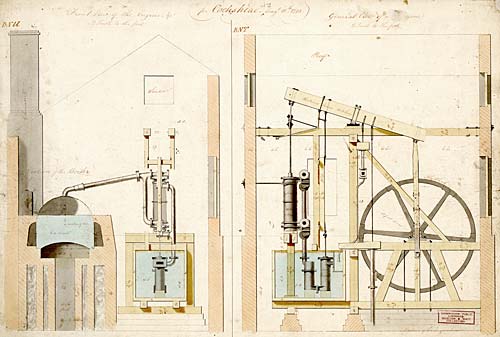 |
| Six horse power crank engine for the Cockshead Colliery in Staffs. 1793. |
 |
| Alteration to an engine by Boulton & Watt. 1776-7. |
 |
| Pumping engine from the Paris Water Works, 1779. |
Curious Machines: Ralph Heaton's Button Shank Machine (c. 1794)
 |
| c. 1794 button shank machine at Thinktank Museum, Birmingham. |
Between the 1790s and about 1807 Ralph Heaton (1755-1832) ran a brass foundry on Slaney Street, so making a variety of brass wares, where he also made rose engines. A biographical description of Ralph's stated that he had:
invented a most curious machine for making of button shanks, of so complicated a nature that although he did not obtain a patent for it, and admits every mechanic readily to see it, there is not one who could ever construct another.*
The button shank was at the back of a button, and was what attached the button to clothing. The machine was so 'curious' and 'complicated' because it worked in a fully automated process. Richard Prosser, in 1881, described the process as 'of great interest as being probably the first example of a machine in which the material is subjected to a series of independent operations succeeding each other at regulated intervals of time'.** The machine was powered by steam.
Although the article stated otherwise, Ralph did obtain a patent for his machine, in 1794, and examples of his curious machines are held at London Science Museum and Thinktank Birmingham.
 |
| c. 1794 button shank machine in the London Science Museum. |
** Richard Prosser, Birmingham Inventors and Inventions (1881).
Curious Machines: The Fire and House-Breaking Preservative (1786)

This is 'a machine, calculated to act as a preservative against fire and house-breaking', the design produced by William Hamlet in 1786.


DETAILS OF PUBLICATION: The Plan and Description of a Machine Calculated to Act as a Preservative Against Fire and House-breaking (Birmingham: M. Swinney,1786), p. 43.
Subscribe to:
Posts (Atom)