Showing posts with label Post Office. Show all posts
Tour of Lost Birmingham Nᵒ.34: Charles Edge's Post Office (New Street)
Communication is one of the most important parts of our daily lives, you can gauge that simply be seeing how many people walk around the streets on their mobile phones. Before the technology that we rely upon today, the only way to stay in touch with distant family and friends was via written mail. As Birmingham grew, the services, such as the post office, had to grow with it in order to accomodate for the growing population. The first known post office was in a small Georgian cottage with room only for a handful of people, which was later converted, but by the 1840s a larger premises was required. But Birmingham was growing quickly, and over the Victorian era two more custom built post offices had to be erected. The many post offices erected offers an insight into just how quickly buildings could become surplus to requirement in the rapidly growing town.
The architectural drawings for the 1842 conversion (some of which are included in this post) were produced by architect Charles Edge,* who may have been responsible (in some part) for extending the building ten years previously when it was converted into a hotel, the New Royal Hotel. Edge worked initially only the west wing (marked A above), transforming it into the post office, but then about ten years later converted the original house (section B), a grand Georgian gentleman's home called Portugal House, into Inland Revenue offices. The majority of his work seems to have been on the refurbishment of the interior sections, and Edge's designs for the serving section of the post office can be seen, below, as well as designs for the workings of the shutters, and the posting window. The top diagram is of the serving area, but as it is a plan we cannot be certain how close to the finished design it is, but it does offer some insight into the working of the early Victorian postal service.
Below is my own illustration showing the side view of the west wing how it probably would have looked after being altered by Charles Edge, using some of his own drawings as a guide. Although the main structure does not seem to be altered from the time that the building was a hotel, it seem from Edge's drawings of 1842 that he may have added the long portico that stretched along the side of the building. The arched window is the posting window shown above.
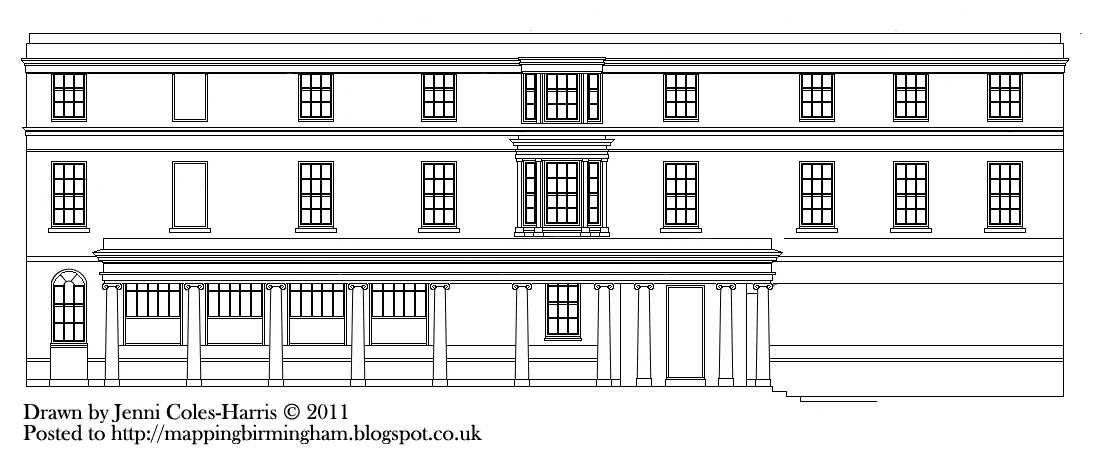
If we travelled along from here to the right we would find the white gates that are seen in the top image (where the arrow is), and this was the access from Post Office Place (now Ethel Street) to the Post Office Yard behind. This was where, on the 1851 census, some of the post office employees lived, but it also adjoined some of the back buildings used by the Theatre Royal, coloured pink.
NOTES
* The collection of Charles Edge's architectural drawings (MS1703) are from Birmingham Library and Archive Services, the archive is closed for transfer to the new building at present. I have included a selection of the Post Office conversion in this post, but there are more available.
Tour of Lost Birmingham Nᵒ.2: Georgian Post Office (New Street)
It is easy to forget in this information age, when you can communicate with the other side of the planet within seconds, that the only way to be in contact with those outside of the town in the Georgian era was either to go and visit them or through the post office. The post office was very much the hub of communication in the Georgian town; it was where information was transmitted, not only through letters, but the post office was where you could find news of distant wars and current events, when newspapers were a luxury to many. The buildings life and history was discussed in a column of the Birmingham Daily Post in the 1860s; it was a nostalgic look back, and also, an attempt to comprehend the rapid change that was happening at the time. This post narrates the memories from those articles as well as other sources to understand what was being recorded in the drawing above by those who could actually remember.
For many wealthier visitors to the town, the post office would be their point of arrival, if they had taken the mail coach at least, alighting in the yard behind and walking out into New Street. In front of them would be the Theatre Royal and Portugal House, behind them appearing from behind the trees would be the Baroque tower of St. Philip’s, three of the finest buildings of the town, and this would be their first impression. The post office building itself had either been built or appropriated in about 1784 and was a simple unassuming Georgian house covered with rough stucco and whitewashed. The door to the office was on the right, with a small window for posting letters out of hours that was lit at night by an oil lamp and space for only about six people inside.* In the drawing the step outside has become worn from its service to many feet. To the right was a small outbuilding with a window where the notices would be placed, it was here where news of the Battle of Waterloo was posted.* The house of the postmaster, John Gottwaltz, was entered by a separate door surrounded by elegant Classical porch.
If you turned right out of the coach yard, passing the post office on your right, you would follow the wall of the Gottwaltz garden for a bit, with trees bowing over the top, and then find premises hiring out post horses and hackney coaches. Post horses were not just for the fast delivery of mail, but could be hired for carriages; often someone with their own carriage would start out with their own horses, but for long journeys the horses would need to be rested and then returned home, and the traveller could hire the post horses to the next town, and so on till their destination was reached. Hackney coaches were rented four wheeled vehicles, with or without a coachman, but were thought of socially as an inferior mode of transport to the mail coaches which delivered the post. The mail coach was usually how someone with means but who could not afford their own carriage would arrive in a town from afar.
The first mail coach to deliver and collect from Birmingham was in 1812 (though mail coaches began in 1784), it would have delivered to the local inns and clattered up Georgian New Street through the post office gates. The coaches all looked the same; large red wheels with maroon on the lower body and the doors and a black upper body. Each door was painted with the royal arms as well as the words Royal Mail, and on the side of the drivers carriage the letters GR were intertwined for George Regina. The panels on either side of the doors were painted with stars of the principal orders of the knighthood; the garter, bath, thistle and St. Patrick, and painted on the rear was the coaches individual number.* Each coach carried a driver and an armed guard both wearing smart red uniforms but with different coloured collars so that they could be distinguished from each other. The guard was responsible for locking the mail in a box at the rear of the coach. Sometimes the guard would hand over his watch to the postmaster to be checked and repaired to maintain the good time keeping of the coaches.
~A Georgian mail coach (produced circa 1870); the heads from this scrap have been lost.~
In about 1820 a brand new street, Bennett’s Hill, cut down onto New Street straight past the post office, which was at that time extensively altered. Bennett’s Hill sat where the yard and its gates had sat, and no more mail coaches disembarked at the post office; mail and visitors instead arriving at one of the towns several inns and hotels. This post office was run by John Gottwaltz’s unmarried daughter, Georgina Margaret, who had taken over when her father died in 1817, and who moved with the post office as it transferred over the street to the converted Portugal House in 1842. The old building was taken down shortly afterwards.
NOTES
*From Kirsten Olsen, All Things Austen (Oxford: Greenwood World Publishing, 2008).
Images courtesy of Birmingham Library and Archive Services.
To find out more, click the labels below.
Any questions? Please add them to the comments section, below.
![]() |
| The Post Office (right) and other shops on New Street in 1824. By Samuel Lines Senior |
It is easy to forget in this information age, when you can communicate with the other side of the planet within seconds, that the only way to be in contact with those outside of the town in the Georgian era was either to go and visit them or through the post office. The post office was very much the hub of communication in the Georgian town; it was where information was transmitted, not only through letters, but the post office was where you could find news of distant wars and current events, when newspapers were a luxury to many. The buildings life and history was discussed in a column of the Birmingham Daily Post in the 1860s; it was a nostalgic look back, and also, an attempt to comprehend the rapid change that was happening at the time. This post narrates the memories from those articles as well as other sources to understand what was being recorded in the drawing above by those who could actually remember.
For many wealthier visitors to the town, the post office would be their point of arrival, if they had taken the mail coach at least, alighting in the yard behind and walking out into New Street. In front of them would be the Theatre Royal and Portugal House, behind them appearing from behind the trees would be the Baroque tower of St. Philip’s, three of the finest buildings of the town, and this would be their first impression. The post office building itself had either been built or appropriated in about 1784 and was a simple unassuming Georgian house covered with rough stucco and whitewashed. The door to the office was on the right, with a small window for posting letters out of hours that was lit at night by an oil lamp and space for only about six people inside.* In the drawing the step outside has become worn from its service to many feet. To the right was a small outbuilding with a window where the notices would be placed, it was here where news of the Battle of Waterloo was posted.* The house of the postmaster, John Gottwaltz, was entered by a separate door surrounded by elegant Classical porch.
If you turned right out of the coach yard, passing the post office on your right, you would follow the wall of the Gottwaltz garden for a bit, with trees bowing over the top, and then find premises hiring out post horses and hackney coaches. Post horses were not just for the fast delivery of mail, but could be hired for carriages; often someone with their own carriage would start out with their own horses, but for long journeys the horses would need to be rested and then returned home, and the traveller could hire the post horses to the next town, and so on till their destination was reached. Hackney coaches were rented four wheeled vehicles, with or without a coachman, but were thought of socially as an inferior mode of transport to the mail coaches which delivered the post. The mail coach was usually how someone with means but who could not afford their own carriage would arrive in a town from afar.
The first mail coach to deliver and collect from Birmingham was in 1812 (though mail coaches began in 1784), it would have delivered to the local inns and clattered up Georgian New Street through the post office gates. The coaches all looked the same; large red wheels with maroon on the lower body and the doors and a black upper body. Each door was painted with the royal arms as well as the words Royal Mail, and on the side of the drivers carriage the letters GR were intertwined for George Regina. The panels on either side of the doors were painted with stars of the principal orders of the knighthood; the garter, bath, thistle and St. Patrick, and painted on the rear was the coaches individual number.* Each coach carried a driver and an armed guard both wearing smart red uniforms but with different coloured collars so that they could be distinguished from each other. The guard was responsible for locking the mail in a box at the rear of the coach. Sometimes the guard would hand over his watch to the postmaster to be checked and repaired to maintain the good time keeping of the coaches.
~A Georgian mail coach (produced circa 1870); the heads from this scrap have been lost.~
In about 1820 a brand new street, Bennett’s Hill, cut down onto New Street straight past the post office, which was at that time extensively altered. Bennett’s Hill sat where the yard and its gates had sat, and no more mail coaches disembarked at the post office; mail and visitors instead arriving at one of the towns several inns and hotels. This post office was run by John Gottwaltz’s unmarried daughter, Georgina Margaret, who had taken over when her father died in 1817, and who moved with the post office as it transferred over the street to the converted Portugal House in 1842. The old building was taken down shortly afterwards.
NOTES
*From Kirsten Olsen, All Things Austen (Oxford: Greenwood World Publishing, 2008).
Images courtesy of Birmingham Library and Archive Services.
To find out more, click the labels below.
Any questions? Please add them to the comments section, below.
Subscribe to:
Posts (Atom)


