![]() |
| Equipage with egg-shaped containers and etui, c. 1760s. Wolverhampton Museum Collection. |
The Making of Gilt & Enamel Equipage (c. 1760s)
Lost Trades Nᵒ.11: John Taylor (c. 1711 to 1775) & Birmingham's First Factory (probably)
![]() |
| John Taylor I, c. 1750. In the possession of Lloyd's Bank, London. |
John Taylor (c. 1711 to 1775)
John Taylor was one of Birmingham’s most dominant manufacturers of small wares, often called 'toys', including japanned goods (decorative lacquer), metal buttons and enamelled boxes. In 1766 Lady Shelburne, who was visiting the Birmingham manufactories with her husband and some friends, called Taylor the 'principal manufacturer' of the town.* Taylor's business had grown from the 1730s, and his manufactory was probably Birmingham's first factory, in the sense we understand it today. He also was a partner in Taylor and Lloyd's bank, which opened in Birmingham in 1765 and is now simply Lloyd's Bank, and he died in 1775 a very wealth man.
Enamel (& Metal) Things: A Pair of Flowery Wall Plaques for the First Day of Spring (c. 1760s)
![]() |
| Private collection. |
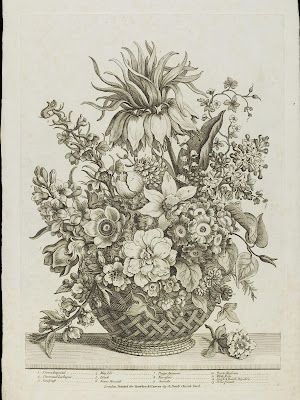
| A Select Collection of the most beautiful Flowers, Drawn after Nature, after Heckel (1795, reprint from c. 1750-1770 prints). Held at the V&A. One of a set of six. |
Equipage - Displaying Workmanship & Craftswomanship in the Eighteenth Century
![]() |
| A gilt metal equipage with enamel adornments and watch, made in Birmingham, c. 1770. Sold at Bonhams in 2011 for £3,250. |
Birmingham Button Box: Country Life in Transfer Printed Enamel (c. 1760s)
Object Focus: Four buttons from what would have been a larger set of gentlemen's buttons depicting hunting scenes. Above a gentleman leans on his horse with his hunting dogs around, and below are images of the hunt.
Birmingham Button Box: Floral Enamel Buttons (c. 1745-c. 1765)
These enamel buttons were almost certainly produced in Birmingham between about 1745 and 1765, and were possibly made in the manufactory of John Talyor. Taylor ran, probably, the largest manufactory in Birmingham at this time, including making enamel toys and gilt buttons. These buttons have a painted enamel centre set in gilt metal. There were other button-makers and enamellers in the town, but the combining of the two makes Taylor's factory a likely candidate for their manufacture. If they were not the product of Taylor's manufactory then they were probably produced through collaboration, with one maker producing the enamel circles and another mounting them in gilt metal.
Metal Things: Gallery of Filigree Counter Boxes
| Silver filigree counter box with painted enamel insert, c. 1790. Private collection. |
Several silver filigree counter boxes with enamel tops survive in museums and private collections, dating, probably, from the late 1700s. Counters were used in gaming so a decorative box was an eye-catching accessory on the gaming table.
Like much silver filigree of this period, these boxes aren't marked, but the combination of filigree and enamel makes it almost certain that these decorative objects were made in Birmingham and nearby. Birmingham was dominant in the manufacture of filigree (see post here) and, unlike other towns, contained within and nearby a diverse number of other artisans including skilled enamellers. Birmingham's famed Soho manufactory produced many filigree items including items for gaming such as quadrille pools and dice boxes. The 1782 inventory of the contents of the manufactory included 'Small Enamels Richards' and 'Enamels from Wednesbury' so, if they made boxes similar to the one above, they may bought the decorated enamel circles in from local makers in Birmingham (Richards was possibly Theophilus Richards, a local Birmingham filigree and toy maker) and Wednesbury.* There is no reason to believe that these boxes were made in Soho, but it is very likely that the filigree makers ordered in the enamel tops from other local makers.
| Top with Knave of Clubs. |
| Base. |
Gallery Below
Lost Trades Nᵒ. 7: An Overview of Eighteenth-Century English Enamels
![]() |
| Equipage, watch and watchcase in gold and enamel, 1777-1778. Enamel painted figures marked W. Craft (William Hopkins Craft). British Museum Collection. |
Enamelling is an ancient craft practiced in various ways across the the world. Enamel is made by heating and fusing glass powder to a metal base to create a glossy surface. Sometimes this can be done in segments to form patterns, or the enamelled surface can be larger and then painted or, through an innovation of the late 1740s, printed. Over the eighteenth century, these painted and printed enamels gained in popularity, predominantly made in London, Birmingham, the Black Country towns of Bilston and Wednesbury, and some in Liverpool, and these are the focus here.
Enamelled Edibles (c. 1760s)
![]() |
| Selection of enamel boxes, probably Birmingham, Bilston or Wednesbury, c. 1760-85. Sold at Sotheby's in a lot of 15 for £15,000. |
Enamel Boxes: Le Panier Misterieux Enamel Box (c. 1750s or 1760s)
Enamel Boxes: Les Fêtes Vénetiennes Bonbonnière (c. 1751)
Object Focus: This enamel bonbonnière (sweet box) is considered to be made in Birmingham in the very early stages of transfer-printing being developed in the town (more on transfer printing here). The transfer-print is in red and it has been over-painted in orange and purple, suggesting the transfer-print was of a poorer quality due to it still being in a period of development.
Balloon Mania and Enamel Ballooning Souvenirs (1780s & 1790s)
![]() |
| Ballooning enamel patch box, c. 1790. Private Collection |
Early balloon flight from the perspective of design and celebratory crafts.
Balloon flight was a novelty in the 1780s and demonstrations attracted large crowds well into the 1800s. The first manned flight without ropes tying the balloon to the ground was on 21 November 1783 in the gardens of the Château de la Muette on the outskirts of Paris.* This was a Montgolfier balloon designed by brothers Jacques-Étienne and Joseph-Michel, who were paper makers from a lineage of paper makers and this trade served them in developing their balloon. Paper lanterns, small hot air balloons, have been made in China for over a thousand years, paper used as a lightweight material so that there was enough lift. The brothers developed a lightweight and non-flammable balloon capable of carrying people by experimenting with different combinations of paper, linen, taffeta and other silks, and varnish.**
Enamel Menagerie Nᵒ.9: Squirrel Boxes
![]() |
| Enamel squirrel bonbonnière, c. 1765-70. Sold at Bonham's in 2011 for £2,250. Originally from the Mort & Moira Lesser collection. (6 cm high) |
An enamelled red squirrel sitting upright and nibbling at a nut, with additional nuts depicted in the grass (see below). It was probably made in Birmingham, Bilston or Wednesbury and was part of range of creatures produced between in about the 1760s and 1770s, see the rest of the enamel menagerie.
Enamel Menagerie Nᵒ.8: Swan Boxes
![]() |
| Enamel swan bonbonnière, c. 1760-1770. Privately sold (English Enamel Company). |
![]() |
| Base of swan bonbonnière, above. |
Enamel Menagerie Nᵒ.7: Lions Boxes
![]() |
| Enamel lion bonbonnière, c. 1760-70. Sold at Bonham's in 2011 for £2,750. Originally from the Mort & Moira Lesser collection, and before that, the Ionides Collection. |
Enamel Menagerie Nᵒ.6: Tiger Boxes
![]() |
| Enamel tiger bonbonnière, c. 1760 (5.8cm diameter). Sold at Bonham's in 2011 for £4,500. Originally from the Mort & Moira Lesser collection. |
The lid (below) is hinged and simply mounted onto the box, and decorated with a hunting scene, with a pyramid or obelisk behind the tiger, all framed in colourful scrolling. Many boxes depicting large cats included hunting scenes on the lid, perhaps influenced by well-known prints produced 150 years previously by Antonio Tempesta, an Italian painter and engraver (see lion boxes).
Enamel Menagerie Nᵒ.5: Pigeon Boxes
![]() |
| Enamel pigeons, c. 1760-70 (6.3cm high). Sold at Bonham's in 2011. Originally from the Mort & Moira Lesser collection. |
These amorous pigeons provide another example of the variety of animal bonbonnières (sweet boxes) produced in enamel in eighteenth-century Birmingham and Bilston. The two pigeons have interlocking beaks, one painted purple, and the other brown, and may have been given as a token of love or affection. Doves are more usually the bird of love as doves pulled Venus's chariot so became associated with her, the goddess of love. The difference between pigeons and doves, though, is linguistic and aesthetic rather than scientific, and some doves look similar to certain pigeons.*
![]() |
| Venus, by Carlo Lasinio (after Raphael) c. 1780s. Wellcome Collection. |
Enamel Menagerie Nᵒ.4: Boar Boxes
![]() |
| Enamel wild boar, c. 1760-70. Sold at Bonham's for £1.375 in 2011. Originally from the Mort & Moira Lesser collection. |
Important note: Some of these boxes include mild eighteenth-century erotica.
Enamel Menagerie Nᵒ.3: Birds of Prey Boxes
![]() |
| Enamel hawk or falcon bonbonnière, c. 1765. Sold at Bonham's. Originally from the Mort & Moira Lesser collection. (6.1cm long) |
An either Birmingham or South Staffordshire made bonbonnière (sweet box) in the shape of a bird of prey from about 1760 to 1770, with intricately painted plumage, especially around the beak. The lid (below) is painted with a mother-hen protecting her chicks from a falcon or hawk flying overhead. The mount is of gilt metal.
![]() |
| Lid of above box. |
Enamel Menagerie Nᵒ.2: Owl (and Unfortunate Frog) Boxes
![]() |
| Box 1: Snuff-box or bonbonnière, c. 1760. Sold at Bonhams. Originally from the Mort & Moira Lesser collection. |
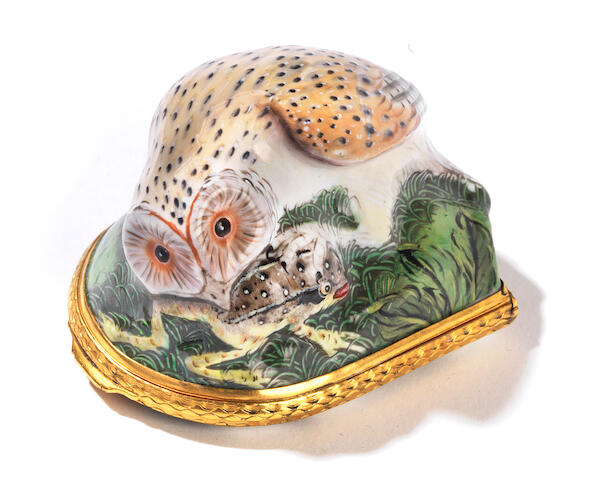
Many of these animal-shaped boxes were made between about 1760 and 1780 in Birmingham or South Staffordshire, and depict all kinds of creatures, both exotic and more familiar. They were made using a shaped copper base which was then enamelled and mounted with a decorative rim. The copper shape of this owl must have been particularly difficult to form with his raised wing.