Showing posts with label Books and Bookshops. Show all posts

Birmingham Women: Catherine Hutton, Writer and Home Crafter (1756-1846)

Catherine Hutton (11 February 1756 to 13 March 1846) was part of the Birmingham Hutton family, the daughter of stationer, book seller and historian William Hutton and his wife Sarah Cock.*1* Catherine was a weaver of tales as well as a needlecrafter, a weaver of threads, and was putting pen to paper right up to her death at the age of 91. She was particularly a fan of Jane Austen, as she explained 'I have been going through a course of novels by lady authors, beginning with Mrs Brooke and ending with Miss Austen, who is my especial favourite. I had always wished, not daring to hope, that I might be something like Miss Austen; and, having finished her works, I took to my own, to see if I could find any resemblance'.*2* In 1813 she published her first novel, The Miser Married (1813), and published two subsequent novels, The Welsh Mountaineer (1817) and Oakwell Hall (1819). Catherine published other fiction and articles in magazines, and her published letters outline the life of a middle-class woman at this time. 

Birmingham Bookshop Nᵒ.4: South View of from "A History of Birmingham" by William Hutton (1782 (1783 edition))

South view of Birmingham from the summer house, Cheapside, Bordesley, c. 1782.
Click to enlarge.

In 1782 the first history of the town of Birmingham was published by William Hutton, and the image above, depicting a vista of the town, was added as the frontispiece (the image correlates nicely with the 1778 map). Hutton had first come to Birmingham nearly forty years previously and had found it a fascinating town; he was very fond of the place, and his history finally recorded the town's growth on paper.

Lost Trades Nᵒ.13: Trade Catalogue for Knott's Marbled, Coloured and Fancy Papers (c. 1836)

Held at Birmingham Archive (8039734).

Beautiful marbled papers from the 1830s, produced by John M. Knott. The book is dated by the archive as an uncertain 1833, but John Morgan Knott was in partnership with Thomas Beilby and James Henry Beilby until June 1835, so this book was probably produced shortly after this date. In 1841 John Morgan Knott went bankrupt.

Many of Knott's fancy papers were manufactured in Bordesley, but the offices were at the old premises for Aris's Birmingham Gazette. A map of the Swan Hotel shows 'Mr. Knott's Printing Establishment' in 1836.

See examples below.

Birmingham Printers: Thomas Aris & the Gazette Offices

Plate D from Bisset's Directory,
showing High Street, including the
Aris's Birmingham Gazette offices.

Thomas Aris was a London stationer and printer who came to Birmingham in about 1740 in order to set up a printing business, including publishing a newspaper in the town. It was not the town's first newspaper. Thomas Warren had printed The Birmingham Journal from 1732 which continued till 1743, but the paper that Aris set up, The Gazette, or Aris's Birmingham Gazette, was the dominant paper of Birmingham over the eighteenth-century. Also, Aris's Gazette survives, whereas there is only one known surviving copy of Warren's Journal.

Birmingham Printers: Thomas Warren, Lady Holte & Links to Samuel Johnson

Printed in Joseph Hill's Bookmakers of Old Birmingham (1907),
the original in Birmingham Archive.

Thomas Warren (1700-1767) was first noted as a 'bookseller' in 1727.* He sold a range of works, some of them known about through the shopping bills of Lady Holte, of Aston Hall, who visited frequently between 1729 and 1730. She bought two volumes of Gulliver's Travels; Hutchinson's 'On ye Passions'; spelling books, presumably for her children; 'Headley's method of Teaching'; the 'Beggars Opera', first performed in 1728; two volumes of 'Cyclopedia'; as well as many more publications. She had books bound and bought ink, and also paid for 'Reading' certain books, so presumably Warren offered a lending service. Warren also sold Holte other items, including a 'Pair of fine Pockett Globes' which he bought in from London. Books allowed the reader to explore the expanding eighteenth-century world, so the globes were an apt addition to the bookshop, and Warren sold books about globes and exploration too.**

Birmingham Printers: Henry Butler & His Ballads

Cupid's Cabinet, p. 1.

Henry Butler was a printer in Birmingham between about 1719 and 1758, when an Esther Butler (his widow or daughter) took over the business. Butler was particularly a printer of ballads, such as Cupid's Cabinet Open'd (above and continued below) and ephemeral items, rather than books, and produced prints of Newcomen's steam engine in the late 1720s. His print shop was on New Street, probably tucked between the New Street entrance to the Swan Hotel, and what later became the Fountain Inn, not far from High Street. 

Curious Machines: The Fire and House-Breaking Preservative (1786)


One of many curious machines invented or made in Birmingham.

This is 'a machine, calculated to act as a preservative against fire and house-breaking', the design produced by William Hamlet in 1786.

It came with a long description (see here), but seems to be an elaborate bell-ringing device 


DETAILS OF PUBLICATION: The Plan and Description of a Machine Calculated to Act as a Preservative Against Fire and House-breaking (Birmingham: M. Swinney,1786), p. 43.

Birmingham Printers: Birmingham's First Book (Probably) & Matthew Unwin

A Sermon Preached, p. 1.

Above is the title page of what is probably the first book printed in Birmingham, produced by Matthew Unwin, whose press was near St. Martin's church. The book is not dated, which suggests that it was printed in the same year as the sermon was preached, 1716. Unwin also printed two other known books in Birmingham; A Loyal Oration (see below) and The Martyrdom of King Charles the First, both in 1717. The Martyrdom of King Charles was written by 'J. B.', thought to be the Reverend John Bridgeman, who was Master of King Edward's School on New Street between 1705 and 1714. A Sermon Preached [...] (title page above, and continued below) was written by Thomas Southall, the vicar at Harbourne, so these were both local works. 

Tour of Lost Birmingham Nᵒ.42: The Birmingham Library & a Ticket to Knowledge (Union Street)


Leading up to the anniversary of the Priestley Riots, which occurred in Birmingham from 14th July to 17th July 1791, an exploration of the Birmingham Library in which Dr. Joseph Priestley was involved.

The Birmingham Library was not the first in the town, but was the first that opened up the world of knowledge to a wider section of society. The establishment was set up in 1779 by 19 men, all but one of whom were religious Dissenters, already open to inquiry. To join the library members paid a guinea (21 shillings), and then, from 1781, paid a further eight shillings per year, so this was by no means learning for all, but it paved the way for the advancement of learning through the classes.**

When Joseph Priestley came to Birmingham in 1780 the library found an enthusiastic supporter, one who had competently helped build other such institutions already, and so its management was entrusted to him. The institution had great hopes for a freedom of learning, the initial principal put forward by Priestley being that 'this institution can never answer the purpose of party, civil or religious, but, on the contrary, may be expected to promote a spirit of liberality and friendship among all classes of men without distinction'.* He believed that controversial literature, even his own, should not be included among the books. By 1786 the library committee contained a mix of the original Dissenter groups, as well as a higher proportion from the Anglican church, but surprisingly it was the latter who pushed to have Priestley's books included in the library. John Money believes this to be a purposeful 'manoeuvre' which 'produced predictable results. The acquisition of Priestley’s work was attributed not to the cabal on the committee but to the Doctor [Priestley] himself and his friends, and it was followed by a series of ostentatious Anglican protests and resignations'.*** After this Priestley promoted that all books, including both his own and those that contradicted them, should be included. But differing opinions caused tension, and eventually rupture within the organisation; in 1794, the library split into two groups becoming the Old Library, which eventually moved to Union Street, and the New Library, which became located in Cannon Street.*


In 1796 it was decided that the library needed a purpose built building for its expanding collection, and William Hollins was chosen to design and build the structure, left (I will explore the architecture of the building in a separate post). The building opened late in 1797, and the rent of the land was paid for by a Tontine Deed drawn up at the beginning of 1798. Tontine meant that a number of subscribers would pay a subscription out of which the rent would be taken out and the excess reserved. Each subscriber could nominate either themselves or another individual to the Tontine and whoever survived the rest received the lump accumulated sum; this is why it was often very young children who were nominated. Nearly 180 individuals were nominated (with about 150 doing the nominating) for the library Tontine Deed (details and names of these can be seen here).

Above the library was carved 'AD MERCATURAM BONARTUM ARTIUM PROFECTUS, ET TIBI ET OMNIBUS DITESCES' translated as 'resorting to the mart of sciences, you will grow rich, both for yourself and others'. The library itself definitely grew and flourished; in 1784 it had owned about 900 books but in its new home in Union Street this rose to more like 7,000 by 1799.* The libraries that were established across many of the towns were a step towards providing education and learning to a wider section of the population. Among all the names nominated for the Tontine Deed, of people who lived in or near Birmingham, nearly a third were manufacturers, especially those in the button and metal trades, another third were merchants, one sixth were gentlemen and the other sixth were predominantly,what were deemed as, higher professions such as doctors, attorneys, bankers, artists and churchmen.* This was a move in the right direction in supplying learning to those who had been excluded from it previously.


ABOVE: Late Victorian Union Street, but still retaining its Georgian and Regency architecture. In 1845 the library had been extended to the left, as can be seen in the photograph.

NOTES
* References on request.
Other sources are this article and **British History Online.
*** John Money, Experience and Identity: Birmingham and the West Midlands 1760 - 1800


Seal from library card, above.

Birmingham Bookshop Nᵒ.3: Illustrations form "An Historical and Descriptive Sketch" (1830)


Plate 1: St. Peter's Church, St. George's Church, Christ Church, St. Thomas' Church

An Historical and Descriptive Sketch of Birmingham was published in Birmingham by Beilby, Knott and Beilby in 1830. It contained several copperplate images of forty-four local buildings, produced about two years earlier, with descriptions of these as well as the rest of the town, so provides an interesting tour around the town at this time. All the images are included in this post, with links to any posts which explore them, and a digital version of the book can be found here.


Plate 2: St. Paul's Church, St. Mary's Church, St. Bartholomew's Church


Plate 3: Trinity Chapel Bordesley, St. John's Chapel Deritend, St. James' Chapel Ashted


Plate 4: Carrs Lane Meeting House, Cherry Street Meeting House, Ebenezer Meeting House, Mount Zion Chapel


Plate 5: Institution for the Deaf and Dumb Edgbaston (centre top), Dispensary (top left), Charity School Park Street (top right), General Hospital (bottom left), Blue Coat Charity School (bottom right)


Plate 6: Philosophical Society Lecture Room, Academy of Arts, The Grammar School of King Edward the 6th


Plate 7: Cavalry Barracks, Workhouse, Gun Barrel Proof House, Asylum for Infant Poor


Plate 8: Theatre Royal, Library, New Library, News Rooms


Plate 9: Society of Arts Exhibition Rooms: 1. Interior. 2. Exterior.


Plate 10: Public Office, Post Office, Birmingham Fire Office, Birmingham Canal Office

An Historical and Descriptive Sketch of Birmingham (Birmingham: Beilby, Knott and Beilby, 1830)

Christmas Carols - Regency Style

'Christmas-Carols' by Henry Heath, 1835.

Carols are different from hymns, they are generally more joyous, often deriving from folk music (especially the older ones) and would have originally involved folk dances as well as the music. Due to this, carols have not always been predominantly sung in church, though they have become very much linked with the church choir now, and were often printed (as the folk ballads were) for people to buy and sing for pleasure, either at home or in public. Many of these original prints survive, I have found some printed in Birmingham from the early 1800s but have published for this post some printed in the town in 1826. Song or ballad singing was a very popular part of everyday life at this time, so singing Christmas carols was not a big departure from usual forms of entertainment, though the songs were, of course, seasonal. We can only guess about the style in which many of the carols were sung.

The carols in this post were printed in Birmingham by Charles Watson, later to become a wealthy printer, this was the only year that Watson produced songs or ballads of any kind. This was possibly his first venture; the address is shown as Jamaica Row, he later moved to High Street (c. 1831), a great improvement of address at the time. This may hint that the printed carols sold well, so were very popular. Christmas, during this period though, was not the 'event' that it has become today due to the enthusiasm of the Victorian's for the holiday.

Although some of the carols printed in 1826 may be familiar not all their tunes would be, as for a number of the carols that we sing today the music was re-written over the Victorian period. Hark! The Herald Angels Sing, for example, was written by Charles Wesley in 1739, amended by George Whitfield in 1753, and was originally sung to a solemn melody. The more joyful tune that we sing it to today was written by Mendohlsson in 1840 and widely adopted by 1855.


From the Bodleian Library
INDEX OF CAROLS FROM THE 1826 PRINTED BROADSHEETS
Click on the orange links to listen to examples of the carols.

1) The carols 'The Fountain of Christ's Blood', 'Hark, Hark, What News?', 'The Babe of Bethlehem' and 'Arise and Hail the Sacred Day'.
2) 'A New Carol on the Birth of Our Savior'.
3) 'When War on Earth', 'Angels From the Realms', 'Hark! The Herald Angel' and 'Stupendious Stranger'.
4) 'The Scene &c', 'The Condemnation', 'Awake! Awake!' and 'Bright is the Morn'.
5) 'The Virgin Unspotted', 'Christmas at Hand', 'While Shepherds Watch', 'To Adam Thus' and 'Rejoice and be Merry'.
6) 'The Best Wisdom-A Carol for the New Year', 'Good Things to All People', 'Christ's Love to Sinners' and 'The Nativity of Christ'.

In Anticipation of Absence: New Lost Birmingham at Central Library

The paintings that adorn Central Library at present (2012), seem to me to be saying 'goodbye' to it as much as marking its presence. The building will be replaced in the next few years, but at present it "converses" with neighbouring buildings and objects, such as in the reflections of the Council House in its glass (different from every angle), and the red of this years flowers which compliments the red berries.

The murals on the library are by Lucy Mclauchlan.

Resources: Books Printed By Thomas Warren (fl. 1730s-1767)

Sermons, 1733.

The Genuine Life, Confession and Dying
Speech, of Richard Wallton
, 1733.

The Young Christian's Prayer Book, 1733.

Philosophical Dissertations, 1738.

Catalogue of Curious Books, 1738.

A Journey Thro' the World, 1738.

A Catalogue of Curious and Valuable Books, 1739.

Lectures to Children and Young People, 1739.

A Christian Catechism, 1744.

Ornithologia nova, volume 1, 1745.

Ornithologia Nova, volume 2, 1745.

A Sermon Preached at Shrewsbury, 1745.

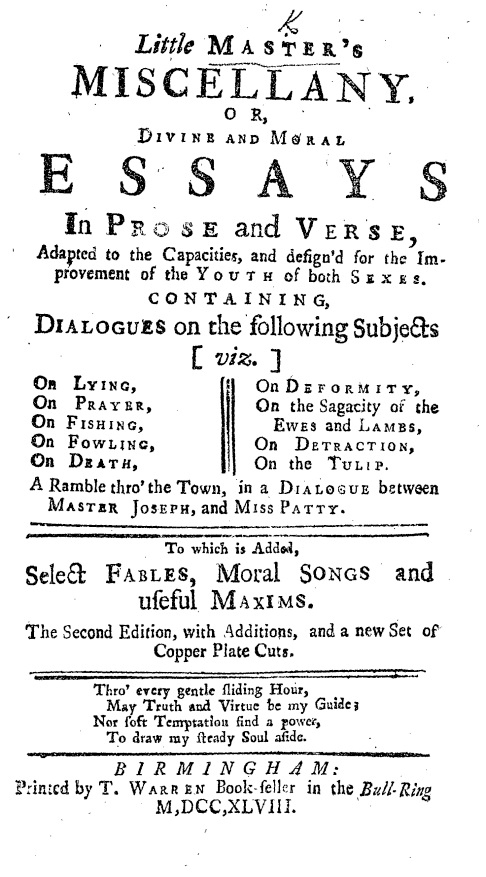
Little Master's Miscellany, 1748.

Resources: Books Printed By Thomas Aris (fl. 1742-1761)

A Lyrick Poem, 1742.

1742.

The Good Shepherd, 1743 (10 pages).

A Miscellany of Mathematical Problems, 1743.

The Humours of the Fleet, c. 1745. 

A Treatise [...], 1746.

The Judgment of Whole Kingdoms and Nations, 1747.

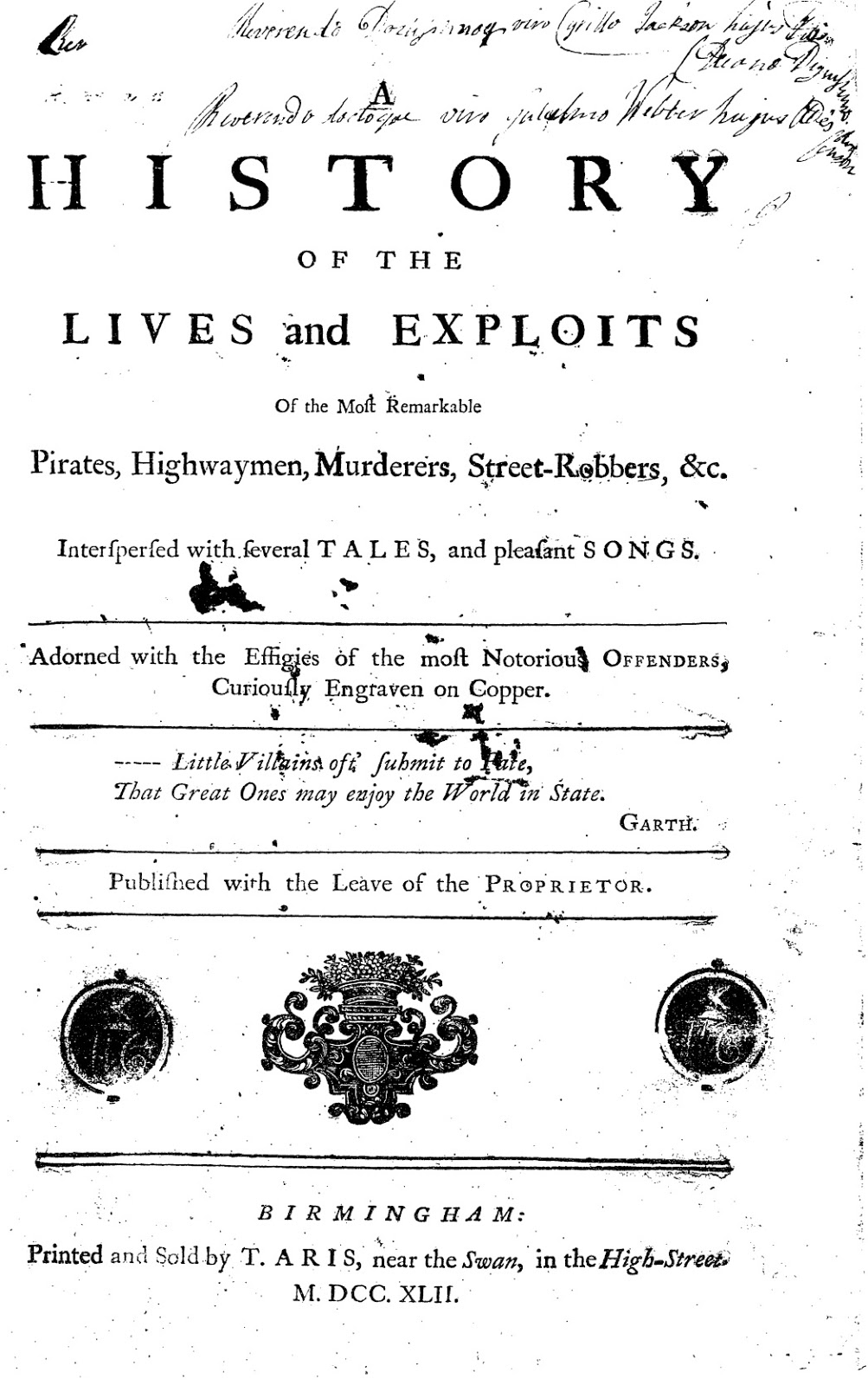
The Polite Companion (volume 1), 1749.

The Polite Companion (volume 2), 1749.

Divine Harmony, 1752.

A Collection (music), 1753.

The Art of Pleasing at Court, 1754.

The Life of Miss Fanny Brown, 1760.