Showing posts with label Coins and Tokens. Show all posts

Metal Things: Charles Jones's "Love Tokens" (1830s)

The reverse side of the Love Tokens, with
the makers name, Charles Jones.

These ‘Love Tokens’ were made in Birmingham in bronze and gold gilt in the 1830s by Charles Jones of the Pantechnetheca (a grand toy-shop/repository). These are gold gilt examples of the whole set of six. Each token depicts two cupids rolling dice on the reverse [above], and a different scene (again, each with Cupid) on the obverse, as follows:

Tour of Lost Birmingham Nᵒ.42: The Birmingham Library & a Ticket to Knowledge (Union Street)


Leading up to the anniversary of the Priestley Riots, which occurred in Birmingham from 14th July to 17th July 1791, an exploration of the Birmingham Library in which Dr. Joseph Priestley was involved.

The Birmingham Library was not the first in the town, but was the first that opened up the world of knowledge to a wider section of society. The establishment was set up in 1779 by 19 men, all but one of whom were religious Dissenters, already open to inquiry. To join the library members paid a guinea (21 shillings), and then, from 1781, paid a further eight shillings per year, so this was by no means learning for all, but it paved the way for the advancement of learning through the classes.**

When Joseph Priestley came to Birmingham in 1780 the library found an enthusiastic supporter, one who had competently helped build other such institutions already, and so its management was entrusted to him. The institution had great hopes for a freedom of learning, the initial principal put forward by Priestley being that 'this institution can never answer the purpose of party, civil or religious, but, on the contrary, may be expected to promote a spirit of liberality and friendship among all classes of men without distinction'.* He believed that controversial literature, even his own, should not be included among the books. By 1786 the library committee contained a mix of the original Dissenter groups, as well as a higher proportion from the Anglican church, but surprisingly it was the latter who pushed to have Priestley's books included in the library. John Money believes this to be a purposeful 'manoeuvre' which 'produced predictable results. The acquisition of Priestley’s work was attributed not to the cabal on the committee but to the Doctor [Priestley] himself and his friends, and it was followed by a series of ostentatious Anglican protests and resignations'.*** After this Priestley promoted that all books, including both his own and those that contradicted them, should be included. But differing opinions caused tension, and eventually rupture within the organisation; in 1794, the library split into two groups becoming the Old Library, which eventually moved to Union Street, and the New Library, which became located in Cannon Street.*


In 1796 it was decided that the library needed a purpose built building for its expanding collection, and William Hollins was chosen to design and build the structure, left (I will explore the architecture of the building in a separate post). The building opened late in 1797, and the rent of the land was paid for by a Tontine Deed drawn up at the beginning of 1798. Tontine meant that a number of subscribers would pay a subscription out of which the rent would be taken out and the excess reserved. Each subscriber could nominate either themselves or another individual to the Tontine and whoever survived the rest received the lump accumulated sum; this is why it was often very young children who were nominated. Nearly 180 individuals were nominated (with about 150 doing the nominating) for the library Tontine Deed (details and names of these can be seen here).

Above the library was carved 'AD MERCATURAM BONARTUM ARTIUM PROFECTUS, ET TIBI ET OMNIBUS DITESCES' translated as 'resorting to the mart of sciences, you will grow rich, both for yourself and others'. The library itself definitely grew and flourished; in 1784 it had owned about 900 books but in its new home in Union Street this rose to more like 7,000 by 1799.* The libraries that were established across many of the towns were a step towards providing education and learning to a wider section of the population. Among all the names nominated for the Tontine Deed, of people who lived in or near Birmingham, nearly a third were manufacturers, especially those in the button and metal trades, another third were merchants, one sixth were gentlemen and the other sixth were predominantly,what were deemed as, higher professions such as doctors, attorneys, bankers, artists and churchmen.* This was a move in the right direction in supplying learning to those who had been excluded from it previously.


ABOVE: Late Victorian Union Street, but still retaining its Georgian and Regency architecture. In 1845 the library had been extended to the left, as can be seen in the photograph.

NOTES
* References on request.
Other sources are this article and **British History Online.
*** John Money, Experience and Identity: Birmingham and the West Midlands 1760 - 1800


Seal from library card, above.

Tour of Lost Birmingham Nᵒ.35: Art Experiences - Immersion and the Panorama (New Street)

Image of the Panorama on New Street (right) from a handbill advertising
a panoramic display of Constantinople, 1806. The church is Christ Church.
As town planning and the new forms of architectural design became embedded into the landscape of the city, the city itself became a thing to be observed; a scene, a skyline, an aesthetic entity. The panorama fed on the desire to observe the aesthetic beauty of the distant city, its displays contemplated cities from across the world, as well as battle scenes, and were designed to make the observer feel as if they were present in the place or event depicted. This was an early form of immersive art.

The panorama was designed to enhance the experience of immersion, see illustration below. From the moment you entered, (A), you were sent beneath the display (B) and entered it from below (C). You would then stand in the viewing platform (D), the barriers of which limited your movement to within a particular area. Above was an umbrella-like device (E) which, along with the barriers, limited your lines of sight (F). This would mean that all that was visible were the walls of the panorama (H), painted 360 degrees around with the scene (on cloth), and part of the floor (G) that would also be decorated in a relevant way, for example, in a battle scene there may be models of fallen horses.

Conjectural view of the interior of Birmingham's panorama. Details above.

In October 1798, probably what was a travelling panorama, had been erected on Union Street. It depicted the Grand Fleet 'under sail, off the Isle of Wight' escaping from the 98 gun 'Boyne Man of War', which was in flames, and all actual size. The event was described as to depict 'the Hurry and Bustle of various Boats, and the eager Anxiety in the Countenances of the Seamen' and formed 'at once a Scene of Terror and Sublimity'. And all for one shilling. The whole experience was designed to immerse you in a spacial narrative, and give you the visual and emotional sensations of being elsewhere, in this instance, at sea during a naval battle. There were also others that were intrigued by the panorama, a local entrepreneurial tailor produced a miniature version from about 1796 where the scenes changed every other day, and produced a coin to advertise it along with his 'Grand Exhibition' of other curiosities (below, and here), and which was on display well into the nineteenth century.


The Panorama on New Street (top image) opened in 1804 to the showing of a 'View of Ramsgate', depicting 'the Embarkation of Troops, both Horse and Foot, taken on the Spot at the Time' and including 'a very great Extent of Sea, and Ships in every Direction [...] with a distant View of the Coast of France [...]'.* The building had been opened by the Barker's, Robert Barker had been responsible for the invention of the Panorama, patented in 1787,* and was in business with his equally talented son Henry Aston Barker. Robert had coined the word 'panorama'  from the Greek meaning an 'all-embracing view'.* The Barker's probably opened provincial Panoramas as a way to create a network across the country to tour their work, thus getting the greatest income for their output. It would be interesting to discover if Birmingham was on a route that the panoramic paintings would take across the country once produced.

Example of the interior of a Panorama displaying a
scene of London.

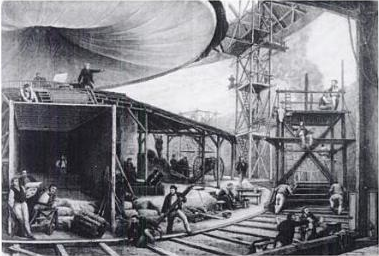
Robert Barker died in 1806 and in 1807 a Panoramic view of Edinburgh was displayed in Birmingham, perhaps as a tribute to Robert Barker's favourite Scottish town, and the one that had inspired his original idea. After his father's death Henry took over the business and continued to travel and produce panoramas, but the original panoramic views that had been painted through Robert's lifetime still toured the country. His view of the Battle of Waterloo came to Birmingham in August 1817, but this was the last known panorama to be shown in the building. Towards the end of its life the New Street Panorama came under some competition from another built nearby at Baskerville Place by S. J. Richardson. How much of a threat this establishment was we do not know, but the expense of maintaining the Panorama would have been very high. The painted scenes were of an immense size, which would all be hand painted, and it would have taken a great deal of time installing them into the building with all the additional props as well (see below). There was also competition from moving panoramas, which were shown in Birmingham's Theatre Royal at about this time. Outside of Birmingham the display of panoramas continued successfully throughout the nineteenth century, especially in Europe's capitals.


A Panorama being installed in the 1840s. 

When William Hutton visited the Panorama he stated that it was 'an entertainment that, I believe, no man who ever saw repented a lost shilling', and throughout its life the Birmingham Panorama had always cost a shilling to enter. This was the same price as a visit to the Theatre with a seat in the gallery, the cheapest seats, and would be within the range of all but the very poorest, bearing in mind that an artisans wage could be 20 to 30 shillings a week depending on their skill. Viewing depended on good light, so the building was usually open between nine or ten in the morning till dusk, it was lit inside too, and in the winter would be heated. Sometimes, such as at the scene of the Siege of Flushing in 1813, talks would be given from the platform by those who had been present at the time of the events, to give an even greater sense of place, and for those involved to feel that they were re-living the events. This suggests that the experience of visiting the Panorama was one of showmanship, where commentary would be given whilst you viewed. Through the years it operated the inhabitants of Birmingham would have been able to visit Paris, ancient and modern Rome, Constantinople, the burning of Moscow, Glasgow, as well as a number of battle scenes. After the Panorama's closure the building was used for a time by auctioneers Robins Brothers* before being taken over by the Society of Arts as a gallery in 1822 and then rebuilt in 1828.

NOTES
* References on request fl. 6. LF56.1 GRE, #18 1999

Japanned Things: Fire Balloons - The First Small Step


~Japanned tray depicting Mr Sadler’s ascension from Birmingham's Crescent on 13th October 1823. From the BMAG collection on display at the Birmingham History Galleries. ~

Ballooning was one of the most novel entertainments of the late eighteenth and early nineteenth centuries as it marked the beginning of man taking off from the planet; a new and exciting prospect. The first aviators were adventurers and daredevils, made all the more exciting by the flying balloons that they ascended in being called fire balloons. They were simply hot air balloons, but the idea of going to see a fire balloon take off definitely had a more dramatic sound to it. The first Englishman to take off was James Saddler (1753-1828) who took flight in London in October 1784 (the first Englishwoman, Mrs. Sage, ascended in June 1785). The spectacle spurred others to take balloons and travel around the country to put on balloon ascensions for paying spectators. A Mr. Harper was the first to arrive in Birmingham, in January 1785, taking off twice, the second time from a tennis court in Coleshill Street.* Ballooning could be a dangerous feat, accidents did occur, but although often not fatal, Mr. Sadler's own son, Windham Sadler, was killed in an accident in 1824.*

It was not till October 7th, 1811, that Mr. Sadler arrived to a great crowd in Birmingham's Vauxhall Gardens; it was his 21st ascent and a commemorative coin, left, was struck for the notable event.

By the time of the balloon ascension in 1823 commemorated on the tray, above, James Saddler was 70 years old, and it was one of his sons (either Windham or his other aeronaut son, John) who took flight from the Crescent.** The ropes were held by local school boys; the crowd paying 3s 6d each, all apart from a Mr. James Busby who paid 20 guineas to take his place inside the balloon's basket. The massive crowd filled the Crescent with 'shouts of an almost countless multitude';* a Mr. G. R. Bird, who ran a wharf on the canal near the Crescent, and who may have invested some money in the day's events, recorded in his diary that at 'a quarter before 3 o'clock Mr Sadler Junior went up in a fire balloon from the Crescent accompanied by James Busby, [and it] was seen for 20 minutes, took direction of Hagley and descended safe in a field near Kinver or Enville. The balloon was up 25 minutes and went 17 mile'. The balloon must have been quite a sight, not just for the paying spectators, but also anyone in the near vicinity. It was a rare sight as well, and must have captured the imagination of the country, as from at least 1787 stage coaches began being called 'balloon coaches'. We think of a balloon ride today as slow and relaxing travel, but in the late eighteenth century this was the fastest mode of inland transport (if not the most accurate) and perhaps coach proprietors used the name to assert their coaches as being speedy vehicles.  They were fire balloons after all!


NOTES
What to wear for a balloon ascent, 1785.
* References on request
** The Crescent was a development of smart town houses, planned to be like the Crescent in Bath, but never completed.

Tour of Lost Birmingham Nᵒ.28: A New Theatre on New Street


Inside the Swan Inn on High Street on 10 August 1773 a group of enthusiastic manufacturers and tradesmen met with the intention of opening a new playhouse, each subscribing a certain amount of money for the venture. The group elected the celebrated actor Richard Yates to manage the establishment, a friend of David Garrick, the well know actor who managed London's Drury Lane Theatre Royal making it one of Europe's leading theatres. Yates himself had been managing what would become the new theatre's Birmingham rival, the King Street Theatre. Land near New Street was chosen, the site of a Mr. Greenwood's orchard. Joseph Green, one of the subscribers to the theatre who owned one share, took land adjoining to build his new grand house (visit here), and at least one meeting of the subscribers, in 1776, was held at Mr. Green's house.* Green and the New Street Theatre had a number of disputes over land boundaries though, but the proximity of Green's house to the theatre was probably most keenly felt when the latter was set on fire in 1792.

The New Street Theatre was built by Thomas Saul, a Birmingham builder and surveyor, and opened on 20 June 1774; the first performance was recorded in the local paper:
'On Monday last the new Theatre in this Town wes opened with the Comedy of 'As you like it' and the Entertainment of 'Miss in her Teens; a Prologue (said to be written by Mr Foote) was spoke by Mr Yates, which was suitable to the Occasion, and very well received by the Audience. The drawing up of the Curtain about the Middle of the Prologue, discovering a most magnificent Scene of a Palace, had a very fine Effect, and was received with a prodigious Burst of Applause. The different Parts of the plays performed this week have been well-filled, and the Performers on general met with universal Approbation. Particular Encomiums are due to Mr Columba, from the King's Theatre, who painted the Scenes,** which are allowed to be as well executed as any in London. The Audience each Night has been brilliant and numerous, [...] -One Circumstance we are sorry to remark - that several of the Gentlemen that appeared in the Boxes were dressed in a very improper Manner for so conspicuous a Place, and it is recommended to them in future to pay more Respect to the Ladies, by dressing themselves in a Manner suitable to the Company, and as Gentlemen should, who appear in the Boxes.'*


The Gentlemen, improperly dressed in the boxes, were given a bit of a telling off; theatre going could not be seen as refined and respectible (as it needed to be to defend against attacks from many critics) if theatre-goers did not arrive in the proper mode of dress. This kind of behaviour also distinguished provincial theatres from the London ones, and it was these differences that many wished to be lessened.

The coin, above, is a very rare token owned by Birmingham Museum, produced for the New Street Theatre to allow free entry for the bearer.* Shakespeare is depicted on one side with the words 'WE SHALL NOT LOOK UPON HIS LIKE AGAIN', and on the reverse 'FREE TICKET FOR BIRMINGHAM THEATRE 1774' with a space above; the space filled with the engraved name of Mr. Faulcanbridge. Thomas Faulconbridge, like Joseph Green, was a subscriber to the theatre, he was actively involved in the venture till his death, and chaired a number of the meetings. There is another of these coins in the posession of Birmingham Museum, in silver, and with the name 'Jos.h Green's' engraved into the space. Historian David Symons suggests that the silver coins belonged to the subscribers, allowing them free entry to the theatre, whilst the copper coins were given to others by those named. I wonder that both the coins allowed only the named persons, the paying subscribers, in for free; it does not seem good business sense to be allowing friends of subscribers free entrance, but Joseph Green was well known as a dandy; he was often called 'Beau Green', and with the need for flamboyant 'bling' that any self respecting dandy would need, Joseph may have had his token struck in silver as a status symbol. Only the discovery of more of these tokens though, would shine light on either of these proposals.

NOTES
* References on request
** The older King Street Theatre had an ongoing rivalry with the New Street establishment after its opening, but it is unsurprising after it stole its successful manager, Richard Yates, and then pilfered the talents of the scene painter as well.

Lost Trades: The Coins of John Gregory Hancock

Angelsey Druid coin, die engraved by Hancock, struck
in Wales.

John Gregory Hancock was a die-engraver and coin manufacturer and was thought one of the finest engravers, not just in Birmingham, but world-wide. The process of die-engraving involved incising the image in reverse (including dimensionally in reverse) in metal so that a coin could be struck from it. John engraved the die for the 1792 Washington cent, which is a very skilful example of the trade (see below, left), and made print engravings for Bisset’s Magnificent Directory. John was also the first to patent the process of paper embossing in 1796 (and may have invented it)* which is the method of raising a pattern or picture on paper by pressing it between two metal dies.


A lovely example of a coin is one produced by Hancock’s son (also called John Gregory Hancock, see above right) in 1800 when he was only seven years old. It shows a bust of Shakespeare, and was probably a product of Hancock senior handing down his skills to his young son. Coins were not just produced as part of general currency, but they were used by businesses to advertise, to commemorate people or events, as special currency such as workhouse tokens, as medals and to promote political messages (as with the medal below). The process of die-engraving is complex, dark must be engraved as light; raised sections as dropped ones, which requires a great deal of technical skill.

Medal cast in 1800, die by Hancock. The medal states
'THE UNCHARITABLE MONOPOLIZER WILL STARVE THE
POOR' and around the globe is written 'TAKE NOT WHAT
WAS MADE FOR ALL'. The band on the figures head states
'POSSESSION'. 


NOTES
A Thomas Hancock was an engraver (art) working at 14 Congreve Street. He worked on Bisset's directory as well, which suggests that he could have been related to John Gregory Hancock. Thomas was the son, or another relation of renowned Worcestershire engraver Robert Hancock, who was apprenticed to Birmingham's George Anderton in 1746.
A William Hancock produced and patented the first metal rope in Birmingham which made coal mining safer as metal was less likely to break.
* References on request.

A Tour of Lost Birmingham Nᵒ.13: James Bisset's 'Objects of Curiosity'


A promotional coin struck for James Bisset advertising his own museum and other 'objects of curiosity' in Birmingham. Circa 1800.

Side A.
OBJECTS OF CURIOSITY AND CONSEQUENCE, TO BE SEEN IN BIRMINGHAM.
---------
BISSET'S MUSEUM, AND GRAND PICTURE GALLERY.
---------
CLAY'S PATENT PAPER MANUFACTORY.
---------
---------
---------
WHITMORE'S ENGINE WORKS.
---------
NELSON'S STATUE.
---------
---------


Side B.
BIRMINGHAM MANUFACTORIES.
ARMY
ACCOUTREMENT.
BUTTON, BUCKLE,
GLASS & CHINA.
JAPAN, AND PAPER MACHEE.
NEEDLE, AND FISH HOOK.
STEEL, GOLD, SILVER, AND GILT TOY.
SWORD, GUN, & PISTOL.
TEA URN, WHIP, PIN, & WIRE.
TYPE, CAST IRON, & BRASS FOUNDRY.
---------
PRINCIPAL INNS.
CASTLE, DOG, GEORGE,
SARACENS HEAD, & UNION
INNS.
SHAKESPEAR TAVERN.

Resources: Pound Shilling and Pence Currency Conversions

Pounds, shillings and pence
1 pound = 20 shillings
1 shilling = 12 pence, a shilling was sometimes called a bob
240 pence = 1 pound, a penny was sometimes called a copper

Other denominations: largest to smallest
1 guinea = 21 shillings (1 pound & 1 shilling) a guinea was an amount considered more gentlemanly than a pound. Tradesmen would be paid in pounds, whilst more gentlemanly trades, such as a solicitor, could be paid in guineas.
1/2 guinea = 10 shillings & 6 pence (10/6d)
1 crown = 5 shillings
1/2 crown = 2 shillings & 6 pence (2/6d)
1 florin = 2 shillings (2/-) sometimes called a two bob bit
A sixpence = six pennies, sometimes called a tanner
A groat = four pennies
A threepence, or, threepenny bit = three pennies
A half-groat = two pennies
A halfpenny = 1/2 a penny, pronounced hay p' ny
A farthing = 1/4 of a penny