Showing posts with label Colmore Row. Show all posts

Tour of Lost Birmingham Nᵒ.16: Heptinstall's File Manufactory (Ann Street, now Colmore Row)

File Maunfactory. Circa 1789 to 1872.

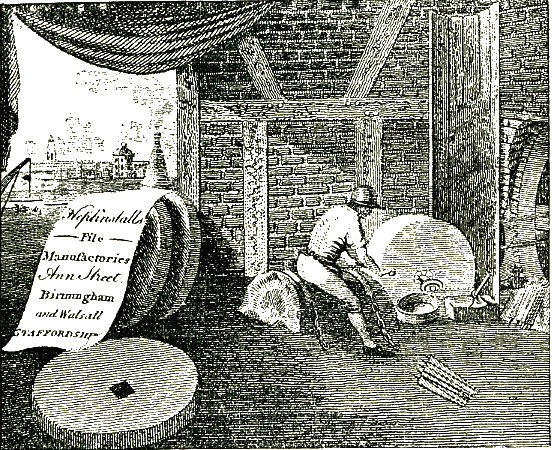
The etchings below were originally produced in 1800, and were described as being part of Heptinstall's 'Mill for Grinding Files', the etching produced 'by P Rothwell after a drawing by T Hollins of men making files'.*

Heptinstall's file manufactory was probably Ann Street's longest standing business, it was situated behind the small house (left) at number 27 (before number changes it was 26), the family living in this original dwelling house with the manufactory buildings being built in what had originally been the garden behind. It was, in part, this ability to build onto the properties that helped the industries thrive, businesses could extend from the houses that people lived in, and properties could be purchased with land attached with the idea to build a manufactory. John Heptinstall began his business in the mid 1700s in Walsall, and his son Joseph had expanded the business in Birmingham's Ann Street in the 1780s or 90s.*  The site was probably chosen because it had a water supply (possibly only a stream, but now gone), which was used to power some of the machinery (see bottom image below), and this water supply is mentioned in 1796 when a neighbour is requested by their landlord to 'repair [...] the water courses'.*

Unlike descriptions of dark and stuffy work-places, the workshop
(top image below) seems flooded with light by the many windows that would have also allowed a good flow of air. You can see the employees at work at their seperate benches, as well as both water and hand powered file grinders in use, which shows some of the seperate processes in making the files. There is a suggestion of a friendly work environment as well, the men are not all with their heads down, some are raised as if in conversation. This atmosphere is asserted when James Pool, an employee of 40 years, had to travel to London in 1838 to defend his friend, Samuel Phipps, accused of stealing; as his 'shopmates' helped to pay some of his travel expenses, though it is not mentioned that his master paid anything towards the trip.*

Inside the Manufactory

The inside of Heptinstall's file manufactory taken from Bisset's directory
of 1808. Original drawing by Thomas Hollins. 

The water mill powering the equipment. Files can be seen on the floor.
Original drawing by Thomas Hollins.  

The business had also been known as Heptintall and Parker's (William Parker being John Heptinstall's son-in-law), but in the early 1820s, when Joseph Heptinstall died and his wife Ann married William Lawledge, the business became known as Heptinstall and Lawledge's. The business remained on the same site in Ann Street till the whole part of that street was demolished in the 1870s for the new Council House to be built. The file business at this time moved to new premises.

* References on request.Birmingham History

Tour of Lost Birmingham Nᵒ.8: Birmingham's 'Old Curiosity Shop' (Ann Street & Congreve Street)

Circa 1740s-1874


~Reproduction from the 1870s of John Allin’s business (run from c. 1785-1813), made by his great-grandson Clement Selkirk Jones, on the corner of Ann Street (to the right) and Congreve Street (left). The building on the far right next to the castellated shop is the White Lion public house. The birds in the first floor window were taxidermies and part of a cabinet of curiosities.~

In the middle of Victoria Square, just behind where the statue of Queen Victoria stands, stood an eccentric little shop. They say an Englishman’s home is his castle, and the house that stood here, on the corner of Ann Street and Congreve Street, with its castellated top and tower, topped with the union jack, is definitely John Allin’s castle. It is likely that Allin’s father (or grandfather) built the property, as the family owned it and the three buildings next to it up Ann Street, but it was probably initially only a dwelling house. Allin usually flew the union jack from the roof of his shop and the premises became known simply as ‘The Flag’, and it seems that John was quite a patriot as he also named one of his daughters Caroline Britannia. Allin was a tailor, appearing first in trade directories in 1785 as a habit maker, but he imaginatively developed the business by diversifying his products along with creatively promoting the business.

In 1803 he produced a booklet advertising his shop in a series of poems. These show that as well as new and second hand clothes, hats, linen and hosiery he also sold toys for children, puzzling cards, amusing cards and spelling books, art materials, sheet music and instruments, stationary and educational material, maps and travel charts and medicines including an amazing ‘cure all’ balm. He might also play his clarinet whilst you were perusing in his shop. And this was not all; he would soak your feet to clear them of corns, and pull your rotten teeth! The Latin phrase that is written on the shop in the advert (above) is ‘Multum in Parvo’ which means ‘much in little’, or ‘much in a small place’, which could not be truer. You can just imagine browsing through the shop, which would be jam-packed with all number of surprising objects (click here to view some possible items); and then of course you could go upstairs for a shilling and look at the Cabinet of Curiosities.

The Cabinet consisted of all sorts of items that would have amazed those in the late 18th century as there was a definite culture of curiosity. Travel was prohibitively expensive and much of the world had yet to even be explored, so collections filled with natural history objects and items from around the globe were particularly popular. In Allin’s cabinet there were taxidermied animals; ‘birds of all kinds and beasts of rare creation’ and in the image above there are two birds on the window ledge of the first floor window. Also on display were ‘shells, medals [and] foreign coins from every nation’, and Allin had his own coin struck advertising his shop and his miniature panorama. The scenes in his panorama changed on alternate days, unlike the full scale panorama nearby on New Street, which changed, usually, monthly. He also boasts of a 'crooked telescope that views straight', a mirror that distorts the image and a model of the solar system. Visitors could also get their portraits sketched by a young employee.

~A close-up of the advert John Allin produced to promote his business showing Allin's window display. You can see the images of the fashionable dress of the time, clothes hung on pegs outside, and what could be mannequins inside the window. Examples of his clothes can also be seen hung on pegs outside.~

In the late 1800s Allin extended his business to larger premises in High Street and left the Ann Street shop in charge of his son William. When John died in 1813 William moved permanently to High Street, which took with it the name ‘The Flag’, but because the family owned the property in Ann Street they rented it out. The next known usage was as a chemist’s, run by Samuel Wilson Suffield.
Further information.
References available on request.
To find out more click on the labels below.
Any questions? Please use the comments section below.

Tour of Lost Birmingham Nᵒ.7: Bennett's Hill House and Gardens (Bennetts Hill and Ann Street (Colmore Row))

Top of Newhall Street, looking towards St. Philip's and Bennett's Hill House.
Probably by Samuel Lines Senior.

The sketch above is recorded in the archive as being made in 1828, though it may possibly be earlier that decade as the house on the far right was most likely taken down when Bennett's Hill was cut in the early 1820s. The three storey house just to the left is Bennett's Hill House, and the land that the road 'Bennett's Hill' was built on (as well as Waterloo Street) was attached to this house. The house was built in 1698 by the wealthy iron merchant, John Pemberton, with a lease for the land of 120 years, but it was his son, Thomas, that added the fashionable gardens to the house in the early 1730s. He initially added a walled garden and then planted long walks lined with trees (see map). A visitor to the house in 1755 described the gardens:
‘[They] consist of two parts, a handsome flower-garden about half an acre, square and walled in; neatly laid out, and as neatly kept. On the left hand stands a convenient summer-house, opposite to which is a gate opening to a long grass-walk, having a row of fan elms on each side, with borders of various kinds of plants and flowering shrubs; this walk parts the fruit and kitchen garden; at the end is another walk on the left hand, with rows of tall fir-trees, etc. The house stands on the highest ground of the town, over which the garden commands a good view of the country on that side for some miles.’*


Part of T. Underwood's copy of the 1731 south-west prospect of Birmingham
Bennett's Hill House is under the star, and the hill infront is Bennett's Hill

During this period the fashion for public walks and promenards expanded. Walks were sociable environments, a place for 'refined' people to meet similar friends and acquaintances, and a place to meet prospective spouses. St. Philip's church, which can be seen to the right of Bennett's Hill House in the image above, had a public walk attached to its grounds throughout the middle of the eighteenth century. The gardens and walks at Bennett's Hill House although private, show the 'walk' as a popular leisure pursuit of the wealthier classes of the time, and Pemberton's personal gardens asserted his personal wealth and pre-eminence within the town. They would have been enjoyed by the Pemberton's and their wealthy friends and acquaintances.

About 15 years after the 1731 prospect was drawn, Thomas Pemberton must have felt that the rural ambience of his gardens was under threat by the growing town, as he added terms to the family's 120 year lease that the land could not be built on the the term of the lease. This meant that as the town grew up all around, Bennett's Hill became marooned from the rest of the countryside, and a green enclave in the bustle of Birmingham. Ann street which passed it leading to St. Philip's became known as Mount Pleasant, probably because it was such a pleasant walk from St. Philip's down to the newly developed middle-class areas of the town.  From 1794 to 1817 a hay market was held on the hill, and in 1805 a site at the bottom corner was negotiated for the building of Christ Church, a church with free pews for the poor. In 1818 the 120 year lease expired and the land could then be built on, and two new streets, Bennett's Hill and Waterloo Street were laid out across what had been the Pemberton gardens. The house itself remained until 1849.


Bennett's Hill House, shortly before demolition.

 NOTES
* References on request
Images courtesy of Birmingham Library and Archive Services

Tour of Lost Birmingham Nᵒ.5: Birmingham's First Infant School (Ann Street, now Colmore Row)


~Oil painting of the interior of the school (1855) by Alfred H. Green. On the wall you can see maps, a very large clock, and coats hung up neatly on hooks. Several lessons are being conducted with different groups, some children are daydreaming, but most seem enthralled in their seperate activites. When the school first opened visitors were so numerous wanting to see the running of the school (which would have been a novelty) visiting times had to be restricted. Outside the rear of the building was a playground, and a house for the Master and Mistress was also built. ~  

The story of Birmingham's first infant school began in August 1825 with the formation of Birmingham's Infant School Society. This group saw the benefits in forming an Infant School for the poorer classes, based on establishments already set up in London, and visited Spitalfields School to gain inspiration for their own venture. Although small scale schools had been run previously (as in the Sunday School rooms of St. Philip's), now a permanent site on Ann Street was chosen (near Harris's glass warehouse) and a design for the building drawn up by Thomas Rickman and Henry Hutchinson which was built by 1826.*

The undertaking was all part of the wider infant school movement of the 1820s which had grown out of the observation that many mothers of working class children were employed for long hours in the workshops and factories of many of the towns, leaving their children to fend for themselves. Joseph Corbett (born c. 1792), a man who worked his way up from humble beginnings, wrote of his own working mother;
She 'worked in a manufactory from a very early age. She was clever and industrious, and [...] was regarded as an excellent match for a working man. She was married early [and] became the mother of eleven children: I am the eldest. [...] She had children apace. As she recovered from her lying-in, so she went to work, the babe being brought to her at stated times to receive nourishment. As the family increased, so everything like comfort disappeared altogether. The power to make a home cheerful and comfortable was never given to her. [...] She made many efforts to obstain from shop work; but her pecuniary [monetary] necessities forced her back into the shop. [...] I have known her, after the close of a hard day's work, sit up nearly all night for several nights together washing and mending clothes. [...] [The] cold and hunger, and the innumerable sufferings of my childhood, crowd upon my mind and overpower me [...]'.

It was stories like this one that encouraged the wealthier to help these children that were affected by so many mothers needing to work. It was not all charity though, there was a fear factor involved as well, as Lynn Hollen Lees states; '[s]avage, uncontrolled children became central symbols of danger in the new urban, industrial society'.** Children were the next generation and their 'vices' would be passed down to the future (growing) generations, but so too could any virtues instilled in them. The school stated that it was proud of rescuing the children ‘from bad examples, and idle and vicious habits in the streets’, and providing ‘seminaries of early moral and religious instruction’.*

The school was run, like many infant schools across the country, by many members of the Society of Friends. Payment of 2d per week was required for attendance of the school, which took up to 200 children aged between two and six.* Lessons were often taught using pictures and letter frames, maths was also taught, but at this point, education was secondary; the Infant School Society itself stated ‘[t]he knowledge acquired by the children is, on its own account, comparatively of little importance, but the habits they acquire are invaluable’.* The school followed the published advise of the W. Wilson, vicar of Walthamstow, who had been writing on the subject of instruction in infant schools since at least 1825 (see external links, below).***

To raise funds in order to keep the school running, the Infant School Society had decided in 1825 to have an upper floor built to the premises and rent it out to the Lancastrian Girls School. There were probably two separate entrances for the two schools, the Infant School was at number 48 and the Ladies School above was classed as number 47. The lower floor was also rented out to Christ Church's Sunday School. By 1857 the Ladies School upstairs was still going strong, and was for the purpose of educating young working women who were employed for long hours, sometimes from 8am till 9 pm, in the manufatories. It offered morning classes, and to a lesser extent evening classes teaching reading, writing and household duties, geography was also introduced, and there was a decent collection of books on these subjects.* The school also organised days out to places such as Bewdley, this particular excursion planned and carried out by Charles and Mary Sturge, two of the school's supporters.*

NOTES
* References on request
** Lynn Hollen Lees, The Solidarities of Strangers: The English Poor Laws and the People, 1700-1848 (Cambridge University Press, 1998).
Books utilised.
Nanette Whitbread, The Evolution of the Nursery Infant School: A History and Nursery Education in Britain, 1800-1970 (London: Routledge and Kegan Paul Ltd, 1972).
External Links
***Book: A Manual of Instruction for Infant Schools by W. Wilson, click here.

To find out more click on the labels below.

The Works of Mr. Heptinstall and Lawledge


Accompaniment to the post on Heptinsall and Lawledge's file manufactory on Ann Street, here.