Showing posts with label Social Life and Entertainment. Show all posts

Victorian Photo Album: The Old Farrier's Arms (Lichfield Street)

Old Farrier's Arms, c. 1880s or 1890s.
Held by Birmingham Archive - WK/B11/1264.

The Old Farrier's Arms was a public house on Lichfield Street, a street which was removed as part of the Corporation Street development, completed in 1903. The buildings were constructed in the eighteenth century, and the pub probably opened in the 1840s. 

Tour of Lost Birmingham Nᵒ.53: Freeth's Coffee House & the Society Feasts (Bell Street)


Freeth's Coffee House was a tavern (more formally known as the Leicester Arms) on Bell Street, a lost street which would have stood under the complex of the new Bull Ring Shopping Centre. It was run by John Freeth (sometimes John Free), a local poet and political commentator, often known as Poet Freeth and printing publications such as The Political Songster. As with many coffee houses in the eighteenth-century, it was a meeting place, not just of people, but of ideas. Most well-known are the meetings of the Jacobin Club, a group of political radicals including James Bisset (toy-maker and museum keeper) and James Sketchley (printer and auctioneer). In his obituary in 1808 it was noted that Freeth would sing his poems and 'delight a large company with original songs, composed from subjects of a public nature, replete with wit and humour'.

The pub was the site of a number of dinners where the radical politics and current affairs of the day could be discussed. The call to these feasts was frequently through a few lines of poetry, printed in letterpress onto small cards. Here are some examples:

Click on the cards to enlarge.


Poet Freeth (John Freeth).
1730-1808.

Tour of Lost Birmingham Nᵒ.52: The Swan Hotel in Pictures (High Street)

Swan Hotel in 1829.

The Swan Hotel was a large and dominant coaching inn on the High Street throughout the eighteenth-century and before. According to Joseph Hill it was an ancient tavern, the land of which stretching across the corner of High and New Streets, and belonged to a family called Rastell during the reign of Henry VIII. Between 1666 and 1688 the landlord of the Swan was Edward Crank, who demolished the old tavern, and built another set back from the street, with a large yard in front for carriages, and erected a row of five smart town houses along the street (seen on the left of the trade card, above).* The Swan was a haunt of Samuel Johnson, who wrote in 1755 'I was extremely pleased to find that you have not forgotten your old friend, who yet recollects the evenings which we have passed together at Warren's and the Swan'. Johnson resided in Birmingham in the early 1730s with Edmund Hector (to whom he writes above) at Thomas Warren's bookshop, which situated opposite the Swan at that time, as Warren's shop moved about.

Contemporary colouring of the 1829 card.

In the 1730s, as the notice below announces, you could catch a stage-coach to London at the Swan at six on a Monday morning, and return 'if God permit' on the Saturday. Take a journey on the Birmingham to London stage-coach here.


A map of the Swan Hotel was produced for a sale of the property in 1836. Although the hotel survived after this date, many of the extended parts of the property, such as the stables on Worcester Street, were being sold in different lots. The railway came to Birmingham in 1838 with the opening of Curzon Street Station, and whether prospective buyers would have been aware of the impact of the looming rail network, this was the end of an era for coaching inns like the Swan.

Held at Birmingham Archive.

The 'Coach Office', which can be seen in green on the map (Lot 1) on New Street, is depicted in the image belowThe street on the right of 'W. JONES', the trunk manufacturer, was Worcester Street, and when the Rotunda was built, this became Worcester Passage, which has now gone itself, but was covered and cut underneath the Rotunda building.

New Street (left) at the corner of Worcester Street (right), c. 1840.
By Thomas Underwood, held at Birmingham Archive.

A later map of the Swan, from the 1850s, shows that the grand open entrance, where the coaches would turn (as seen in the 1820s trade card), had been built up with new shops, and the hotel itself had been limited to the site behind the New Street Coach Office.

1850s map showing the Swan Hotel.

The Twentieth Century Swan
The hotel survived until the late 1950s, but was demolished before 1961 to make way for the new Rotunda. The photos below were taken in 1932 by William A. Clark (all held at Birmingham Archive).

The swan over the door. 
The entrance door with the swan over, looking up
Swan Alley. Note Fred Burn on the right.
Poor image of the alley from the other direction. Not taken by Clark.
Landing of the Swan Hotel.

~ FINIS ~

Swan atop the left-hand building of the Hotel in 1800.
From Bisset's directory.

Paper Remnants: Your Invitation to the French Revolution Dinner (1791)


Dear Reader,

We would like to invite you to a Grand Dinner being held at Dadley's Hotel on Temple Row on July 14th to celebrate the second anniversary of Revolution in France. We aim to promote 'equal government' and a 'free intercourse' in promoting the 'Rights of Mankind'. If you are 'disposed to join the intended temperate festivity, [it] is desired [that you] leave [your] name at the bar of the Hotel, where tickets may be had at five shillings each, including a bottle of wine'. The dinner will commence at three o'clock and we expect near 100 gentlemen to attend, including, we have been advised, Dr. Priestley.

Yesterday Aris's Birmingham Gazette, printed, as advised, the announcement of our plans to dine (see below). There has been a little concern that attached to this advertisement the paper have stated that they will publish the names of the diners, seemingly to stir up animosity towards our gathering. If you are 'any friend of freedom' be not moved by this act, but although this will not subvert our celebration we propose to make our first toasts to 'The King and Constitution' and 'The Prince of Wales'. We are certain that the dinner will pass with no trouble.


Your sincerely,
J. D.

This is part of a series of posts about the Priestley Riots which took place in Birmingham from 14th to 17th July 1791; and this dinner was a significant spark. Dr. Priestley, after advice from friends, did not attend the dinner in the end, but this did not quash the angry mobs. Click here to see all posts about the riots and Joseph Priestley.

Tour of Lost Birmingham Nᵒ.42: The Birmingham Library & a Ticket to Knowledge (Union Street)


Leading up to the anniversary of the Priestley Riots, which occurred in Birmingham from 14th July to 17th July 1791, an exploration of the Birmingham Library in which Dr. Joseph Priestley was involved.

The Birmingham Library was not the first in the town, but was the first that opened up the world of knowledge to a wider section of society. The establishment was set up in 1779 by 19 men, all but one of whom were religious Dissenters, already open to inquiry. To join the library members paid a guinea (21 shillings), and then, from 1781, paid a further eight shillings per year, so this was by no means learning for all, but it paved the way for the advancement of learning through the classes.**

When Joseph Priestley came to Birmingham in 1780 the library found an enthusiastic supporter, one who had competently helped build other such institutions already, and so its management was entrusted to him. The institution had great hopes for a freedom of learning, the initial principal put forward by Priestley being that 'this institution can never answer the purpose of party, civil or religious, but, on the contrary, may be expected to promote a spirit of liberality and friendship among all classes of men without distinction'.* He believed that controversial literature, even his own, should not be included among the books. By 1786 the library committee contained a mix of the original Dissenter groups, as well as a higher proportion from the Anglican church, but surprisingly it was the latter who pushed to have Priestley's books included in the library. John Money believes this to be a purposeful 'manoeuvre' which 'produced predictable results. The acquisition of Priestley’s work was attributed not to the cabal on the committee but to the Doctor [Priestley] himself and his friends, and it was followed by a series of ostentatious Anglican protests and resignations'.*** After this Priestley promoted that all books, including both his own and those that contradicted them, should be included. But differing opinions caused tension, and eventually rupture within the organisation; in 1794, the library split into two groups becoming the Old Library, which eventually moved to Union Street, and the New Library, which became located in Cannon Street.*


In 1796 it was decided that the library needed a purpose built building for its expanding collection, and William Hollins was chosen to design and build the structure, left (I will explore the architecture of the building in a separate post). The building opened late in 1797, and the rent of the land was paid for by a Tontine Deed drawn up at the beginning of 1798. Tontine meant that a number of subscribers would pay a subscription out of which the rent would be taken out and the excess reserved. Each subscriber could nominate either themselves or another individual to the Tontine and whoever survived the rest received the lump accumulated sum; this is why it was often very young children who were nominated. Nearly 180 individuals were nominated (with about 150 doing the nominating) for the library Tontine Deed (details and names of these can be seen here).

Above the library was carved 'AD MERCATURAM BONARTUM ARTIUM PROFECTUS, ET TIBI ET OMNIBUS DITESCES' translated as 'resorting to the mart of sciences, you will grow rich, both for yourself and others'. The library itself definitely grew and flourished; in 1784 it had owned about 900 books but in its new home in Union Street this rose to more like 7,000 by 1799.* The libraries that were established across many of the towns were a step towards providing education and learning to a wider section of the population. Among all the names nominated for the Tontine Deed, of people who lived in or near Birmingham, nearly a third were manufacturers, especially those in the button and metal trades, another third were merchants, one sixth were gentlemen and the other sixth were predominantly,what were deemed as, higher professions such as doctors, attorneys, bankers, artists and churchmen.* This was a move in the right direction in supplying learning to those who had been excluded from it previously.


ABOVE: Late Victorian Union Street, but still retaining its Georgian and Regency architecture. In 1845 the library had been extended to the left, as can be seen in the photograph.

NOTES
* References on request.
Other sources are this article and **British History Online.
*** John Money, Experience and Identity: Birmingham and the West Midlands 1760 - 1800


Seal from library card, above.

Paper Remnants: Curtius's Grand Cabinet of Curiosities (New Street, 1796)

Handbill for Curtius' Grand Cabinet of
Curiosities on New Street. 1796.
For a full size image see below.

Curtius's Grand Cabinet of Curiosities' had begun showing in London in 1795, but began touring the country from the beginning of 1796, arriving in Birmingham in the September. The Cabinet contained items from the collection of Phillippe Curtius, who had died in 1794. Curtius had been a physician who began producing anatomical models, before setting up in business making wax portraits. From the 1770s Curtius began training Marie Grosholtz (later to become Madame Tussaud), and on his death left his collection of waxworks to Marie. During the French Revolution, after a close encounter with the guillotine herself, Marie was employed to make death masks of the beheaded, including the King and Marie Antoinette. Amongst the collection shown at Birmingham was the head of the Governor of the Bastille as well as a model of the guillotine; all taking advantage of a morbid fascination in the events of the Revolution.  

Tour of Lost Birmingham Nᵒ.40: Love-days and Loveday Street

There aren't many Loveday Streets in the country, Birmingham seems to have one the only one (if you type "Loveday Street" into Google Maps it goes straight to Birmingham), which is surprising as the love-days were an ancient but not uncommon custom. The tradition of these days stretches back quite a bit further than the period this blog covers, but they were an important cultural event which may have reached into the early Georgian period. William Hutton, writing in 1782, noted that the land which Loveday Street had been built on was a croft** donated by a John Cooper*** in the late sixteenth century for use on love-days. A love-day was a Medieval practice for the settlement of disputes and differences through arbitration, and kept personal disputes between friends, neighbours and townspeople out of the courts. Shakespeare mentioned it as a day when 'quarrels die'.*

The meeting of those in disagreement could be arranged anywhere, but perhaps Birmingham was one of only a few places that had a particular place set for these meetings, which is why it has the rare recording of the event in one of its street names. It would be important to settle these quarrels as they developed, and the love-days would have helped to regulate social behaviour and bring peace in the community. With this in mind it seems likely that love-days would have been a regular occurrence. With the Birmingham archives closed at present I cannot delve deeper to see if there is any more information on this intriguing practice, but I can make some speculations.

Hutton mentioned that the land of the croft where the love-day was held was of about four acres, so we can only imagine that the love-day may have been more of an event than its descriptions as an arbitration of disputes allows for. It could be that the scene attracted large crowds, which is likely as disputes probably were not quick to be resolved and could have held some entertainment value. Or it could be that once disputes were settled there was some form of celebration to seal the deal, as it were. Chaucer's The Canterbury Tales hints at this, as the character of the Friar who arbitrates at love-days, is 'wanton and a merry' and 'a very festive man', he also 'arranged full many a marriage [o]f young women'.*4* This opens up the possibility for another aspect to the love-day, a more event based one, and the arranging full of marriages suggests that marriage contracts may also have been negotiated on love-days, which, on an agreement, could have resulted in some kind of festivity afterwards. Also, in 1339 in Oxford, a disagreement over the butcher's shambles led to the mayor holding a love-day where plentiful 'wine, oysters, herring, stockfish, plaice, lampreys, pickerels, eels and fruit' could all be had,* outlining more than just simple arbitration. The love-days could also have acted as more than just resolving disputes, but also as a formal piece of reconciliation, where appeasement could be given in a public place.

Whatever form the love-day took, those held in the Birmingham croft left their mark on the landscape of today, and Loveday Street is a reminder of this near forgotten custom.    

Part of Loveday Street built circa 1800. One of the few
groups of housing from this period still standing in the city.


NOTES
* References on request
** The croft was between Walmer Lane, St. Mary's Chapel and Steelhouse Lane.
*** This is the same John Cooper who was given leave to bait bulls as he pleased in the Bull Ring. Find out more here.
*4* Translation of Chaucer's The Canterbury Tales, see here.

Alternative Townscapes Nᵒ.1: The Town Hall That Wasn't

How the Town Hall might have looked if John Fallows had won the
competition to build. Fallows came 2nd in the competition.

GUEST ARTICLE: By Anthony Peers, author of the book Birmingham Town Hall, available to buy now. See below.

The Triennial Musical Festival of October 1834 was celebrated in a big way. Held every three years since the 1760s, the by now internationally renowned festival had had to be cancelled two years on the trot. After a five year wait this highly popular society event was eagerly anticipated. There was a sound reason for the postponement of the festival: It had taken much longer than originally anticipated to construct the new venue in which the evening concerts were to be performed. There had been much criticism in the press about the delays in the building process. Hampered by strikes, crippling budgetary constraints and challenging issues with stone procurement the project’s architects and their contractors had worked themselves to the bone, eventually succumbing, in spring 1834, to bankruptcy. That the necessary remaining works were undertaken in time to render the building fit to hold the October Festival was something of a miracle.

The fact is things could all have turned out even worse had the Streets Commissioners, the unelected body of townsmen who commissioned the building, not been quite so sharp in relation to the project funding. Although it appears that not one of them had any experience in building contracts, most members of the committee – which was charged with choosing the design for the Town Hall, appointing the architect and setting the budget – were in trade and thus well versed in striking a bargain. First up they held an architectural competition. Although their offering of £100 for the winner was far from generous, the competition for this prestigious project attracted as many as 70 entrants. Having eventually chosen their preferred design the Streets Commissioners more than got their money’s worth from the competition through asking the winning architects (for there were two of them, working in partnership) to amend their design to incorporate elements seen in some of the other submissions. Such sharp practice and tight-fistedness by the client continued through the course of the contract.

With the architects and the contractors all but ruined by the Streets Commissioners’ unflinching parsimony, it is all too easy to see these, the town’s forefathers, as the villains of the piece. However, these men were acting on behalf of the people. The funds required for the construction of the Town Hall had to be raised through a public rate - the budget had to be tight. From our early 21st Century perspective it is interesting to reflect on the thought that if the Town Hall had been commissioned by a less commercially savvy client the ‘pride of Birmingham’ would almost certainly never have been commissioned, let alone seen through to completion.

The architectural competition itself was fraught with potential pit-holes about which the Streets Commissioners successfully negotiated their way. One, a classic of such competitions, was the temptation to fall for the ‘too good to be true’ submission. Evidence that this ruse was tried on in the Town Hall competition can be observed in Birmingham’s Central Library where the full set of competition drawings, executed by the Birmingham based John Fallows, are archived (see below and top). Producing designs for an impressive and highly decorative building - which patently could not have been built within the specified budget - this architect chanced his arm, clearly hoping that the competition assessors would be so won over by his beautifully produced presentation drawings that they would disregard all other submissions. The Streets Commissioners’ native instincts won out : Comparing this impossibly grandiose design with the other (pared back) proposals, they smelled a rat – in no way would Fallows’ submission be realisable within the budget. Recognition of the fact that they were indeed mightily impressed with Fallows’ submission can be seen in the fact that this architect was awarded the second prize in the competition.

Interior of the un-built Town Hall designed by John Fallows

Had the Streets Commissioners fallen for Fallows’ enticing ruse it can only be imagined that the outcome would have been failure and disappointment. The process of constructing the Hansom and Welch designed Town Hall may have been accompanied by delays and disasters but the building was, eventually, completed. This magnificent temple of a building stands as a testament to the collective civic spirit of the people of Birmingham, the Streets Commissioners’ thrift and the ‘never-say-die’ graft and determination of its youthful architects.

Cover photo by James Davies/English Heritage
You can discover much more about the fascinating history of Birmingham Town Hall in my recently released book. Published by Lund Humphries, it is a hardback measuring 26.2 x 23.2 x 2.8 cm. The book’s 100,000 words are generously illustrated with nearly 300 images, the majority of which are reproduced in colour. The RRP is £30.00.

Buy on Amazon.

Fallows' submission drawings are courtesy of Birmingham Library and Archive Services.

Tour of Lost Birmingham Nᵒ.35: Art Experiences - Immersion and the Panorama (New Street)

Image of the Panorama on New Street (right) from a handbill advertising
a panoramic display of Constantinople, 1806. The church is Christ Church.
As town planning and the new forms of architectural design became embedded into the landscape of the city, the city itself became a thing to be observed; a scene, a skyline, an aesthetic entity. The panorama fed on the desire to observe the aesthetic beauty of the distant city, its displays contemplated cities from across the world, as well as battle scenes, and were designed to make the observer feel as if they were present in the place or event depicted. This was an early form of immersive art.

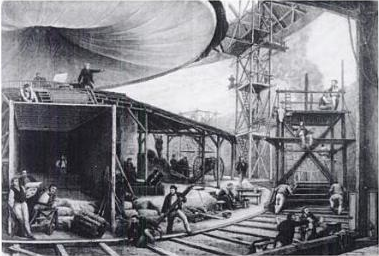
The panorama was designed to enhance the experience of immersion, see illustration below. From the moment you entered, (A), you were sent beneath the display (B) and entered it from below (C). You would then stand in the viewing platform (D), the barriers of which limited your movement to within a particular area. Above was an umbrella-like device (E) which, along with the barriers, limited your lines of sight (F). This would mean that all that was visible were the walls of the panorama (H), painted 360 degrees around with the scene (on cloth), and part of the floor (G) that would also be decorated in a relevant way, for example, in a battle scene there may be models of fallen horses.

Conjectural view of the interior of Birmingham's panorama. Details above.

In October 1798, probably what was a travelling panorama, had been erected on Union Street. It depicted the Grand Fleet 'under sail, off the Isle of Wight' escaping from the 98 gun 'Boyne Man of War', which was in flames, and all actual size. The event was described as to depict 'the Hurry and Bustle of various Boats, and the eager Anxiety in the Countenances of the Seamen' and formed 'at once a Scene of Terror and Sublimity'. And all for one shilling. The whole experience was designed to immerse you in a spacial narrative, and give you the visual and emotional sensations of being elsewhere, in this instance, at sea during a naval battle. There were also others that were intrigued by the panorama, a local entrepreneurial tailor produced a miniature version from about 1796 where the scenes changed every other day, and produced a coin to advertise it along with his 'Grand Exhibition' of other curiosities (below, and here), and which was on display well into the nineteenth century.


The Panorama on New Street (top image) opened in 1804 to the showing of a 'View of Ramsgate', depicting 'the Embarkation of Troops, both Horse and Foot, taken on the Spot at the Time' and including 'a very great Extent of Sea, and Ships in every Direction [...] with a distant View of the Coast of France [...]'.* The building had been opened by the Barker's, Robert Barker had been responsible for the invention of the Panorama, patented in 1787,* and was in business with his equally talented son Henry Aston Barker. Robert had coined the word 'panorama'  from the Greek meaning an 'all-embracing view'.* The Barker's probably opened provincial Panoramas as a way to create a network across the country to tour their work, thus getting the greatest income for their output. It would be interesting to discover if Birmingham was on a route that the panoramic paintings would take across the country once produced.

Example of the interior of a Panorama displaying a
scene of London.

Robert Barker died in 1806 and in 1807 a Panoramic view of Edinburgh was displayed in Birmingham, perhaps as a tribute to Robert Barker's favourite Scottish town, and the one that had inspired his original idea. After his father's death Henry took over the business and continued to travel and produce panoramas, but the original panoramic views that had been painted through Robert's lifetime still toured the country. His view of the Battle of Waterloo came to Birmingham in August 1817, but this was the last known panorama to be shown in the building. Towards the end of its life the New Street Panorama came under some competition from another built nearby at Baskerville Place by S. J. Richardson. How much of a threat this establishment was we do not know, but the expense of maintaining the Panorama would have been very high. The painted scenes were of an immense size, which would all be hand painted, and it would have taken a great deal of time installing them into the building with all the additional props as well (see below). There was also competition from moving panoramas, which were shown in Birmingham's Theatre Royal at about this time. Outside of Birmingham the display of panoramas continued successfully throughout the nineteenth century, especially in Europe's capitals.


A Panorama being installed in the 1840s. 

When William Hutton visited the Panorama he stated that it was 'an entertainment that, I believe, no man who ever saw repented a lost shilling', and throughout its life the Birmingham Panorama had always cost a shilling to enter. This was the same price as a visit to the Theatre with a seat in the gallery, the cheapest seats, and would be within the range of all but the very poorest, bearing in mind that an artisans wage could be 20 to 30 shillings a week depending on their skill. Viewing depended on good light, so the building was usually open between nine or ten in the morning till dusk, it was lit inside too, and in the winter would be heated. Sometimes, such as at the scene of the Siege of Flushing in 1813, talks would be given from the platform by those who had been present at the time of the events, to give an even greater sense of place, and for those involved to feel that they were re-living the events. This suggests that the experience of visiting the Panorama was one of showmanship, where commentary would be given whilst you viewed. Through the years it operated the inhabitants of Birmingham would have been able to visit Paris, ancient and modern Rome, Constantinople, the burning of Moscow, Glasgow, as well as a number of battle scenes. After the Panorama's closure the building was used for a time by auctioneers Robins Brothers* before being taken over by the Society of Arts as a gallery in 1822 and then rebuilt in 1828.

NOTES
* References on request fl. 6. LF56.1 GRE, #18 1999

Paper Remnants: Panorama Handbill - A View of Edinburgh (New Street Panorama, 1807)


Printed in 1807 for the showing of the Edinburgh panorama on Birmingham's New Street. Original in Birmingham Archive. Find out about the Panorama here.

Tour of Lost Birmingham Nᵒ.33: A Visit to the Brand New Theatre (New Street, 1794)

Sadler's Wells Theatre in London in 1807. The Theatre in Birmingham
used this theatre's scene painter, Thomas Greenwood, for their own
painted curtain and scenery. The colour-scheme for the Birmingham
Theatre was deep pink, crimson and apple green and it had two tiers
rather than the three of Sadler's Wells. 

After the Theatre on New Street was burnt down in 1792 George Saunders of London was employed in its rebuilding, with the help of a 29 year old William Hollins, who later went on to build a number of Birmingham's most prominent buildings himself. The facade that had been designed by Samuel Wyatt in about 1780 had survived the fire, so Saunders rebuilt the main building, which re-opened in May 1794.
We can take a little look inside:
'Upon entering the House, the eye is struck with its capaciousness, elegence and richness. Its form, for the audience part of the Theatre, is semi-circular to the box on either side of the stage, which, as far as each extends, takes the line of a circle reversed. Two tier of Sixteen Boxes surround the House; they are decorated with many white enamelled Iron Columns, representing a Bundle of Reeds, the fillet that encircles and binds them, and the vases and capitals, being richly gilt. From above the columns project elegant brackets, which suspend the brilliant cut glass chandeliers [of which there were twenty]. The colour of the inside of the Boxes is a deep pink, the covering of the seats crimson, and the cushions apple green.'*
There were also 'elegant ornaments painted on the parapets in Front of the Boxes' and a 'magnificent Ceiling in the form of a Fan, adorned with antique figures and ornaments corresponding with the decoration of the Boxes, and a painted Curtain with stage scenery by Messrs. Greenwood and Dixon'.** In the new building the boxes (costing 4 shillings), gallery (1 shilling) and pits (2 shillings) were all accessed by entrances on seperate streets, which meant that visitors did not have to ascend or descend steps on arriving at or departing the theatre; an early thought to safety. Visitors to the boxes were attended to in a custom built saloon, and all areas could access the ballroom which stood at the front of the building, and where refreshments would be served. There were also The Shakespeare Rooms, for alcoholic drinks, and a coffee house, which were both run by Mr. Wilday.

NOTES
* References on request
**Thomas Greenwood was a scene painter who had worked at Drury Lane Theatre and, at the time of working on Birmingham's theatre, at the Sadler's Wells in London. Find out more about the Sadler's Wells theatre here.

Tour of Lost Birmingham Nᵒ.32: The Bull Ring & the Spectacle of Bull Baiting (High Street)

Drawing by Samuel Lines Senior. Held by Birmingham Museum and Art Gallery.

The Georgian Bull Ring (part of Birmingham's market area, now a shopping centre) would have been a very crowded and muddled hodge-podge of buildings, many of which encroached over the roads and left scarce room for pedestrians, let alone carts. The Shambles was a group of butcher's shops, which can be seen on the right of the image, above, and filled the area leading to St. Martin's church (left). As the town grew this traditional market place became too small and crowded, and so, from 1801, the Bull Ring was cleared of many of the obstructions, including the Shambles. This was done by the Street Commissioners who were in charge of maintaining the town, and especially in keeping the markets running smoothly.

At the time when this whole area was cleared, a small metal ring was removed from the middle of the ground between the Shambles and St. Martin's church. These rings, that were found in other towns too (Ludlow still has a street called Bull Ring), were 'an iron ring that sticketh in the corne market, to which the bulles that are yearelie bated be usallie tied',* and it was one of these rings that had given the Bull Ring its name. Bull-baiting was a popular recreation in markets, dating back to origins perhaps in the 12th century. The bull would be attached to the ring and dogs would be set on it, this was thought to improve the quality of the meat and make it 'softer in digestion',* as well as provide 'sport' for the spectators in the market. In fact, there is evidence that bull baiting was developed not as an entertainment, but solely as the way to slaughter the meat of older bulls, which would often be tough, and was common practice for butchers.** It is no surprise that the Birmingham 'bull ring' was placed by the butcher's shambles, as it would be a short journey from the killed bull to having the meat then placed on sale.

There is very little evidence of the tradition of bull baiting in Birmingham's market, but if bull baiting began less as a sport and more as the common process of slaughter, this is not so surprising. The area known as the Bull Ring was first shown on the 1778 map, before that (1750 map) it was just the Shambles and the corn market recorded, so it could be that the ring was a late addition to the market area and the practice relatively short lived within the market place. Equally so, the actual ring could have been in place for many, many years, but the area only became known as the 'Bull Ring' at this time.

There are some mentions of bull baiting in the records. In the 1760s a man called John Cooper was given permission to bait a bull in the Bull Ring 'whenever he pleased' by the Lord of the Manor,* probably for the supply of baited meat, but Showell tells us that bull baiting was completely prohibited in Birmingham in 1773.* There were still attempts, though, to bait in and around the town in 1777:
'There have been great Disturbances in the Hamlets of Deritend, Erdington, Saltley, and other Places, in or near this town [Birmingham], occasioned by Bull-baiting, and other Methods made use of to collect disorderly People together, to the great Annoyance of the Publick Peace'.**
The reason for banning bull baiting at this time was less about any mistreatment of the animal and more about unruly groups of people and the 'unsanctioned use of the streets'.**

It was not till the early 1800s that the practice came under any real criticism with regards to cruelty to the animals involved. Although Birmingham was free from bull baiting by this time, many surrounding areas, especially in the Black Country, still maintained a number of blood 'sports', and complaints were issued in the Birmingham Gazette about the custom:
18 March 1828


The 'sport' was also thought to cause drunkeness, and alongside a blood-lust, consequently could lead to violence through fighting and domestic abuse, which are hinted at in the article. Bull baiting was finally banned by law in 1835, though the last known instance in England was in 1838 near Birmingham Heath on the outskirts of the town.*

Bear baiting in a provincial town, 1749. The bear is being
taunted and hit with wheel-barrows.


NOTES
Top image drawn by Samuel Lines Senior
* References on request
** Emma Griffin, England's Revelry: A History of Popular Sports and Pastimes, 1660-1830.

Newspaper Clippings: Preparing for Christmas in 1827


From ARIS'S BIRMINGHAM GAZETTE on 17 December 1827.
Follow the links to discover the places where these Christmas events were happening.
Leading up to Christmas in Regency Birmingham, what were the wealthier inhabitants up to? They may have visited the Mechanical Theatre, at the Theatre Royal.


Or perhaps they went to one of the seasonal concerts or balls. The Royal Hotel had one of the finest concert rooms of the town, but only allowed the elite to attend. If inhabitants fancied travelling further afield then there was much fun to be had at the winter balls in Lichfield and Meriden.


Christmas has always been a time for good food, and a couple of adverts depict the kind of food stuffs being bought leading up to the Christmas period, in Bull Street and the Bull Ring. Fruit and spices were particularly popular; cinnamon, nutmeg and cloves were essential to the baking of the period, and still an expensive commodity.