Showing posts with label Transfer Printing. Show all posts

Lost Trades Nᵒ.9: Robert Hancock (c. 1731-1817), Birmingham, Transfer Printing, & the Worcestershire Potteries

1: Mezzotint print of Robert Hancock by Hancock, c. 1770.
British Museum Collection.

Robert Hancock worked as an engraver throughout his life, and produced engravings for paper prints, as well as those for transfer printing onto enamel and porcelain. He moved all over the Midlands and was important to many areas printing history, mainly in this contribution to transfer printing. Birmingham, for example, was highly influential in the innovation of transfer printing onto enamel in the early 1750s and Hancock was significant in this. He then moved to the Worcestershire potteries and innovated the process further on porcelain.

Enamel (& Metal) Things: A Pair of Flowery Wall Plaques for the First Day of Spring (c. 1760s)

Private collection.

Object focus: A pair of enamelled wall plaques in gilt metal frames, depicting flowers in urns, transfer printed and over-painted, c. 1760s. Probably made in Birmingham or the Black Country.

Enamelling was conducted in Bilston and Wednesbury as well as Birmingham, so these plaques may have been name in any of these towns. They have been transfer printed, a process new to this period, and over-painted in vibrant enamel colours. Several butterflies flutter around the flowers.

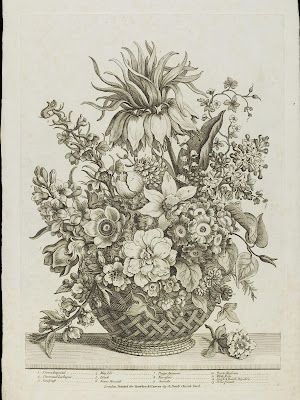
The artisans making these decorative goods often took inspiration, or directly copied, from a range of books designed for engravers, enamellers, japanners, and other craftspeople; for ladies' needlework; as well as the general interest for the public. They were usually published in sets of six, such as the example below:

A Select Collection of the most beautiful Flowers, Drawn after Nature, after Heckel (1795, reprint from c. 1750-1770 prints).
Held at the V&A. One of a set of six.


See more prints, below:

Birmingham Button Box: Country Life in Transfer Printed Enamel (c. 1760s)

Object Focus: Four buttons from what would have been a larger set of gentlemen's buttons depicting hunting scenes. Above a gentleman leans on his horse with his hunting dogs around, and below are images of the hunt.  

Enamel Boxes: Le Panier Misterieux Enamel Box (c. 1750s or 1760s)

Lid of box depicting Le Panier Misterieux.
Wolverhampton Museum.
EM48

Object Focus: Box transfer-printed in red, probably made in Birmingham or Bilston between about 1753 and 1765.

Enamel Boxes: Les Fêtes Vénetiennes Bonbonnière (c. 1751)

Bonbonnière with enamel lid and gilt copper basket, c. 1748-1756.
Wolverhampton Museum (EM131).

Object Focus: This enamel bonbonnière (sweet box) is considered to be made in Birmingham in the very early stages of transfer-printing being developed in the town (more on transfer printing here). The transfer-print is in red and it has been over-painted in orange and purple, suggesting the transfer-print was of a poorer quality due to it still being in a period of development.

Enamel Menagerie Nᵒ.9: Squirrel Boxes

Enamel squirrel bonbonnière, c. 1765-70.
Sold at Bonham's in 2011 for £2,250. Originally from
the Mort & Moira Lesser collection. (6 cm high)

An enamelled red squirrel sitting upright and nibbling at a nut, with additional nuts depicted in the grass (see below). It was probably made in Birmingham, Bilston or Wednesbury and was part of range of creatures produced between in about the 1760s and 1770s, see the rest of the enamel menagerie.

Enamel Menagerie Nᵒ.8: Swan Boxes


Enamel swan bonbonnière, c. 1760-1770.
Privately sold (English Enamel Company).


This swan bonbonnière (sweet box) adds another form to the range of animals produced in enamelled copper boxes in the later eighteenth century, made in the Birmingham, Bilston or Wednesbury areas. The swan is simply painted with festoons of grey dots forming the plumage on the body and more intricately painted wing feathers in three kinds. Other animals were made sitting on grassy mounds, such as frogs and tigers. The base of this swan box is below.


Base of swan bonbonnière, above.

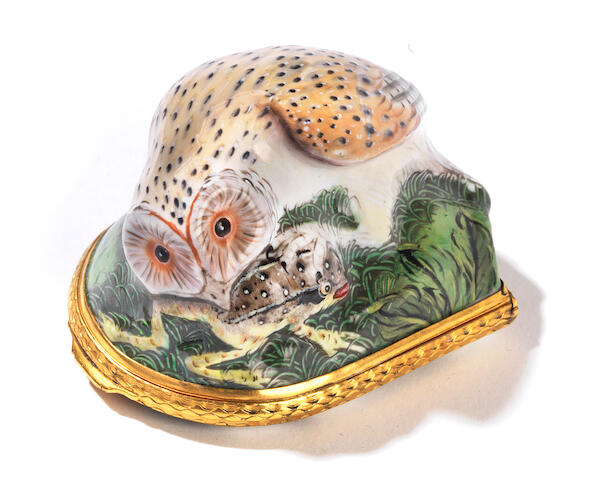
Enamel Menagerie Nᵒ.2: Owl (and Unfortunate Frog) Boxes

A fine Birmingham or South Staffordshire enamel bonbonnière, circa 1760
Box 1: Snuff-box or bonbonnière, c. 1760. Sold at Bonhams. 
Originally from the Mort & Moira Lesser collection.

Previously I wrote about enamelled frog boxes, but here, I'm afraid, it is bad news for the unfortunate frog. He's owl supper!

Many of these animal-shaped boxes were made between about 1760 and 1780 in Birmingham or South Staffordshire, and depict all kinds of creatures, both exotic and more familiar. They were made using a shaped copper base which was then enamelled and mounted with a decorative rim. The copper shape of this owl must have been particularly difficult to form with his raised wing.

Base of owl bonbonnière, above. Transfer printed and overpainted.

The First Known Transfer Printed Enamel (c. 1750) & the Development of Transfer Printing


Success to the British Fisheries, 1750-51, probably Birmingham.
12.4 cm wide, 9.8 cm high held by the V&A.

This is the earliest known example of the transfer-printing process on enamel. The transfer-print is in red, on white enamel with a copper base, and framed in a gilt metal frame.

As an early example, the process hasn’t been mastered yet, and the lines were a little powdery and needed to be over-painted in places. The plaque is held by the V&A, who state that it 'commemorates the foundation by Royal Charter of the "Free British Fishery Society" or British Herring Fishery Company, on 25 October 1750'. The design is similar to other Birmingham enamels of this period, including the picturing of swans, which was a re-used motif on Birmingham enamels.

Engravers known to be working on producing prints to transfer onto enamel at this time were John Brooks and Robert Hancock.*

Development of Transfer Printing
Enamel plaque of the King of Prussia by J. Sadler of Liverpool, c. 1758.
Sold at Bonham's in 2009 for £1,920.

Transfer printing was the process of applying copperplate prints to the surface of enamel. It was possibly developed in Liverpool in about 1749, as was claimed by two engravers of the town, John Sadler and Guy Green.*14* Whether this was true or not, John Sadler produced a variety of transfer printed enamels till about the 1770s (image above), as well as prints on earthenware.

The earliest known surviving transfer printed enamel (above) is generally thought to have been made in Birmingham. In 1751 a Birmingham-based engraver, John Brooks, attempted to take out a patent for the process but a year later apologised in the local newspaper, Aris's Birmingham Gazette, that 'he never intended to encourage a Monopoly in that Branch of the Trade', suggesting that it was not his invention and was already being practiced in Birmingham.*15* Brooks later moved to London and formed a partnership with Stephen Theodore Jansen and Henry Delamain in setting up the Battersea enamel manufactory producing printed enamels.*16

Base of snuff-box with transfer print of owl and birds, c. 1758-60.
Probably Birmingham made, see more on this print here.


The trade continued in Birmingham under several makers, and one of the largest enamel makers was John Taylor, possibly employing up to 200 people across the enamelling and gilding trades. As well a painting enamel boxes, Taylor's manufactory produced transfer-printed enamel. Lady Shelburne visited the enamelling part of Taylor's factory in 1766 and described the transfer printing of enamel:

At Mr. Taylor's we met again, and he made and enamel'd a landscape on the top of a box before us, which he afterwards gave me as a curiosity from my having seen it done. The method of doing it is this: a stamping instrument managed only by one woman first impresses the picture on paper, which paper is then laid even upon a piece of white enamel and rubbed hard with a knife or instrument like it, till it is marked upon the box. Then there is spread over it with a brush some metallic colour reduced to a fine powder which adheres to the moist part, and, by putting it afterwards into an oven for a few minutes, the whole is completed by fixing the colour.*17*

The Battersea factory in London was open between 1753 and 1756. Although transfer printing had been conducted in Birmingham for at least two years already, many of the early Birmingham transfer prints were overpainted, so Battersea goods were the first time London shoppers saw and bought transfer-printed enamels. Horace Walpole wrote to his friend Richard Bentley in 1755 sending him ‘trifling snuff box’ which he sent to a friend as a ‘sample of the new manufacture at Battersea, which is done with copper-plates' and Walpole had his own ‘cabinet of enamels’ where he displayed intriguing samples of the manufacture.*18* After the closure of the Battersea factory in 1756, they advertised their remaining stock for sale, which included:

A quantity of beautiful enamel, coloured and uncoloured, […] and never yet exhibited to the public view, consisting of snuff boxes of all sizes, of great variety of patterns, […], very proper ornaments for the cabinets of the curious, bottle-tickets, with chains for all sorts of liquors and of different subjects, watch-cases, tooth-pick-cases, coat and sleeve buttons and other curiosities.*19*

Bottle ticket, probably Battersea made 1753-1756.
Sold at Bonhams in 2019 for £956.


Notes
* The plaque (top image) is sometimes claimed to have been designed by the London-based engraver Louis Philippe Boitard, but this is not currently evidenced. Victorian and early 1900s scholars thought that only London produced these goods, which has since been disproved. See Susan Benjamin, English Enamel Boxes (1978).

Lost Trades: The Engraved Work of Thomas Rothwell (1740-1807)


Thomas Rothwell (1740-1807) was a British engraver working in England and Wales in the late eighteenth century, whose skills were utilised in both the book trade and in the making of enameled and pottery goods. He was born in Liverpool, and began working as an enamel painter,* later, in the early 1760s, working for Humphrey Palmer in Hanley, Staffordshire, (a rival of Josiah Wedgwood) painting enamel as well as engraving designs for the printed creamware being produced by Palmer.

Teapot with design by T. Rothwell "Delin & Sculp.",
meaning that he drew the design and engraved it.
Produced in the mid 1760s, maker unknown.
A detail of the lid is at the top of the post.

In 1769 Rothwell produced the copper plate engravings for a publication of A Pilgrim's Progress published in Wolverhampton by Thomas Smith, and by 1770 was in Birmingham; this time engraving plates for printer Christopher Earl. The work printed in Birmingham was The Genuine Works of Flavius Josephus, and Rothwell produced engravings taken from drawings produced by Birmingham born painter James Millar.


In 1774 Rothwell had set up a partnership with a Mr. Hick's on Birmingham's Church Street, but the next reference to him is not till 1782 where he takes on an apprentice engraver called Henry Allden in Birmingham;** he appears in Birmingham trade directories throughout the 1780s till 1788.

By 1790 he was in Swansea, producing topographical views of the city, as well as working within the Swansea ceramics trade, especially producing commemorative items.

Swansea commemorative ceramics.
Attributed to Rothwell. 

In 1794 he was in London (or possibly his son, Peter, was), producing engraved plated for books, including portraits of famous people and notable London buildings. It seems that he spent the next few years between London and Birmingham; in 1798 he took on an apprentice engraver (Horace W. Fell) in Birmingham and in 1799 his copper plate engravings were published in London in The Cabinet of Arts. He was now nearly 60 years of age.

The Admiralty, from The Cabinet of Arts, 1799.

Rothwell was back in Birmingham in about 1803, and died in the town in 1807, being buried in St. Mary's Church on January 19th.


Transfer Printed Enamels: Overpainted Parrot & Fruit (c. 1749-1755), probably Robert Hancock

Enamel plaque or box lid with parrot, c. 1749-1755.
Transfer printed and overpainted.
Wolverhampton Museum.

This object is part of Birmingham's history of transfer printing onto enamel. It was produced by making a copperplate engraving which was then "transferred" onto the white enamel, and it has then been overpainted with bright enamel colours. The long-tailed Macaw is perched on the jardiniere, reaching for the fruits below. The original engraving was likely done by Robert Hancock who was prominent in Birmingham's transfer printing history in the early 1750s, when this plaque or box lid was produced. 

The transfer print for the enamel plaque/lid is considered to have been produced by Hancock because he produced the same or similar designs for porcelain when he later moved to Worcester and worked for the potteries. 

Worcester Porcelain transfer printed mug, c. 1756-1760.
Sold at Christie's in 2010 for £1,375.

Mug with transfer print by Robert Hancock produced for the Worcester Porcelain factory, c. 1756. British Museum.

Hancock signature on mug (above).
Click to enlarge.

Mug with transfer print by Robert Hancock produced for the
Caughley factory, Shropshire, c. 1780-1785. V&A Collection.