 |
| Trade card for Billinge & Edwards on Snow Hill, c. 1810. Engraved by Cottrell. Held at Yale Center for British Art. B1978.43.956. |

Showing posts with label Manufactures and Industries. Show all posts
Showing posts with label Manufactures and Industries. Show all posts
Paper Remnants: Billinge & Edwards Tool Makers on Snow Hill (c. 1810)
Tour of Lost Birmingham Nᵒ.60: Turner's Brass Houses (Coleshill Street, c. 1740)
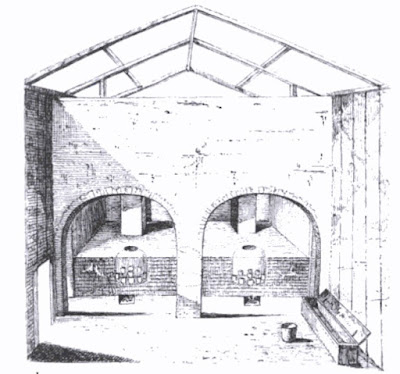 |
| Interior Mr. Turner's Brass Works from R. R. Angerstein's Illustrated Travel Diary, 1753-1755. |
Reinhold Rücker Angerstein was a Swedish metallurgist from a family of iron masters, who extensively travelled Britain's industrial works in the early 1750s, including many in Birmingham and nearby. In 1754 he visited Turner's brass works in Birmingham:
The brass-works [...] belongs to Mr Turner and consists of nine furnaces with three built together in each of three separate buildings. The furnaces are heated with mineral coal, of which 15 tons is used for each furnace, and melting lasting ten hours. Each furnace holds nine pots, 14 inches high and nine inches diameter at the top. Each pot is charged with 41 pounds of copper and 50 pounds of calamine. Mixed with [char]coal. During charging I observed that a handful of coal and calamine was first placed on the bottom of the pot, then came the mixture, which was packed in tightly, followed by about a pound of copper in small pieces, and finally again coal and calamine without copper, covering the top. This procedure was said to lengthen the life of the pot both at the top and the bottom. [...] There are six workers for the nine furnaces and casting takes place twice every 24 hours.*1*
Lost Trades Nᵒ.12: The Trade Catalogue of Ford Whitmore & Brunton (c. 1775)
 |
| Held at Birmingham Archive, MS 3506. |
This catalogue for Ford, Whitmore and Brunton (c. 1775) provides amazing insight into the tools of the eighteenth-century Birmingham jeweller and watchmaker, including the range of precision instruments which were being used.
Lost Trades Nᵒ.11: John Taylor (c. 1711 to 1775) & Birmingham's First Factory (probably)
 |
| John Taylor I, c. 1750. In the possession of Lloyd's Bank, London. |
John Taylor (c. 1711 to 1775)
John Taylor was one of Birmingham’s most dominant manufacturers of small wares, often called 'toys', including japanned goods (decorative lacquer), metal buttons and enamelled boxes. In 1766 Lady Shelburne, who was visiting the Birmingham manufactories with her husband and some friends, called Taylor the 'principal manufacturer' of the town.* Taylor's business had grown from the 1730s, and his manufactory was probably Birmingham's first factory, in the sense we understand it today. He also was a partner in Taylor and Lloyd's bank, which opened in Birmingham in 1765 and is now simply Lloyd's Bank, and he died in 1775 a very wealth man.
Tour of Lost Birmingham Nᵒ.56: Bromford Forge, and the Interior of the 18th Century Iron Forge (Aston)
 |
| An Iron Forge, by Joseph Wright of Derby (1772) |
The first mention of the Bromford mill as a forge was in 1605, but the site had previously worked as a water-powered mill, possibly dating back to Domesday, but definitely the thirteenth century. Like many mills it had been converted from corn grinding to fulling, the pounding of wool to remove oil and dirt.* From working as a fulling mill it was an easy conversion to become a forge to hammer iron instead of wool, as seen in Joseph Wright’s 1772 painting of an iron forge (above). Wright was inspired by the industries of the Midlands, and although there is no reason to believe that he visited Bromford, there would be similarities.
Tour of Lost Birmingham Nᵒ.55: Aston Furnace in the 1750s (Aston)
 |
| Aston Furnace in 1753, drawn by R. R. Angerstein.** |
Aston Furnace, now demolished, was on the Hockley Brook, near where Porchester Street is today. The current site is grade A listed, although it has been built on. The original furnace was for iron and was first noted in 1615. In the late 1600s it was run by the renowned Jennens ironmasters, who also worked Bromford Forge. British History Online states that there is no evidence that the furnace itself was water-powered, but that the brook was used to power the bellows.*
Curious Machines: Beautiful Machinery - Double Cylinder Steam Engine (1797)
 |
| Double cylinder engine produced for a mill in Nottinghamshire, 1797. |
Many Birmingham industrialists fought for their decorative manufactured goods to be seen within the bracket of 'arts' and they were often called the 'useful arts'. The machinery produced in the town, though, had a beauty of its own, especially in the way it was drawn and depicted in the eighteenth century style of depiction.
These engine plans were produced by Boulton & Watt at the Soho manufactory near Birmingham. They have been digitised by Digital Handsworth and placed online here, with additional information.
 |
| Engine for Henry Whately, gun manufacturer, Smethwick. 1796. |
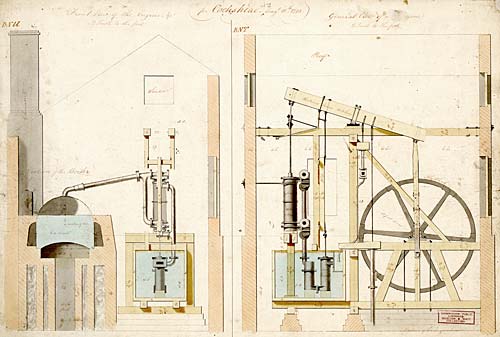 |
| Six horse power crank engine for the Cockshead Colliery in Staffs. 1793. |
 |
| Alteration to an engine by Boulton & Watt. 1776-7. |
 |
| Pumping engine from the Paris Water Works, 1779. |
Artisan Districts: The Gun Quarter
 |
| Photographs taken in the early 1960s by Phyllis Nicklin. |
It is uncertain exactly when gun making began in Birmingham and its surrounding areas in the West Midlands. When William III came to the throne in 1689 there were gun makers in the town, who benefited from the King keeping the country at near permanent war with France throughout his reign. Technological developments of the gun had led it to be used more reliably in warfare over the previous centuries, and demand was increasing. The gun makers of Birmingham were noted by the government in the late 1600s and several trial orders were made for weapons, eventually leading to contracts being placed with a number of local manufacturers.
The trade expanded over the next fifty years, and like Birmingham's Jewellery Quarter, which still survives to this day, the gun trade also developed in a distinct 'quarter' etched into the landscape of the town. The term 'gun quarter' seems to be a much more modern term than the quarter itself, the district evolved over time through amenity; there were many processes in the making of a single weapon, and each process would be conducted by different skilled workers in separate premises. The making of the guns was divided into two main areas; the component parts were produced by the 'makers' who were breechers, borers, stock makers, barrel welders, bayonet forgers, socket and ring stampers etc, these parts were then assembled by the 'setters up' who assembled to parts to produce the finished article. These were polishers, engravers, browner's, sighters etc. Each finished gun would have gone through about fifty different hands. This method of making guns, due to the complexity of the article, changed little over the years; it was the longest surviving traditional industry in Birmingham.
The 'gun quarter' was concentrated within St. Mary's parish, and many gun makers converted the smart houses that had been built around and near St. Mary's church into manufactories. These have all gone, but in the early 1960s they were beginning to be taken down; Phyllis Nicklin took her camera and recorded some of the area....


But these empty streets lined with cars do little to describe the area at its height; with people and gun parts moving from workshop to workshop the area would have been filled with hustle and bustle, the noise leaking out into the streets from the craftsmen working busily inside at their workbenches. Weaving through the street gunsmiths would be seen:
"one with half a dozen stocked guns on his shoulder, conveying them from the stocker to the screwer, another with a tray full of locks for the polisher, a third on his way with a few barrels to the Proof House, and so on".*


"Some rooms you walked up to from outside on wooden staircases and each had a name-plate on the door. Inside the rooms were very cramped, with the work benches all along the walls [....] The men were working on polishing the gun barrels or carving wood-stocks for handles. There were tools everywhere, hanging on nails and straps all over the walls and lying on benches, you gradually became aware of it all in the dim shafts of light from the small windows. The men were very skilled at their trades which were handed down from father to son"**
NOTES
* Goodman from Skipp
** Albert Fenton from Carl Chinn's, The Great Working City.
PHOTOS
1) Partridge Works on Price Street (off Loveday Street), 1960. 2) No. 3 Whittal Street, 1963. 3) Sand Street near Whittal Street, 1960. 4) St. Mary's Row, 1960. 5) Nos. 9-11 St. Mary's Row, 1960. 6) Behind 9-11 St. Mary's Row, 1960. 7) Behind 10-11 St. Mary's Row, 1963.
Tour of Lost Birmingham Nᵒ.16: Heptinstall's File Manufactory (Ann Street, now Colmore Row)
File Maunfactory. Circa 1789 to 1872.
 The etchings below were originally produced in 1800, and were described as being part of Heptinstall's 'Mill for Grinding Files', the etching produced 'by P Rothwell after a drawing by T Hollins of men making files'.*
Heptinstall's file manufactory was probably Ann Street's longest standing business, it was situated behind the small house (left) at number 27 (before number changes it was 26), the family living in this original dwelling house with the manufactory buildings being built in what had originally been the garden behind. It was, in part, this ability to build onto the properties that helped the industries thrive, businesses could extend from the houses that people lived in, and properties could be purchased with land attached with the idea to build a manufactory. John Heptinstall began his business in the mid 1700s in Walsall, and his son Joseph had expanded the business in Birmingham's Ann Street in the 1780s or 90s.* The site was probably chosen because it had a water supply (possibly only a stream, but now gone), which was used to power some of the machinery (see bottom image below), and this water supply is mentioned in 1796 when a neighbour is requested by their landlord to 'repair [...] the water courses'.*
Unlike descriptions of dark and stuffy work-places, the workshop
(top image below) seems flooded with light by the many windows that would have also allowed a good flow of air. You can see the employees at work at their seperate benches, as well as both water and hand powered file grinders in use, which shows some of the seperate processes in making the files. There is a suggestion of a friendly work environment as well, the men are not all with their heads down, some are raised as if in conversation. This atmosphere is asserted when James Pool, an employee of 40 years, had to travel to London in 1838 to defend his friend, Samuel Phipps, accused of stealing; as his 'shopmates' helped to pay some of his travel expenses, though it is not mentioned that his master paid anything towards the trip.*
Inside the Manufactory
The business had also been known as Heptintall and Parker's (William Parker being John Heptinstall's son-in-law), but in the early 1820s, when Joseph Heptinstall died and his wife Ann married William Lawledge, the business became known as Heptinstall and Lawledge's. The business remained on the same site in Ann Street till the whole part of that street was demolished in the 1870s for the new Council House to be built. The file business at this time moved to new premises.
* References on request.Birmingham History

Heptinstall's file manufactory was probably Ann Street's longest standing business, it was situated behind the small house (left) at number 27 (before number changes it was 26), the family living in this original dwelling house with the manufactory buildings being built in what had originally been the garden behind. It was, in part, this ability to build onto the properties that helped the industries thrive, businesses could extend from the houses that people lived in, and properties could be purchased with land attached with the idea to build a manufactory. John Heptinstall began his business in the mid 1700s in Walsall, and his son Joseph had expanded the business in Birmingham's Ann Street in the 1780s or 90s.* The site was probably chosen because it had a water supply (possibly only a stream, but now gone), which was used to power some of the machinery (see bottom image below), and this water supply is mentioned in 1796 when a neighbour is requested by their landlord to 'repair [...] the water courses'.*
Unlike descriptions of dark and stuffy work-places, the workshop
(top image below) seems flooded with light by the many windows that would have also allowed a good flow of air. You can see the employees at work at their seperate benches, as well as both water and hand powered file grinders in use, which shows some of the seperate processes in making the files. There is a suggestion of a friendly work environment as well, the men are not all with their heads down, some are raised as if in conversation. This atmosphere is asserted when James Pool, an employee of 40 years, had to travel to London in 1838 to defend his friend, Samuel Phipps, accused of stealing; as his 'shopmates' helped to pay some of his travel expenses, though it is not mentioned that his master paid anything towards the trip.*
Inside the Manufactory
 |
| The inside of Heptinstall's file manufactory taken from Bisset's directory of 1808. Original drawing by Thomas Hollins. |
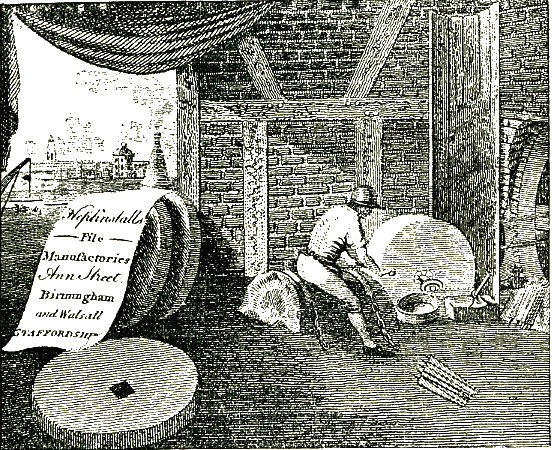 |
| The water mill powering the equipment. Files can be seen on the floor. Original drawing by Thomas Hollins. |
The business had also been known as Heptintall and Parker's (William Parker being John Heptinstall's son-in-law), but in the early 1820s, when Joseph Heptinstall died and his wife Ann married William Lawledge, the business became known as Heptinstall and Lawledge's. The business remained on the same site in Ann Street till the whole part of that street was demolished in the 1870s for the new Council House to be built. The file business at this time moved to new premises.
* References on request.Birmingham History
Street By Street: Berkley Street (c. 1830s-Present)

 |
| Berkley Street and surrounding area, including the canal, from the 1841 vista of Birmingham. Held at Birmingham Archive. |
Berkley Street still exists and is off Broad Street.
Images above: The 1841 vista of Birmingham should not be taken as a literal representation of Birmingham, but it provides an impression of the town in the early years of Queen Victoria's reign. Berkley Street was drawn but not named on the 1839 map of Birmingham (see the bottom of the post), the first map on which it can be found. On this map were stone, coal, timber and brick wharfs along the canal basins. The open spaces, such as those by the Jewish Burial Ground (bottom left), were small gardens but these gardens were not to last much longer.
Images below: Looking south-west down Berkeley Street towards the wharfs of the Worcester & Birmingham Canal Company in 1874. Tupper and Company, galvanised iron merchants and manufacturers, had buildings on each side of Berkley Street, accessible by the canal basin which came under the street. This canal basin is visible in the image at the bottom left and right, and boats are moored loading up wares from Tupper & Comp. The premises of the galvanised iron works are also seen on the 1800s map.
 |
| Tupper and Company, 1874. Held at Birmingham Archive, MS 1342/351. |
 |
| 1880s map of Berkeley Street. |
 |
| Snippet from Tupper and Company, 1874, showing the buildings and canal basin (and a dog). |
 |
| Snippet form Tupper and Company, 1874. |
 |
| Full image of Tupper and Company, 1874. |
Maps
Berkley Street was not drawn on the 1819 map of Birmingham.
 |
| Snippet of 1839 map of Birmingham. |
 |
| Snippet of 1851 map of Birmingham. Written Berkeley Street. |
|
| Snippet of 1880s map showing Berkeley Street. |
Rules for Working at Kynoch's
 |
| Rules were strict in an ammunition factory! |
In the mid 1800s, the area around Witton was described as a “countryside of babbling brooks, smiling meadows and green trees, amidst which the song of the cuckoo was heard as early as in any part of rural England.” It was this open landscape that attracted the ammunition makers from nearby Birmingham, as the manufacture of ammunition, with its use of highly explosive chemicals, was not the trade for a built up town. In 1859 the ammunition factory of Pursall And Phillip’s on Birmingham’s busy, built-up Whittall Street exploded killing 19 people, all but one being girls aged between 10 and 31 years. Women and girls were often employed to make ammunition as it was thought they were more dextrous, as well as more careful with the explosive materials. Due to the fatal explosion of 1859, Pursall and Phillip’s moved their manufactory to a site near the River Tame in Witton, their employee, George Kynoch, taking over within the next few years. Kynoch named the manufactory the Lion Works, using a lion as his trademark, and began to build the business from a few wooden sheds.
 |
| Interior, 1889. |
Fisher and Ludlow in Pictures

These are some images that I found saved on my computer when having a clearout. They don't necessarily fit with the theme of this blog, but they might be of interest to some of the readers. They are of Fisher and Ludlow, a manufactory making cars, washing machines and more. More images are below:


Subscribe to:
Posts (Atom)