|
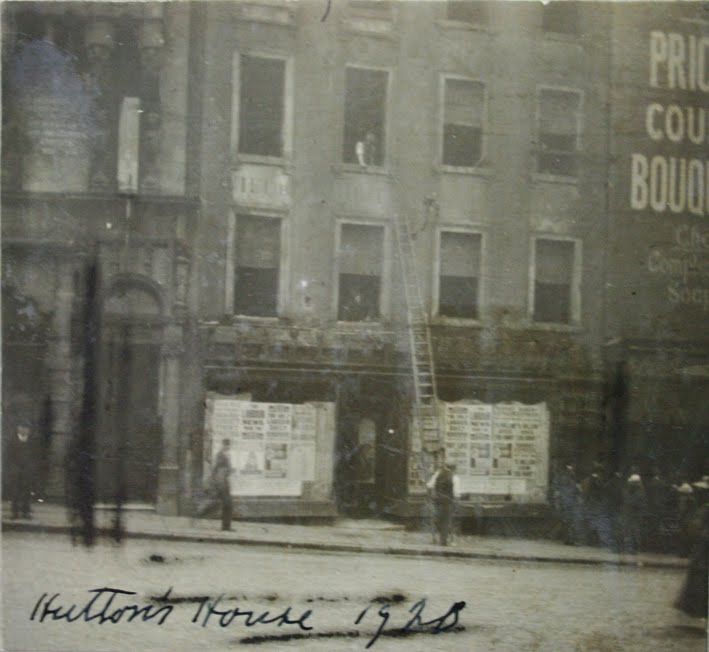
William Hutton's house and shop in High Street, Birmingham, as it was
being taken down in 1928. It was the events that occurred at this house in 1791,
as well as elsewhere in Birmingham, that caused Hutton's daughter Catherine
to declare that she would never live there again.
Held at Birmingham Archive. |
Catherine Hutton
stated in 1791 'I have for ever quited Birmingham as a home', no-one knew if she meant it, but she never did return to live in Birmingham again, and she had good reason to want to stay away.
The 14th of July 1791 was the day of the King and Country Riots, it all boiled up after
a few men met at the Hotel to celebrate the anniversary of the storming of the Bastille and the ideals of the French Revolution. Here, a few windows got smashed, but the riot soon spread across Birmingham and most houses did not get off so lightly, many were burnt to the ground, though William Hutton's house on High Street was saved that fate as the neighbours protested in fear that it may spread to their own homes. The rioting was targeted towards religious dissenters*; research and conjecture as to why this was the case could fill an essay in themselves, so here I will only note that William Hutton was a dissenter, and one, like many others in Birmingham, who had done well for himself in business. He ran his shop as a stationers on High Street, where he lived above, but also had a large house a little out of Birmingham on Washwood Heath where his wife, who suffered from illness, and daughter Catherine usually resided. That house
did get burnt down, but here I will explore what happened on High Street.
Catherine was with her mother at Washwood Heath when the rioters called on her father and brother in High Street on the 15th, the day after the riots began. Dissenter Meeting Houses had already been burnt to the ground, as well as Joseph Priestley's, John Ryland's and John Taylor's houses. William Hutton had not been at the dinner at the Hotel, but he was a Unitarian (dissenter), and as well as that, he was also
a Commissioner at the Court of Requests, dealing with those who owed debts. Hutton stated himself, that 'armed with [this] power, I have put a period to thousands of quarrels, have softened the rugged tempers of devouring antagonists, and, without expense to themselves, sent them away friends.
But the fatal rock upon which I split was, I never could find a way to let both parties win. If ninety-nine were content, and one was not, that one would be more solicitous to injure me than the ninety-nine to serve me'. Hutton was known, when dealing with litigations, for his statement 'thee pay sixpence, and come again next Friday' (Friday was when the court was held); as the mob threw his possessions out of the windows of his house it was recorded that they shouted 'who bids for this?' to which the reply came 'thee pay sixpence, and come again next Friday'.
When the mob gathered before William Hutton's shop** on High Street on the afternoon of the 15th he tried to buy them off with money, even borrowing from neighbours to continue paying; they demanded alcohol and gave them all he could, but when he could give them no more they took him to a local tavern (against his will) and drank 329 gallons on his credit. The destruction of the house began by first only smashing windows and knocking loudly on the doors. Catherine Hutton's brother, Thomas, had gone out to try and deal with them but was nearly attacked with a bludgeon before a friend came to his aid. Thomas then went to try and help save Mr. Taylor's house, but on finding that futile turned back and discovered furniture from his house in Digbeth, thus realising that the crowds had managed to break through the doors of his father's shop. Those inside had thrown paper 'out of the drawing room windows, and women [had carried] out aprons full of [the family's] property'. The neighbours were unwilling to help; those nearby had pleaded for the house not to be burnt to save their own properties, and Thomas Carless,*** who lived opposite, refused to take in paper that had been thrown out of the shop, or to allow the young Mr. Hutton to escape from the crowds through his house. The mob continued through the night, as Catherine Hutton's aunt visited the scene at about 4am and saw 'drawers, wardrobes, and clothes [...] being thrown out of the windows and prints being trampled on the street'.
The mob had threatened the life of William Hutton, so at this point the family, who were staying with that aunt, decided to flee to Sutton.
Once the soldiers were employed to restore some order to Birmingham on the 17th the family returned from their exile.
On High Street, the rioters had 'demolished all the doors, windows, chimney-pieces, wainscotts, skirting boards, and banisters, together with the roof of the house'. They had also attempted to remove the staircase, but had only reached the sixth step (before, presumably, they realised that they should have begun from the top and worked down). The Beadle of the Court had managed to save some of the Hutton's property and keep it in the Court of Requests, which was very near Hutton's shop; Catherine was also reunited with her guitar which a friend had bought from a rioter for sixpence. By the 19th of July, William Hutton had completed some repairs and was able to 'appear at business'; soon Thomas and the servants could sleep in the house, but William preferred to retire with his family in the country. Slowly the repairs were completed until it was business as usual and William remained trading in High Street till 1793 when he handed over the business to Thomas.
NOTES
William Hutton bought a house on High Street in 1772, but the house in the photograph was the one that he had built on that site in 1775.
Photograph courtesy of the Library of Birmingham.
~ References on request.
* Dissenters were Christians who had separated from the Church of England, often due to dislike of state intervention into religious matters, or believing in varying doctrines.
** Hutton was a stationer, he was the first person to Birmingham to make paper and ran his paper mill just out of Birmingham. He also sold books and ran a lending library, at a small charge.
*** Thomas Carless was a druggist, and uncle to Richard Pratchett who I wrote about in the post
Pratchett's Bull Ring.