Showing posts with label Joseph Priestley. Show all posts

Hotting up - The 1791 Riots


By 13th July 1791 things were definitely hotting up in Birmingham. A number of handbills had been circulating, and those who had arranged the French Revolution Dinner published a statement in Aris's Gazette, above, stating their loyalty to the King and the English system. Graffiti could be found scrawled across walls;
Joseph Priestley was advised not to attend the dinner, in an attempt to calm the animosity, to which he agreed.

I PREDICT A RIOT!

'The Test ____' published 20th February 1790. Depicting the percieved
threat of Dissenters to 'Church and King'. This cartoon helps to depict
some of the tensions leading up to the Priestley or 'Church and King'
riots in Birmingham on 14th July 1791.
Joseph Priestley is depicted in the bottom right corner.
'The Flame of Liberty' is about to burn down the building represented
by the symbols of Church (to the left) and King (to the right).


The cartoon above (published February 1790) is fictional, but depicts the perceived threat of the religious Dissenters by the mainstream Anglican church. Joseph Priestley (second image), a Dissenter, is shown as part of a mob bent on the destruction of Church and King (third image). The following post will explore this backdrop to the Priestley riots (also called the Church and King riots, as the mob were for "Church and King") that began on 14th July 1791, and were directed at the Dissenters.

After the Revolution in France there was a rising feeling in England that political change could occur here as well, both from those who desired it and those who feared it. But unlike France, the desire for political change here was greatly tied up with religion, as many fighting for political reform were religious Dissenters who questioned the Anglican church. Dissenters were not allowed to become Members of Parliament, nor study at university, due to the Test Acts that had been written during the Restoration to prevent Catholics gaining power. They wished to change this so that they could have more say, but Parliamnet seemed rooted in opposition to this. As well as this though, Dissenters, and others, fought for universal suffrage, the removal of Rotton Boroughs (boroughs with only a handful of residents where MP's could buy their way in) and to allow growing towns like Birmingham to send members to Parliament (as at this time Birmingham's thousands of residents had no representation in Parliament).

Dissenters attack the Church

Due to the restraint on education many ambitious Dissenters entered trade and manufacturing, which is why there was a strong base of Dissenting groups in Birmingham. By far the largest group were the Unitarians, of which Joseph Priestley was a part, as well as being preacher at the New Meeting House on Moor Street. Priestley was highly outspoken in matters of religion and politics, which worried many; Samuel Johnson stated that Priestley's 'work unsettles everything'.* After the French Revolution Priestley's fervour stepped up a notch, at one point comparing free enquiry to 'laying gunpowder, grain by grain'.* Although he later declared that the allusion to the Gunpowder Plot was unintentional, he became set in the eyes of his critics as a dangerous man, and was nicknamed Gunpowder Joe. Perhaps if Priestley's and the other Dissenters ideas on political reform had not been tied up with religion the story of this country may have been a different one.

Since the commencement of the French Revolution the friction between groups and ideas was heightened, there was fear of the air of revolution and at the beginning of 1790 Samuel Parr wrote that a 'storm is gathering, depend upon it [...] and if the church does not exert itself it will fall'.** The church certainly did exert itself as in 1790 George Croft preached at St. Martin's against the Dissenters and warned that 'while their meeting-houses are open they are weakening and almost demolishing the whole fabric of Christianity'.** The reply from Unitarian minister John Hobson was that Croft was 'viciously prejudiced [...] persecuting and abusive'. And Joseph Priestley himself was a prolific writer and published many pamphlets and leaflets addressing his opponents head-on. Within Birmingham a specific committee was formed to oppose the Dissenter groups, and by the end of 1790 troops were ordered as rioting or similar disorder seemed highly possible. This died down but in July 1791, after the the French Revolution Dinner was announced, trouble began to stir again.**

NOTES
* References on request
** This paragraph written using research from: R. B. Rose, The Priestley Riots of 1791

Paper Remnants: Your Invitation to the French Revolution Dinner (1791)


Dear Reader,

We would like to invite you to a Grand Dinner being held at Dadley's Hotel on Temple Row on July 14th to celebrate the second anniversary of Revolution in France. We aim to promote 'equal government' and a 'free intercourse' in promoting the 'Rights of Mankind'. If you are 'disposed to join the intended temperate festivity, [it] is desired [that you] leave [your] name at the bar of the Hotel, where tickets may be had at five shillings each, including a bottle of wine'. The dinner will commence at three o'clock and we expect near 100 gentlemen to attend, including, we have been advised, Dr. Priestley.

Yesterday Aris's Birmingham Gazette, printed, as advised, the announcement of our plans to dine (see below). There has been a little concern that attached to this advertisement the paper have stated that they will publish the names of the diners, seemingly to stir up animosity towards our gathering. If you are 'any friend of freedom' be not moved by this act, but although this will not subvert our celebration we propose to make our first toasts to 'The King and Constitution' and 'The Prince of Wales'. We are certain that the dinner will pass with no trouble.


Your sincerely,
J. D.

This is part of a series of posts about the Priestley Riots which took place in Birmingham from 14th to 17th July 1791; and this dinner was a significant spark. Dr. Priestley, after advice from friends, did not attend the dinner in the end, but this did not quash the angry mobs. Click here to see all posts about the riots and Joseph Priestley.

Tour of Lost Birmingham Nᵒ.42: The Birmingham Library & a Ticket to Knowledge (Union Street)


Leading up to the anniversary of the Priestley Riots, which occurred in Birmingham from 14th July to 17th July 1791, an exploration of the Birmingham Library in which Dr. Joseph Priestley was involved.

The Birmingham Library was not the first in the town, but was the first that opened up the world of knowledge to a wider section of society. The establishment was set up in 1779 by 19 men, all but one of whom were religious Dissenters, already open to inquiry. To join the library members paid a guinea (21 shillings), and then, from 1781, paid a further eight shillings per year, so this was by no means learning for all, but it paved the way for the advancement of learning through the classes.**

When Joseph Priestley came to Birmingham in 1780 the library found an enthusiastic supporter, one who had competently helped build other such institutions already, and so its management was entrusted to him. The institution had great hopes for a freedom of learning, the initial principal put forward by Priestley being that 'this institution can never answer the purpose of party, civil or religious, but, on the contrary, may be expected to promote a spirit of liberality and friendship among all classes of men without distinction'.* He believed that controversial literature, even his own, should not be included among the books. By 1786 the library committee contained a mix of the original Dissenter groups, as well as a higher proportion from the Anglican church, but surprisingly it was the latter who pushed to have Priestley's books included in the library. John Money believes this to be a purposeful 'manoeuvre' which 'produced predictable results. The acquisition of Priestley’s work was attributed not to the cabal on the committee but to the Doctor [Priestley] himself and his friends, and it was followed by a series of ostentatious Anglican protests and resignations'.*** After this Priestley promoted that all books, including both his own and those that contradicted them, should be included. But differing opinions caused tension, and eventually rupture within the organisation; in 1794, the library split into two groups becoming the Old Library, which eventually moved to Union Street, and the New Library, which became located in Cannon Street.*


In 1796 it was decided that the library needed a purpose built building for its expanding collection, and William Hollins was chosen to design and build the structure, left (I will explore the architecture of the building in a separate post). The building opened late in 1797, and the rent of the land was paid for by a Tontine Deed drawn up at the beginning of 1798. Tontine meant that a number of subscribers would pay a subscription out of which the rent would be taken out and the excess reserved. Each subscriber could nominate either themselves or another individual to the Tontine and whoever survived the rest received the lump accumulated sum; this is why it was often very young children who were nominated. Nearly 180 individuals were nominated (with about 150 doing the nominating) for the library Tontine Deed (details and names of these can be seen here).

Above the library was carved 'AD MERCATURAM BONARTUM ARTIUM PROFECTUS, ET TIBI ET OMNIBUS DITESCES' translated as 'resorting to the mart of sciences, you will grow rich, both for yourself and others'. The library itself definitely grew and flourished; in 1784 it had owned about 900 books but in its new home in Union Street this rose to more like 7,000 by 1799.* The libraries that were established across many of the towns were a step towards providing education and learning to a wider section of the population. Among all the names nominated for the Tontine Deed, of people who lived in or near Birmingham, nearly a third were manufacturers, especially those in the button and metal trades, another third were merchants, one sixth were gentlemen and the other sixth were predominantly,what were deemed as, higher professions such as doctors, attorneys, bankers, artists and churchmen.* This was a move in the right direction in supplying learning to those who had been excluded from it previously.


ABOVE: Late Victorian Union Street, but still retaining its Georgian and Regency architecture. In 1845 the library had been extended to the left, as can be seen in the photograph.

NOTES
* References on request.
Other sources are this article and **British History Online.
*** John Money, Experience and Identity: Birmingham and the West Midlands 1760 - 1800


Seal from library card, above.

Joseph Priestley in Birmingham: Religious Dissent and Political Change


Produced 1790 by William Dent, this charicatured representation of Joseph Priestley depicts him in a barrel with the word FANATICISM written on the side. The group in front ask if there is such a thing as a Devil, to which Priestley replies NO, but behind him is the Devil in flames about to skewer him. Priestley was progressive; he promoted free inquiry in religion, made prominent discoveries in science (he discovered oxygen) and dealt in radical politics including promoting the ideals of the French Revolution which had erupted a year previously. The cartoon is actually quite threatening, with the Devil stating that if Priestley 'had eyes behind [he'd] know better'. Just over a year later Priestley was taught his lesson for talking so candidly, as the rioters of 1791 burnt his home and the meeting house that he preached in to the ground. This was more than just questioning doctrine; Priestley shook the very core of established order. This spirit of questioning remained in Birmingham though, after Priestley abondoned the town following the riots, and it was one of the leading lights in political, and consequently social reform over the next few decades.

The Dinner That Caused a Riot?

A BIRMINGHAM TOAST, published 23 July 1791 following the dinner
at the Hotel which fired the Birmingham riots beginning 14 July 1791.
Published in London.

Visit the Hotel here

The image is meant to depict the Constitutional Society of Birmingham that held a 'French Revolution Dinner' at Birmingham's Hotel to commemorate the second anniversary of the storming of the Bastille on 14th July 1791. The event has been transformed into a satirical cartoon by James Gillray, representing the London viewpoint of the riots and containing a number of false embelishments, one being that Joseph Priestley (standing, second from left) did not attend the dinner at the Hotel, nor did many of the others shown (see below) who lived a good distance from Birmingham. The dinner had caused a stir amongst some of Birmingham's inhabitants who believed that those attending were unpatriotic, and who had been antagonised by a seditious hand-bill that had been distributed a few days before the dinner, though all at the dinner denied any connection with it. But this was before France's King had been executed (which occured in January 1793), and before the full bloody violence of the revolution had truly begun. James Gillray took a conservative stance to the Revolution from the beginning and often ridiculed both it and those who believed in it's ideals.

On the evening of the dinner, the 80 or 90 diners were hissed at as they arrived, then the rioting began later that evening when a mob arrived at the Hotel and started smashing windows. The mob were pursuaded to move on by the Hotel's proprietor Thomas Dadley, but then the rioting continued for another three days. It was easy for those critical of the Revolution in France to blame the dinner, but as we have found more recently in the riots of August 2011, one thing may trigger an anger that has been deep rooted for a considerable amount of time. Joseph Priestley, who was pinpointed by Gillray, was a religious dissenter (specifically, a Unitarian), and he with a large number of other dissenters were targeted by the rioters and their homes destroyed. Priesltley, although not present, describes the dinner as it led up to the riot, and specifically mentions how the chair of the dinner was a church of England man:

"When the company met, a croud [sic] was assembled at the door, and some of them hissed, and shewed [sic] other marks of disapprobation, but no material violence was offered to any body. Mr. Keir, a member of the church of England, took the chair; and when they had dined, drank their toasts, and sung the songs which had been prepared for the occasion, they dispersed. This was about five o'clock, and the town remained quiet till about eight. It was evident, therefore, that the dinner was not the proper cause of the riot which followed: but that the mischief had been pre-concerted, and that this particular opportunity was laid hold of for the purpose."
For Priestley, the dinner was a contrived reason for rioting, as it was easier than voicing fears and predjudices towards the dissenting groups in Birmingham. But what causes riots is something that we may never be able to truly describe, there is often a friction that builds up between different groups of people who want different things, and from the fear of the desires of others.

INFORMATION ABOUT THE PRINT
The print reads: 
A BIRMINGHAM TOAST, as given on the 14th of July, by the ----------* Revolution Society
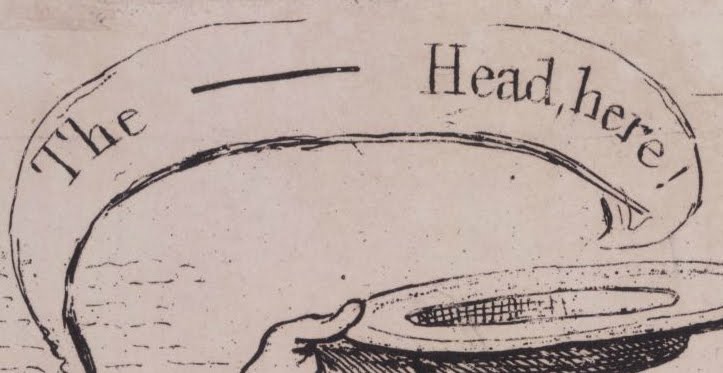
Joseph Priestley (standing) holds up a chalice and communion plate and states: "The King's* Head, here!"
Sir Cecil Wray (on our left) with a reddened face, pours himself some sherry and exclaims "Damn my eyes! but I'll pledge you that Toast tho Hell gapes for me". In the orange coat Richard B. Sheridan declares"O Heavins [sic]! why I empty a Chelsea Pensioner's small-beer barrel, in such a cause!". Charles James Fox's (centre) portly face is also reddened and as he raises his glass he says"My Soul & Body, both, upon the Toast!!!". Next to Fox is Horne Tooke who states"I have not drunk so glorious a Toast since I was Parson of Brentford, & kept it up with Balf & McQuirk!". To the right a rather drunk looking Theophilus Lindsey is saying"Amen, Amen". Behind this group are charicatured religious dissenters, from left to right saying:
"Hear our Prayers: & preserve us from Kings, & Whores of Babylon!!"
"Put enimity between us & the ungodly and bring us down the Heads of all Tyrants & usurpers quickly good Lord--Hear us"
"O, grant the wishes of these inheritance"
The frame on the back wall shows St. Paul's Cathedral, with three pigs eating from a trough, underneath it reads: 'A PIG's STYE, a View from Haskney'


* There are a couple of alterations within the above image, firstly the word 'King's' has been written into Priestley's quote, though later productions show only a dash (both above). Also, at the base of the image a word has been covered up (see below), and other prints show this incorporated. It may be that this was one of the original prints by Gillray and the alterations were made for legal reasons. All those at the dinner were adamant that no toast was made for the head of the King.