Showing posts with label Timber Framed Buildings. Show all posts

Tour of Lost Birmingham Nᵒ.59: St. Martin's Parsonage (Smallbrook Street)

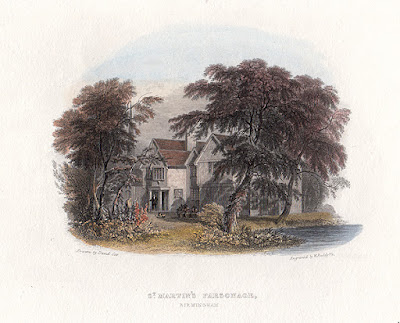
St. Martin's Parsonage, from a drawing by David Cox and engraved by William Radcliffe, published 25 March 1827. Hand coloured later.

St. Martin's Parsonage was demolished in 1826. The image above was drawn in about 1825 or 1826 by David Cox, and the original drawing is held by Birmingham Museums (see here). The Parsonage housed a long line of the rectors of St. Martin's, and stood a little distance from the church, up Edgbaston Street and at the base of Smallbrook Street.

Tour of Lost Birmingham Nᵒ.58: The Old Lamb House (Bull Street)

Photograph of the Old Bull House shortly before demolition. WK-B11-1261.


The Old Lamb House was a timber-framed building which survived the red-brick redevelopments of the eighteenth century and most of the nineteenth century, but was demolished probably in the early 1880s. Despite its name suggesting that it had possibly been a public house there is no evidence that it was ever used as such. It was situated on Bull Street, one of Birmingham's oldest streets, and had probably been the home and retail premises of a wealthy merchant.

Tour of Lost Birmingham Nᵒ.30: Medieval Birmingham


This is quite a bit before the period I cover with this blog, I know, but I felt that this reconstruction of Birmingham in about 1300 was an interesting prelude to the Birmingham that I explore. It is currently situated in the Birmingham History Galleries in Birmingham museum, and was produced using as much educated guess work as archaeological evidence, but is still an interesting impression of the town's beginnings. St. Martin's church can be seen in red, as that was the colour of the local stone, as well as the only other stone building, the manor house. The designers created eight different kinds of wooden houses for the model ranging from the smallest, of which there were many, to only one of the largest house owned by the wealthiest merchant. There was also the manor house for the lord of the manor. The shape of the Bull Ring can be seen, and High Street and New Street are lined with buildings.