Architects Nᵒ.3: William Hollins (1763-1843) and Family

1763-1843. Sculptor and architect working in Birmingham all his life.

William Hollins as sculpted by his son Peter.
The bust is part of a memorial to many of the
Hollins family which is found inside St. Paul's
church in Birmingham.
Find all posts concerning William Hollins : Thomas Hollins

Many of the Hollins family were artistic with varying talents. Thomas, William's brother, was a glass painter, engraver and artist and his (Thomas's) son John moved to London and became a well known artist. Of all of William's sons, the third eldest, Peter, became the most renowned.

It has been suggested that William Hollins was Birmingham’s first architect, he was of the generation of ‘builder-architects’ of the time,* and previous names had come from outside the town, but William lived and worked in Birmingham for most of his life. According to his burial monument in St. Paul's churchyard he was born in 1763 in Shiffnal (Shropshire), his parents being John and Mary. The family moved to Birmingham when William was a boy,* and some sources state that the family originally had come from Moseley.* He trained as a stonemason and sculpted throughout his career producing a number of monuments that still survive inside several standing churches. He was very much self-taught as an architect, reading Vitruvius who he claimed as his favourite author; his obituary stating that ‘he boldly forged a key to the temple of knowledge’.*

Relatively early in his career William assisted George Saunders (a London architect) in the 1793 rebuilding of the interior of New Street’s Theatre Royal, after fire. Following this he received a number of commissions for buildings in and around Birmingham,* his work being mostly in the Greek Revival style, he was also commissioned for work on what is now Alton Towers. He was known outside the UK as Catherine the Great invited him to work in Russia, though he declined the offer.

In 1806 he put forward a proposal for a tributary monument to Lord Nelson which Birmingham was commissioning, but lost out to Sir Richard Westmacott whose work still stands in the Bull Ring. William’s design was much more complex and expensive in comparison with the simple statue that was chosen and included a post office and dispensary. A year later he designed a water conduit to surround the existing pump in the newly cleared Bull Ring which proved very unpopular. The sculpture had been personally commissioned by Richard Pratchett who lived on High Street, in order to conceal the pump that was now exposed after the clearing of the Shambles (old tightly packed buildings that had filled the wide space in the Bull Ring). William called the sculpture the 'Egyptian Conduit', the local people named it 'Pratchett’s Folly'. It was designed as a tribute to Nelson’s victories on the Nile, and may have been an elaborate show of what William could have done with the previous Nelson monument. It was in the shape of a pyramid, combining Egyptian, Grecian and English styles, and was ornamented with papyrus, Grecian honeysuckle and a lion’s head, all with associated mythological symbolism, and crowned with an urn (which was a representation of the ashes of Nelson).* It can just be seen in the image above in front of St. Martin’s, just behind the first pair of horses. It seems that the sculpture was thought of as pretentious, with too much symbolism, unlike the statue of Nelson that was straight forward and to the point.*
Hollins' commissions seems to lessen after 1807, but it is not clear whether the negative reaction to his Bull Ring sculpture is responsible for this, or whether it is simply a gap in the knowledge of his work.

William built up his business and lived at 17 Great Hampton Street. He had many children with his wife Catherine and most of his sons followed his trade, Peter becoming the most well known. William can be found at Great Hampton Street on the 1841 census with his son George Hollins (organist at St. Paul's from 1838, and at the Town Hall from 1837-1841) living next door at number 18, and another son Thomas, a 'mason', living in the court behind the house. Thomas is the only resident of court 5, and the whole area was probably used for the family’s stonemasonry. William Hollins died at his house on 12th January 1843 aged 80 and was buried at St. Paul’s, where his wife and many other members of the Hollins family were buried. A granite monument marks William's grave at the rear of the church, and there is a memorial bust inside. His son Peter, who took over the business after his father’s death, designed a memorial window in St. Paul’s dedicated to his father’s memory.

Find out about how some of William Hollins' memorial monument work that still sits in St. Philip's was recieved by contemporaries here.

Work of William Hollins
Follow the links for visit these buildings.
1796-1797: Revisions to Soho House.
1798-1799: Library in Union Street (demolished)
1805-1813: Christ Church (excluding spire and portico) on the corner of New Street and Ann Street (generally believed, demolished)
1805-1807: Public Offices and prison in Moor Street (demolished)
1806-1808: General Dispensary in Union Street (demolished, though an ornament by Hollins depicting Hygeia (goddess of health) that was above the door still survives)
1807: Sculpture surrounding the pump in the Bull Ring (demolished)
1808-1809: St. Austin’s church.....
1813: Union Mill on Grosvenor Street West (attributed as a possibility by Andy Foster)
1813: Polychrome trophy of ancient and modern arms over the door to the Gun Barrel Proof House in Banbury Street (proof house designed by John Horton of Deritend*)
1820: Restoration of St. Mary’s church, Handsworth (in the Gothic style, with his son Peter)
1831: Almshouses in Warner Street, Bordesley (demolished, decorated panels survive, which may be his son Peter’s work)
(Additional to this list is the Athenaeum, which I am researching at present as there is disparity in the sources.)
NOTES
David Owen was a timber merchant living in Selly Grove in the parish of Northfield.
*References available on request
To find out more, click the labels below.
Any questions? Please add them to the comments section below.

Architects Nᵒ.2: Thomas Stedman Whitwell (c. 1784-1840)

c. 1784-1840. Architect, working in Birmingham about 1813 to 1825.
Thomas Stedman Whitwell was born in Coventry to parents John (an appraiser and auctioneer) and Frances. His grandfather, John Whitwell Senior, was originally a blue maker, then a salesman, alderman and mayor of Coventry in 1783 and 1789.* Thomas spent much of the early years of his career in London where he had family, but worked in Coventry and Birmingham from about 1813 to 1825. From 1825 to 1826 he visited America and was involved in Robert Owen's envisioning of the utopian town, New Harmony, in Indiana. In 1828 he undertook his final commission, the Brunswick Theatre in Whitechapel, parts of which collapsed only days after opening, causing fatalities. He was cleared of responsibility but the incident virtually ended his career and afterwards he wrote a number of books. It is perhaps due to the accident and his damaged reputation that Whitwell is not always mentioned as the architect of his buildings by his contemporaries.

A list of some of Whitwell's Birmingham based work;
1819-1820: Meeting House on Carrs Lane (demolished)
1820-1821: New Library on Temple Row (demolished)
1823: Pantechnetheca on New Street (demolished)

NOTES
* References available on request.
With thanks to Alex Lawrey for his help regarding Thomas Stedman Whitwell's life and work. http://www.builtheritageresearch.org/
External Links.
New Harmony in Indiana    Brunswick Theatre in Whitechapel
Interesting stuff: http://www.futilitycloset.com/2011/05/03/hearing-places/

Tour of Lost Birmingham Nᵒ.5: Birmingham's First Infant School (Ann Street, now Colmore Row)


~Oil painting of the interior of the school (1855) by Alfred H. Green. On the wall you can see maps, a very large clock, and coats hung up neatly on hooks. Several lessons are being conducted with different groups, some children are daydreaming, but most seem enthralled in their seperate activites. When the school first opened visitors were so numerous wanting to see the running of the school (which would have been a novelty) visiting times had to be restricted. Outside the rear of the building was a playground, and a house for the Master and Mistress was also built. ~  

The story of Birmingham's first infant school began in August 1825 with the formation of Birmingham's Infant School Society. This group saw the benefits in forming an Infant School for the poorer classes, based on establishments already set up in London, and visited Spitalfields School to gain inspiration for their own venture. Although small scale schools had been run previously (as in the Sunday School rooms of St. Philip's), now a permanent site on Ann Street was chosen (near Harris's glass warehouse) and a design for the building drawn up by Thomas Rickman and Henry Hutchinson which was built by 1826.*

The undertaking was all part of the wider infant school movement of the 1820s which had grown out of the observation that many mothers of working class children were employed for long hours in the workshops and factories of many of the towns, leaving their children to fend for themselves. Joseph Corbett (born c. 1792), a man who worked his way up from humble beginnings, wrote of his own working mother;
She 'worked in a manufactory from a very early age. She was clever and industrious, and [...] was regarded as an excellent match for a working man. She was married early [and] became the mother of eleven children: I am the eldest. [...] She had children apace. As she recovered from her lying-in, so she went to work, the babe being brought to her at stated times to receive nourishment. As the family increased, so everything like comfort disappeared altogether. The power to make a home cheerful and comfortable was never given to her. [...] She made many efforts to obstain from shop work; but her pecuniary [monetary] necessities forced her back into the shop. [...] I have known her, after the close of a hard day's work, sit up nearly all night for several nights together washing and mending clothes. [...] [The] cold and hunger, and the innumerable sufferings of my childhood, crowd upon my mind and overpower me [...]'.

It was stories like this one that encouraged the wealthier to help these children that were affected by so many mothers needing to work. It was not all charity though, there was a fear factor involved as well, as Lynn Hollen Lees states; '[s]avage, uncontrolled children became central symbols of danger in the new urban, industrial society'.** Children were the next generation and their 'vices' would be passed down to the future (growing) generations, but so too could any virtues instilled in them. The school stated that it was proud of rescuing the children ‘from bad examples, and idle and vicious habits in the streets’, and providing ‘seminaries of early moral and religious instruction’.*

The school was run, like many infant schools across the country, by many members of the Society of Friends. Payment of 2d per week was required for attendance of the school, which took up to 200 children aged between two and six.* Lessons were often taught using pictures and letter frames, maths was also taught, but at this point, education was secondary; the Infant School Society itself stated ‘[t]he knowledge acquired by the children is, on its own account, comparatively of little importance, but the habits they acquire are invaluable’.* The school followed the published advise of the W. Wilson, vicar of Walthamstow, who had been writing on the subject of instruction in infant schools since at least 1825 (see external links, below).***

To raise funds in order to keep the school running, the Infant School Society had decided in 1825 to have an upper floor built to the premises and rent it out to the Lancastrian Girls School. There were probably two separate entrances for the two schools, the Infant School was at number 48 and the Ladies School above was classed as number 47. The lower floor was also rented out to Christ Church's Sunday School. By 1857 the Ladies School upstairs was still going strong, and was for the purpose of educating young working women who were employed for long hours, sometimes from 8am till 9 pm, in the manufatories. It offered morning classes, and to a lesser extent evening classes teaching reading, writing and household duties, geography was also introduced, and there was a decent collection of books on these subjects.* The school also organised days out to places such as Bewdley, this particular excursion planned and carried out by Charles and Mary Sturge, two of the school's supporters.*

NOTES
* References on request
** Lynn Hollen Lees, The Solidarities of Strangers: The English Poor Laws and the People, 1700-1848 (Cambridge University Press, 1998).
Books utilised.
Nanette Whitbread, The Evolution of the Nursery Infant School: A History and Nursery Education in Britain, 1800-1970 (London: Routledge and Kegan Paul Ltd, 1972).
External Links
***Book: A Manual of Instruction for Infant Schools by W. Wilson, click here.

To find out more click on the labels below.

Tour of Lost Birmingham Nᵒ.4: A House for a Dandy - Portugal House (New Street)


It is possibly Joseph Green who is standing outside
Portugal House here, as his furniture is being saved from the
fire that is raging next door at the theatre.

In 1778 Birmingham was surveyed and a map was drawn up of the town. Surrounding the map were a number of engravings of Birmingham’s principal buildings, the two churches were included as well as the four chapels and the meeting house, schools and the hospital were added too, plus The Hotel which housed one of the town’s most prominent assembly rooms, an event every self respecting dandy should be seen at. There was only one private property amongst the selection on the map though, and that was ‘Mr. Green’s House’, below. There were other grand houses in the town, but Joseph Green’s House was newly completed and a very fashionable example of architecture at the time.
Snippet from the 1778 map of Birmingham depicting Portugal House.
Copied for Old and New Birmingham by R. K. Dent.


Joseph Green had leased land on New Street and had plans drawn up for his grand design in 1774, the same year that the New Street Theatre opened next door, on an area that had originally been Collett's Orchard. Green was a subscriber to the theatre, and a few years later made alterations to Samuel Wyatt's designs for the new facade of the theatre, so it seems that he had a nose for fashionable design.* He was also known as Beau Green and was renowned as a bit of a dandy; his trade was as a wine merchant and he had made his fortune in Portugal wine, as well as marrying an heiress.* He was described as 'a prominent man on occasions of public celebrations', which speaks volumes, and served in the community, most notably as High Bailiff in 1778. An area nearby the house (near where Joseph had lived previously) became known as Green's Village and a street bearing that name survived till 1888 when the houses there (which had become very run down) were demolished.

Portugal House itself was grand and austere, everything that a man about town needed to show off his wealth and substance. It had three storeys with the lower two framed with pilasters and the typical smaller windows on the upper floor. The main part of the house was crowned with a pediment and decorated with swags, the whole lot topped with urns (see below). Either side of the house were single bay pavilions connected to the main building by low arcade style walls. The pavilions were perhaps used as summer houses as there were large grounds and gardens attached to the house.

Joseph went bankrupt in 1799* and Portugal House ceased to be occupied by the Green family. By 1800 William Bullock was utilising the building as a cabinet of curiosities, one of many in the town at that time.* Bullock only used the building for a year or two before moving to Liverpool. Sometime after that the house was divided into two properties, as it would have been an expensive prospect to one tenant and was lived in by several occupants.* By 1811 a distillery had been built on the land adjoining Portugal House, which was run at that time by Hicken and Dunsford, who both occupied the house (at least in 1814 and 1811 respectively).* In the mid 1820s John Mouchet Baynham, the resident surgeon at the Union Street dispensary, occupied Portugal House with Samuel Allen Wheeler running the distillery, and perhaps living in the second part of the house.* In about 1830 though, Portugal House was extended and turned into a hotel, the New Royal Hotel, opened by Mr. Wilday who had been the successful proprietor of The Hotel.

~A little artistic license has been used in this early nineteenth century illustration of Portugal House next to the Theatre Royal, as the smaller less elegant buildings that filled the space between the two properties have been excluded. The decorative detail of the house can be seen a little more clearly here. Circa 1809.~


NOTES
* References on request.
Joseph Green died in 1810 at Dalbury in Derbyshire. 74, 1735, 20 May, St. Ph of Joseph

Architects (& Designers) Nᵒ.1: Richard Hicks Bridgens (1785-1846)

Designer and architect. 1785-1846.
Working in Birmingham mainly between 1819 and 1825.

Some sources state that Bridgens was possibly born in Sheffield, though it is most likely that he is the Richard Bridgens born and baptised in Birmingham on 30 August 1784 to Joseph Bridgens and Elizabeth Hicks (married 13 September 1762), and his burial record in Trinidad states that he was born in Warwickshire.*

Richard Hicks Bridgens began his career in Liverpool where he was apprenticed and worked for the cabinet maker and sculptor George Bullock. He moved to London in 1814 to continue working with Bullock. After Bullock's death in 1818 Bridgens set up his own business in Birmingham from 1819 to 1825, but although he was talented, it seems that self promotion was not his forte and custom was slow to materialise. Little is known of the work that he carried out in Birmingham, but he did produce a book, Furniture with candelabra and interior decoration, detailing his ideas for interior design, if not specific commissions. His most noteable known work was for James Watt junior at Aston Hall designing furniture and making architectural alterations in the Jacobean style. When his wife inherited a sugar plantation the couple left Birmingham for Trinidad.

List of Richard Bridgens Birmingham work;
1819-1824 and 1834-1837: Alterations and furniture for Aston Hall, Aston.
Early 1820s: Alterations to Thornhill House, the home of Ann Boulton, Soho.
1823: Candelabra for the Pantechnetheca, New Street (below).


Candelabra for the Pantechnetheca, 1823.


Interior designs with colour added for soft furnishings in the Grecian style from Bridgens' book, Furniture with candelabra and interior decoration (W. Pickering, 1838).


EXTERNAL LINKS
*Judy Raymond, who works in Trinidad, is currently writing a book about Bridgens; you can find out more here.
Find out more about Bridgens' artwork in Trinidad here.
(Acc 2006/028)

Tour of Lost Birmingham Nᵒ.3: The Shops in the Church Wall (New Street)


Part of a larger illustration of the area around Christ Church. Circa 1830.

When Christ Church was built in 1805, it was decided that four small shops should be built into the high church wall, which were to be rented out in order to provide an extra income for the church. I cannot think of another example of shops in the UK that were set into the surrounding wall of a church like this, surviving or otherwise, which would have made these ones, if they had of survived, unique. The shops under Christ Church were too small to be lived in, and the only way in or out was from the front (a health & safety nightmare for today). Behind the back walls of the shops were the catacombs that sat beneath the church, and further back, behind the church, the graveyard.


At the time the church was built this area was developing as a commercial part of the town, it had begun to be built up with residential properties from the 1740s, but later became a busy shopping  area. The illustration (left and above) depicts some of the shops of Ann Street in the distance, with the Bell and Candlestick pub in the centre, its name representing the prominence of the brass trade in Birmingham. The original cobbles of New Street can be seen in the foreground, and a small bow fronted shop window which had developed to better show off the wares which could be bought inside. You can also see the oil lamps used to light the exterior, and the basic sheets being used as cover from the elements.


The plan, above, was drawn up in 1821 and gives an insight into the life behind the facade of the shops. The four small shops that were set into the wall are all different sizes with irregular walls, giving an impression of how they may have been laid out inside. The four shops are run by Jones, Wakelam, Smith and Jones. The plan also shows two new shops in darker pink run by Freeman and Carr, that had just been built, as well as the waggon yard to the right. The buildings just behind, running along the length of the church's wall, are Freeman's kitchen, Freeman's pantry, Carr's brewhouse, the privies and some stables with another brewhouse. Brewhouses were used for washing clothes. The waggon yard was run by a Mr. Wallis, and it seems that it made and stocked waggons for business and goods use rather than having coaches for travelling, though you could hire hackney coaches a little further down New Street.*


Image left: The front gates to Christ Church, with the high wall and shops.

NOTES
* References on request.
Images courtesy of Birmingham Library and Archive Services.

Tour of Lost Birmingham Nᵒ.2: Georgian Post Office (New Street)


The Post Office (right) and other shops on New Street in 1824.
By Samuel Lines Senior

It is easy to forget in this information age, when you can communicate with the other side of the planet within seconds, that the only way to be in contact with those outside of the town in the Georgian era was either to go and visit them or through the post office. The post office was very much the hub of communication in the Georgian town; it was where information was transmitted, not only through letters, but the post office was where you could find news of distant wars and current events, when newspapers were a luxury to many. The buildings life and history was discussed in a column of the Birmingham Daily Post in the 1860s; it was a nostalgic look back, and also, an attempt to comprehend the rapid change that was happening at the time. This post narrates the memories from those articles as well as other sources to understand what was being recorded in the drawing above by those who could actually remember.

For many wealthier visitors to the town, the post office would be their point of arrival, if they had taken the mail coach at least, alighting in the yard behind and walking out into New Street. In front of them would be the Theatre Royal and Portugal House, behind them appearing from behind the trees would be the Baroque tower of St. Philip’s, three of the finest buildings of the town, and this would be their first impression. The post office building itself had either been built or appropriated in about 1784 and was a simple unassuming Georgian house covered with rough stucco and whitewashed. The door to the office was on the right, with a small window for posting letters out of hours that was lit at night by an oil lamp and space for only about six people inside.* In the drawing the step outside has become worn from its service to many feet. To the right was a small outbuilding with a window where the notices would be placed, it was here where news of the Battle of Waterloo was posted.* The house of the postmaster, John Gottwaltz, was entered by a separate door surrounded by elegant Classical porch.

If you turned right out of the coach yard, passing the post office on your right, you would follow the wall of the Gottwaltz garden for a bit, with trees bowing over the top, and then find premises hiring out post horses and hackney coaches. Post horses were not just for the fast delivery of mail, but could be hired for carriages; often someone with their own carriage would start out with their own horses, but for long journeys the horses would need to be rested and then returned home, and the traveller could hire the post horses to the next town, and so on till their destination was reached. Hackney coaches were rented four wheeled vehicles, with or without a coachman, but were thought of socially as an inferior mode of transport to the mail coaches which delivered the post. The mail coach was usually how someone with means but who could not afford their own carriage would arrive in a town from afar.

The first mail coach to deliver and collect from Birmingham was in 1812 (though mail coaches began in 1784), it would have delivered to the local inns and clattered up Georgian New Street through the post office gates. The coaches all looked the same; large red wheels with maroon on the lower body and the doors and a black upper body. Each door was painted with the royal arms as well as the words Royal Mail, and on the side of the drivers carriage the letters GR were intertwined for George Regina. The panels on either side of the doors were painted with stars of the principal orders of the knighthood; the garter, bath, thistle and St. Patrick, and painted on the rear was the coaches individual number.* Each coach carried a driver and an armed guard both wearing smart red uniforms but with different coloured collars so that they could be distinguished from each other. The guard was responsible for locking the mail in a box at the rear of the coach. Sometimes the guard would hand over his watch to the postmaster to be checked and repaired to maintain the good time keeping of the coaches.

~A Georgian mail coach (produced circa 1870); the heads from this scrap have been lost.~


In about 1820 a brand new street, Bennett’s Hill, cut down onto New Street straight past the post office, which was at that time extensively altered. Bennett’s Hill sat where the yard and its gates had sat, and no more mail coaches disembarked at the post office; mail and visitors instead arriving at one of the towns several inns and hotels. This post office was run by John Gottwaltz’s unmarried daughter, Georgina Margaret, who had taken over when her father died in 1817, and who moved with the post office as it transferred over the street to the converted Portugal House in 1842. The old building was taken down shortly afterwards.

NOTES
*From Kirsten Olsen, All Things Austen (Oxford: Greenwood World Publishing, 2008).
Images courtesy of Birmingham Library and Archive Services.
To find out more, click the labels below.
Any questions? Please add them to the comments section, below.

Resources: Books Printed By Thomas Warren (fl. 1730s-1767)

Sermons, 1733.

The Genuine Life, Confession and Dying
Speech, of Richard Wallton
, 1733.

The Young Christian's Prayer Book, 1733.

Philosophical Dissertations, 1738.

Catalogue of Curious Books, 1738.

A Journey Thro' the World, 1738.

A Catalogue of Curious and Valuable Books, 1739.

Lectures to Children and Young People, 1739.

A Christian Catechism, 1744.

Ornithologia nova, volume 1, 1745.

Ornithologia Nova, volume 2, 1745.

A Sermon Preached at Shrewsbury, 1745.

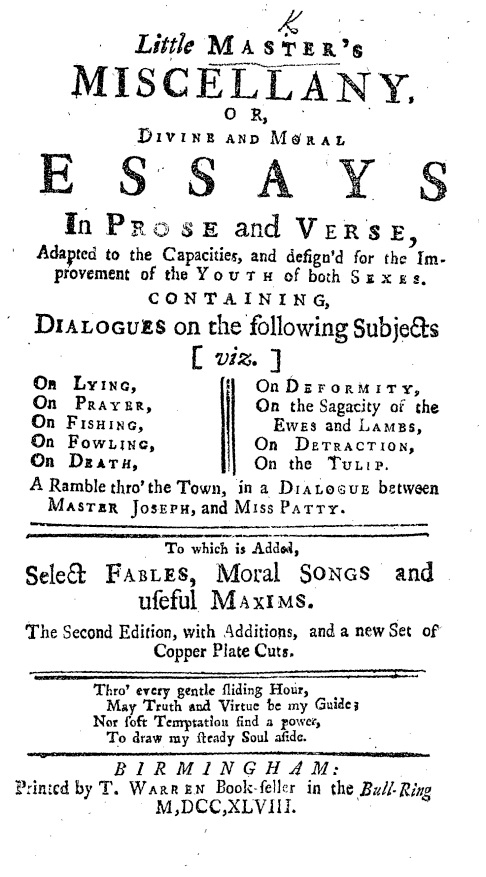
Little Master's Miscellany, 1748.

Enamel Menagerie Extra: Hunting Scenes & Antonio Tempesta

A Lion Hunt, with a Lion Killing a Man (c. 1620),
by Antonio Tempesta.
Held at Harvard Art Museums.

Several enamelled boxes depict hunting scenes on the lid, especially those formed into animals frequently hunted, such as boars, tigers, and lions. Many of these were probably inspired by prints by Antonio Tempesta (lived 1555-1630), an Italian painter and engraver, who produced dozens of hunting prints depicting men hunting both traditional and exotic animals with spears. Above and below are two examples, a lion and an ostrich.

Men and Dogs Hunting Ostriches (1624),
by Antonio Tempesta.
Held at Harvard Art Museums.

Below are examples of lids depicting scenes similar to Tempesta's, with links to the boxes from which they come.

Lid of a lion bonbonnière

The same design can be found on a different box, below, but framed in scrolling.
Lid of a tiger bonbonnière, c. 1760.

The same scrolling can be found on other boxes (below), suggesting that they were made in the same manufactory, or even painted by one individual.
Lid of a lion bonbonnière, c. 1760-5.

More Information
For boar hunting scenes, see the post about boar boxes.

Tour of Lost Birmingham Nᵒ.1: The Unloved Church - Christ Church (Victoria Square As It Was)

Held at Birmingham Archive.


Christ Church stood from 1805 to 1899, but why was it demolished?.

The photograph pictures (what is today) Victoria Square in the 1890s, with the now demolished Christ Church dominating the scene. I am often asked how it is that some of the beautiful buildings that once lined Birmingham's streets were ever demolished, and with many, that is a hard question to answer. Many buildings simply outlived their use, they were too small, inconvenient or outdated. Christ Church was one such building that was no longer fit for use; it had originally served a thriving community, and had been the first free church in Birmingham, offering free seats to the poor. Towards the last quarter of the nineteenth century though, those people that had lived near the church began moving out to the newly formed suburbs. Between the years of 1871 and 1896, the population of Christ Church's parish decreased from 6,636 to 2,500,* and the area became filled with more and more uninhabited shops and offices. The church had served a community, but now that the community was leaving, the church was obsolete. It is not a co-incidence that many churches were built at the same time in the suburbs, as were being demolished in the centre of town, in fact, the proceeds of the sale of Christ Church went to building St. Agatha’s in Sparkbrook, which still stands.* The land that Christ Church sat on was just more valuable as an office and retail complex, which it became, than as a church.

But there is more to the story of Christ Church's demolition. The church was never particularly liked, it was described by one observer as 'ungraceful in its form' and in general 'bad in its whole effect'.* Eliezer Edwards did not hold back, calling the edifice an 'excrescence' which 'disfigures the very finest site in the town'.* Building had begun in 1805, but the church was not completed until 1815 due to difficulty in finding funds. The original design was probably by William Hollins, and had been for the church to have a dome and cupola, similar to St. Philip’s, but he only completed the base (without the portico), sometime in 1813. In 1815 the £1500 Gothic spire** with a single bell was added by John Richardson*, a stone mason from Handsworth, which for some sat unhappily on Hollins's Neoclassical base. In the same year the £1200 classical front portico with its four Doric columns was also added, again by Richardson.* This hodge-podge of styles from different builders and architects arising from the slow process of its building did not set it out as an architectural beauty, and no-one seemed to mourn its demolition in 1899.


NOTES
* References on request.
**  The clock was added by Samuel Allport in 1816.*
Illustration copyright Jenni Dixon 2012

Street By Street: Old Bull Street (Ancient Times-Present)


Bull Street formed a junction with Colmore Row (the top part was called Monmouth Street until about 1841), Snow Hill, and Steelhouse Lane at its north end, and with Dale End and High Street at its south end. Beginning in 1878 work began on building the new Corporation Street, which cut through Bull Street and meant that part of it was knocked down.

Image above: The 1841 vista of Birmingham should not be taken as a literal representation of Birmingham, but it provides an impression of Bull Street in the early years of Queen Victoria's reign.

Image below: The image below shows the entire west side of Bull Street in 1840, so around the same time as the vista, above. The top row shows numbers 109-81, and the bottom row shows numbers 80-54 (street numbers went in order at this time, not evens one side and odds the other - that was a Victorian invention).
Walk Up the West Side of Bull Street
Left to Right (109-54)

Held at Birmingham Archive.

Bull Street from High Street, by Samuel Lines, c. 1835.
Held by Birmingham Museums.

Image above: At the corner of Bull Street and High Street was a timber framed building called the Old Lamb House (see post here), demolished in 1886 (photograph taken shortly before demolition). This shows some of the age of Bull Street. This was 108 and 109 Bull Street.

Image Below: Another old house was at 105 Bull Street. In the 1849 directory of Birmingham this was a woollen drapers' run by Whilock Smith.

'Part of a House in Bull St', lithograph by Thomas Underwood, 1865.
Taken from The Buildings of Birmingham Past and Present.

Image below: This conjectural image, certainly produced with help of the street view of the west side (above) shows 93-93 Bull Street where the Cadbury family ran two shops. Number 93 was the tea shop which began selling a new chocolate drink during the Victorian period. Number 92 was the Cadbury drapers' shop. The scene is set in about the 1840s or 1850s. 


Image Below: The photograph below shows some of the surviving Georgian houses. Depicted are numbers 81-79 with a small slice of 78 on the right. Number 81 Bull Street was being by J. Page as a mantle and shawl warehouse both in the photograph below and in the 1840 illustration above


Walk Down the East Side of Bull Street
Left to Right (53-1)

The Quaker Meeting House with blocked up windows, sometime between 1793 and 1857.


Quaker Meeting House was built in 1702 at the top end of Bull Street. In 1793 the site was extended and the windows at the front bricked up. A new Meeting House was built in its place in 1857, which was set well back from the street behind the frontages. Iron Room / Leaflet ?Number 40 Bull Street at the time of the 1841 vista.

Photograph by Phyllis Nicklin, 1960.

Image above: The sign above Simpson, the fishmonger, states that it was established in 1790, and it was still going strong in this photograph from 1960. It was at 6 Bull Street, so the Georgian building to its right was 5 Bull Street.

http://epapers.bham.ac.uk/296/

Images below: At the bottom end of Bull Street where it met Dale End was a rounded building, seen in both the 1841 vista and Samuel Lines's 1835 drawing (both above). This was 1 Bull Street. In the photographs below it was run by Reece Bros as 'Ye Oldest Tobacconyst Shop in Bermyncham'. From at least 1829 to 1849 the tobacconist at number one was Joseph Smout

Bull Street, c. 1888.

Bottom end of Bull Street with the not yet demolished Old Lamb House, so before 1886.

Portraits Nᵒ.2: Edward Grubb (1740-1816)

Edward Grubb, self portrait, c. 1790.
Held at Stratford-upon-Avon Town Hall.

Edward Grubb (1740 (Towcester)-1816 (Stratford)) came to Birmingham in about 1769, in his late 20s, and is thought to be the first fine art sculptor in the town. Edward later painted portraits, and it was noted that 'his numerous paintings on canvas, however coarse in execution, show his success in delineating the human face’.* See a selection of his paintings here.

Paper Remnants: How to Advertise Regency Style

Frontispiece from Allin's 1803 advert,
copied by Catherine Hutton Beale. 

From about the 1780s till 1813 there stood an eccentric looking shop at the top of New Street, not far from where Queen Victoria stands gazing across the modern Birmingham landscape (see here). The little shop, named Multum in Parvo, or, 'much in a small place', was run by an equally eccentric proprietor, Mr. John Allin. Allin was a tailor (taylor), but also dabbled in all manner of other lines of business, including pulling your rotten teeth. In 1803 he produced a sixteen page booklet promoting his business, but being John Allin this was not your everyday kind of advert; pictures were rarely used as promotion during this period, but Allin used an alternative method to make the pages come to life. He wrote the entire article in verse. 

He was not alone in using verse to promote either an individual establishment, or the town as a whole; James Bisset was particularly keen on a poem or two, but Allin's lines connect with the seemingly mundane everyday articles that he sold and give a wonderful insight into the retail culture of the time. When describing the tailoring aspect of his business he addresses women, children and men in turn, and the articles described build a fragrant picture of the fashions of the time. He also notes his range for farmers, servants and coachmen, the latter particularly needing good quality coats that could withstand the elements they would have been daily exposed to. His list of children's toys is also fascinating and reveals how their entertainments and home education was not so different. His list of stationary brings the Regency writing desk to life, and the prolific letter writing that marked the time. What is particularly fascinating though is the description of his exhibition, which housed curiosities and novelties galore. The poem has been transcribed below, and has links to find out more about particular articles for sale or on display. 


ALLIN, 
TAYLOR, 
Hatter, Haberdasher, Hosier, Linen and 
Woollen Draper, Grocer &c. 
 AT HIS 
Cheap Clothes and York Shoe Warehouse, 

THE FLAG, 
Opposite the TOP of NEW-STREET, 
Birmingham: 

A SHOP 
For the Accommodation of all Sorts of Customers, 
who may be provided with every Necessary of 
 Life; suited Top to Bottom, from Inside 
 to Outside, from right-side to left-side, yes, 
and on ALL SIDES, with every Wearable and 
Tearable, from the Giant of ten Feet high to 
the Infant just popp'd into the World: Sold 

WHOLESALE AND RETAIL, 
At little more than HALF their VALUE, 
FOR 
Ready Money only.


PERMIT me, with respect to greet
All those who tread thro' New-street,
And humbly beg they'll deign to stop,
And choose some goods at ALLIN'S Shop:
Enough I know, you're sure to find.
To charm the sight, delight the mind;
Great choice for luxury or use,
Such goods few others can produce. 
--~~~--
YE fair, to you my first respects
I'll pay, as gratitude directs.
Cloaks, bonnets, shawls, of highest taste,
With gowns and stays to fit your waist, 
Caps and ribbons, gloves and rings,
With many other pretty things
In mantua-millinery way,
My goods with pleasure I'll display,
Muffs and tippets, fans and feathers,
Parasols, para[pluit], to suit all weathers. 
Velvet collars, edgings, lace,
To improve each pretty face.
Quilts and skirts of [stuff] and silk,
Dimity* coats as white as milk.                                    [*a kind of fabric]
Stockings, black or white, quite fine,
Or some more coarse if you incline,
Seal skin and morocco shoes,
Coarse or fine, just as you choose,
Home-made, false-made, very neat,
To suit the make of all your feet:
And shifts, I make them every day,
And drive a mighty trade that way.
Pockets, purses, too, I sell, 
Both these I finger mighty well.
Do pray walk in, and let me try,
Something you cannot fail to buy;
I love to gain by good behaviour,
The ladies interest and their favour.
---~~~---
And now to clothe the young creation,
I've child-bed things for every station;
Shoes to curious here are sold, 
The infant walks at ten months old;
And then to make the teeth cut easy,
I have a thing I know will please ye.
Corals and necklaces abound,
In which much virtue has been found;
A ribbon there to tie them on,
And now for these I think I've done.
---~~~---
A while I'll leave the female fair,
And make the other sex my care,
To suit you all doth please me well,
And much I wish my goods to sell.
Indulge me, gentle sirs, in this, my pride,
By your consent to let me now provide
And suit you, one & all, with coats and breeches, 
They shall be strong & very neat the stitches.
Waistcoats and drawers, wigs and cravats, 
And pantaloons, and every sort of hats.
Shirts plain or frill'd, fine, good and neat,
Sew'd with strong thread & stitch'd complete.
Handkerchiefs for your neck or nose,
And every sort of curious hose.
Shoes, buckles, garters, boots,
All your mind or wishes suits.
Close coats, top coats, smart and strong,
To fit you now I sadly long.
The prince, the porter and the peasant,
If they but bring the cash so pleasant,
May suited be to admiration,
And fitted to their approbation,
For all's alike to I you know,
If they but leave the ready rhino.
And then for black I have beside,
Enough to clothe old Israel's tribe;
From the bishop to the sexton,
Every man without exception;
From life's first dawning the end,
My services I will extend.
With hatband, favors, gloves, and [pall],
Most cheerfully I'll serve you all
And then to prove myself your friend,
As mourning days will have their end,
I'll buy the very things I sold,
And sell them all again for old.
---~~~---
The farmer, too, I can complete,
With good smock-frock, both strong and neat,
Doe-skin breeches, home-made shoes,
Or boots, if he would rather choose.
Strong shirts for them I too provide,
And every article beside.
---~~~---
And next the gammon of the whip,
Who oft to London take a trip,
Good cheap box-coats of every size,
For those who do their health much prize,
To keep them dry in time of need,
A useful article indeed!
'Twill serve sometimes to lend a friend,
And oft-times gain a private end,
For in the wet I think indeed,
All those you serve should freely bleed,
For then the tapster* will take care,                          [*bartender]
And something warm for you prepare.
---~~~---
Does a good servant want a place?
Or is a master in distress?
If to my office they'll repair,
I'll serve them all with speed and care.
---~~~---
A taylor too I am by trade,
I cut to measure, or fit ready made.
From home I have no time to lose,
And this your goodness will excuse,
But at my shop whoe'er attends,
The price shall make him full amends.
---~~~---
Now to amuse the children's mind,
I have toys of all sorts, and kinds,
Formed of pewter and wooden ware,
And long will last with prudent care.
I've puzzling cards of various rules,
Collected for the use of schools;
Dissected maps and travelling charts,
T'improve the mind, engage the hearts.
Teaching geography while you play,
And learning kingdoms all the way;
Cards framed on purpose to amuse,
T'enforce instruction in the use:
A curious map with plain direction,
Suited to juvenile inspection,
Describing all the English towns,
Their limits, situations, bounds, 
Places held in highest note,
Castles, rivers, lake, or moat,
This map 'tis worth your while to try,
Step in and look, I'm sure you'll buy.
Charming little books for spelling,
Such as children may read well in:
Primes, horn books, little pictures,
Curious toys for infant lectures:
Every work that gains applause,
On literature, state, or laws,
Shall be procured, on application,
That I may gain your approbation,
Thus my address to those who read,
To those who write I now proceed:
And to obtain their kind attention,
There's paper of the first invention:
Marble from the French and Dutch,
Soft and pleasant to the touch;
Brown for packing, purple, green,
Royal, [muslium], magazine,
[Lawn], and music, quite inviting,
Gilt [post], and [foolreap] fit for writing;
Whited brown, and common blue,
Elephant, and cartridge too;
Vellum for the bond and deed,
Postcards when you stand in need;
Fine glaz'd paper for the fair,
The ladies still demand my care;
A beauteous show of quills and pens,
From geese and turkeys, [...], and hens,
Cut to suit the various hands,
Us'd in this or foreign lands.
Ink, like jet 'twill shine to bright,
Sure I am 'twill please the sight,
Ink of glowing ruby red,
And the very best that's made;
Powder ink or made in cake,
Or the genuine Indian make.
Wafers*, every kind and hue                                       [*sealing part of envelope]
Black or white, or red, or blue;
Wax to bear the clear impression,
Which conceals the fond expression.
Seals much used by all descriptions,
Poets, lawyers, and physicians;
Rulers, pounce, and silver sand,
Pen knives fullest to your hand;
Drawing pencils red and black,
Cards, to invite, sold by the pack,;
Indian rubber, and pencil tops,
Shells and cups, and paint in drops;
The best lead pencils clothed in reed,
Or in cedar if you need;
Slates and pencils smooth and clear,
Brushes made with camels hair;
Balls to keep the shoes from cracking,
Curious cakes for liquid blacking.
---~~~---
Music divine has charms to case,
And make despair and madness please.
Would you the marbling plate inspire,
To set the love-sick soul on fire,
Or melancholy fits assivage;
To furnish you I now engage;
Or would you charm with notes now strong,
My clarinet assists your song;
At summer's eve, or wintry morn,
Vow here may find the mellow horn,
And make each valley, hill, and plain,
Re-echo the enchanting strain,
Violins, tenors, violincellos,
To suit all honest fiddling fellows;
Cat-calls, jews-harps, port-boys horns,
Drums and trumpets -- wars alarms!
And every instrument beside,
That is of harmony the pride;
And then a choice of songs you see,
Collected with great nicety;
Solos, symphonies, quartettos,
Trios, overtures, duettos;
Favourite marches for the army,
New concertos for to charm ye;
Country dances, and cotillions*,                                        [*type of dance]
Jigs and minuets by millions.
Glees and catches, merry airs,
Books to guide unpractic'd players;
Cat-gut strings, and strings of wire,
All that music can require;
All to aid soft music's power,
And to cheer the lonesome hour.
---~~~---
Have you need of physic's aid,
Med'cine, too, I make my trade:
Warm-cakes, sure to give you ease,
Sov'reign balm* for all disease;                                         [*a kind of cure-all balm]
For corns, that troublesome disaster,
Why, I have got a certain plaster;
Then soak your feet, and come to me,
Your toes from corns I'll quickly free!
All this and more, I'll undertake,
And draw your teeth if they should ache.
---~~~---

EXHIBITION

And now, my friends, with gratitude I own
The num'rous favours you've so kindly shown;
Poor, my expressions, I would [again] convey
My hearty thanks your goodness to repay,
And aiming still to please, with due submission,
I've now prepared a beauteous exhibition.
Multum in Parvo! much compriz'd in little,
Curious, tho' small, 'twill please you to a tittle.
Birds of all kinds, and beasts of rare creation,
Shells, medals, foreign coins from every nation.
India, America, Greenland, Iceland too,
And something of the mines of rich Peru.
The Bird of Paradise, the Ruff, the Gull,
The Flying Rat, the Mouse, the Horned Owl.
From Botany Bay, of birds a good collection;
Worthy the coinnoisseur's[sic] minute inspection.
A panorama,* too, I can display,   [*this would have been a miniature panorama]
With different prospects every other day,
And then my little painter wont refuse,
To sketch you any little thing you choose.
Again [...] changes you may see,
By peeping through my Palagree.
And you this moral may receive,
That men each other oft deceive;
Strong facts are over[...] it by fiction,
And reason oft a contradiction:
This fact is true I now relate,
A crooked telescope views straight.
I have a glass too will erase,
The beauties of your neck and face,
And magnify to such a size,
That your own figure you'll despise.
Globes derived to represent,
Bodies celestial, fully bent
In chaos not to keep their station,
But venture on the new creation.
A thousand things I have to show,
Every day I've something new;
At present I no more will mention,
But only crave your kind attention,
And sign myself, as is expedient,
Your humble servant, most obedient.

---~~~---